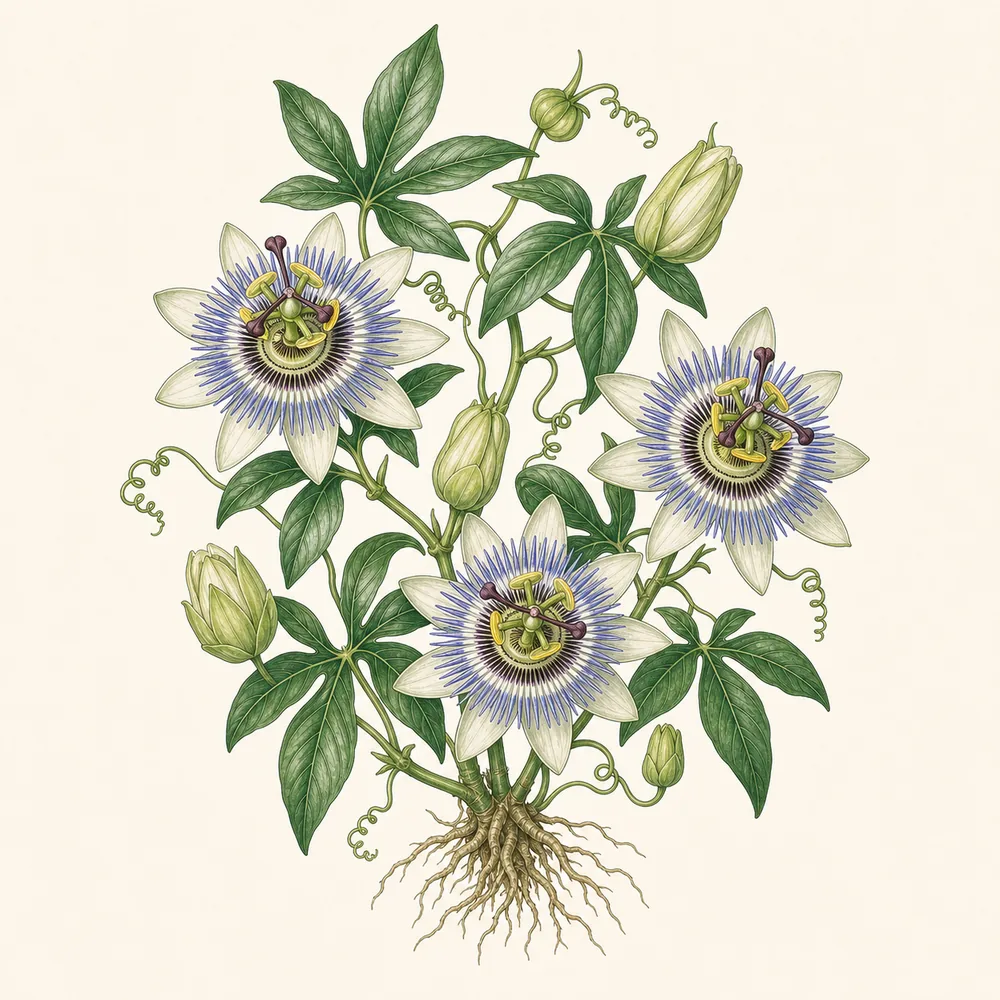
Passionflower
Few hardy climbers look as exotic as the blue passionflower — those cathedral-window blooms seem to belong in a jungle, not on a British fence. It's fast, free-flowering and easy in a warm sunny spot, with one catch: in cold gardens it can be cut to the ground by a hard winter. Learn to expect that and it becomes a reliable, generous climber.
Not listed by ASPCA
The ASPCA doesn't list the blue passionflower (Passiflora caerulea), so we don't stamp it safe. The unripe fruit and foliage contain small amounts of cyanogenic compounds and can cause stomach upset, so we note the caution. With no database entry we flag the gap honestly rather than guess.
Care at a glance
Everything that matters, in six lines. The detail is further down.
Position
Give it the warmest, most sheltered spot you have — a south- or west-facing wall is ideal. Sun ripens the wood and drives the flowering; shade gives you leaf and little else.
Water
Water freely through the growing season while it establishes, then ease off — an established plant copes with dry spells. Wall-foot soil dries fast, so don't let a young plant bake.
Soil
Free-draining soil is essential — soggy roots in winter kill more passionflowers than cold does. Don't over-improve with rich muck; lush feeding gives foliage at the expense of flower.
Support
It climbs by coiling tendrils, which need something thin to grab — trellis, mesh or horizontal wires. Guide the first shoots on and it quickly takes over from there.
Pruning
Wait until spring, then cut out frost-damaged and dead growth back to live wood, and thin the tangle. It flowers on new growth, so spring pruning costs you nothing and keeps it in bounds.
Hardiness
The blue passionflower is the hardiest of the family, but a hard winter can kill the top growth to the ground in colder gardens. Mulch the crown deeply and it usually resprouts from the base.
What to do, and when
Resist the urge to tidy early — wait until growth restarts, then cut all frost-killed stems back to live wood. In cold areas there may be nothing left above ground; be patient, as it resprouts from the crown once the soil warms. Tie in the new shoots.
Fast, leafy growth and the extraordinary flowers from July into September, each lasting only a day but produced in succession. Tie in and steer the tendrils, and water young plants in dry spells.
Orange egg-shaped fruits may form after a warm summer. Growth slows — leave the top growth in place rather than cutting back, as it helps shield the crown from the first frosts.
The riskiest season. Mulch the base thickly to protect the crown, and in cold gardens fleece the whole plant on hard nights. Don't cut anything back yet — dead top growth is insulation.
Fast, exotic and genuinely easy — with one condition
Given a warm wall and sun, Passiflora caerulea is one of the least demanding climbers you can grow. It romps away, clothing a fence or trellis in a single season and throwing out those unmistakable blue-and-white flowers all summer. Each bloom lasts just a day, but they come in relays for months.
The one condition is warmth. This is a plant on the edge of hardiness in Britain — the further north and colder your garden, the more of a gamble the top growth becomes. In a mild coastal or city garden it may stay evergreen; in a frost pocket it behaves almost like a herbaceous plant, dying down and rising again.
Don't panic in spring — it dies down and comes back
Every spring, gardeners write off passionflowers that look stone dead after a cold winter. Wait. In many gardens the top growth is killed but the roots survive, and fresh shoots push up from the base once the soil warms — often not until late spring, later than you'd like.
So the rule is simple: don't cut anything back in autumn or winter, and don't dig it out in early spring. Leave the dead stems as frost protection, mulch the crown deeply, and only reach for the secateurs once you can see where the live growth is starting. Cut back to that, and the plant reclothes itself fast.
Tendrils, and keeping the vigour in check
Passionflower climbs with wiry coiling tendrils that reach out and grab anything thin — wires, mesh, trellis, or the stems of a neighbouring shrub if you let them. On a smooth wall it needs a support fixed for it; it can't cling to bare brick.
In a good year the growth is prodigious, so treat spring pruning as your bounds-control moment. Because it flowers on the current season's growth, you can cut it back hard to a framework without losing that year's display — a real advantage over climbers that flower on old wood.
Flowers versus leaf — and that curious fruit
If you get a wall of healthy foliage and few flowers, the usual culprits are too much shade or too rich a soil. Passionflower flowers best when it's a touch stressed — full sun and lean, well-drained ground. Ease off feeding and give the top growth more light.
After a warm summer you may be rewarded with orange, egg-sized fruits. On the blue passionflower these are ornamental rather than a dessert — the unripe fruit and foliage are best left alone (see the safety note above). Enjoy them as decoration, not a crop.
Common problems
Looks dead in spring
Usually winter dieback rather than death — the top growth is frost-killed but the roots live. Wait for shoots from the base before cutting or digging out, mulch the crown, and be patient into late spring.
Lots of leaf, few flowers
Too shady or too well-fed. Passionflower blooms best in full sun on lean, free-draining soil. Move it into more light where you can, and stop the rich feeding.
Yellowing leaves, poor growth
Often waterlogged, cold roots — the plant hates sitting wet, especially in winter. Improve drainage at the root, and never plant into a spot that puddles.
Swamping its neighbours
In a warm garden the vigour can overwhelm nearby plants. Steer the tendrils onto their support, and cut it hard back to a framework in spring — it flowers on new growth, so you lose nothing.
Everything a passionflower needs
A warm wall, a support for the tendrils, and winter protection for the crown.
We take no commission on anything in the "save your money" tier — if we don't think you should buy it, we don't link it. How our recommendations work
If you like this, try
Other plants with a similar temperament.
How we checked this
Care cross-checked against the RHS. The ASPCA does not list the blue passionflower (Passiflora caerulea), so its pet-safety is unconfirmed and we have not stamped it safe. If our page and these sources ever disagree, believe them — and tell us.
Sources: RHS · ASPCA — toxic & non-toxic plants
Last reviewed · August 2026