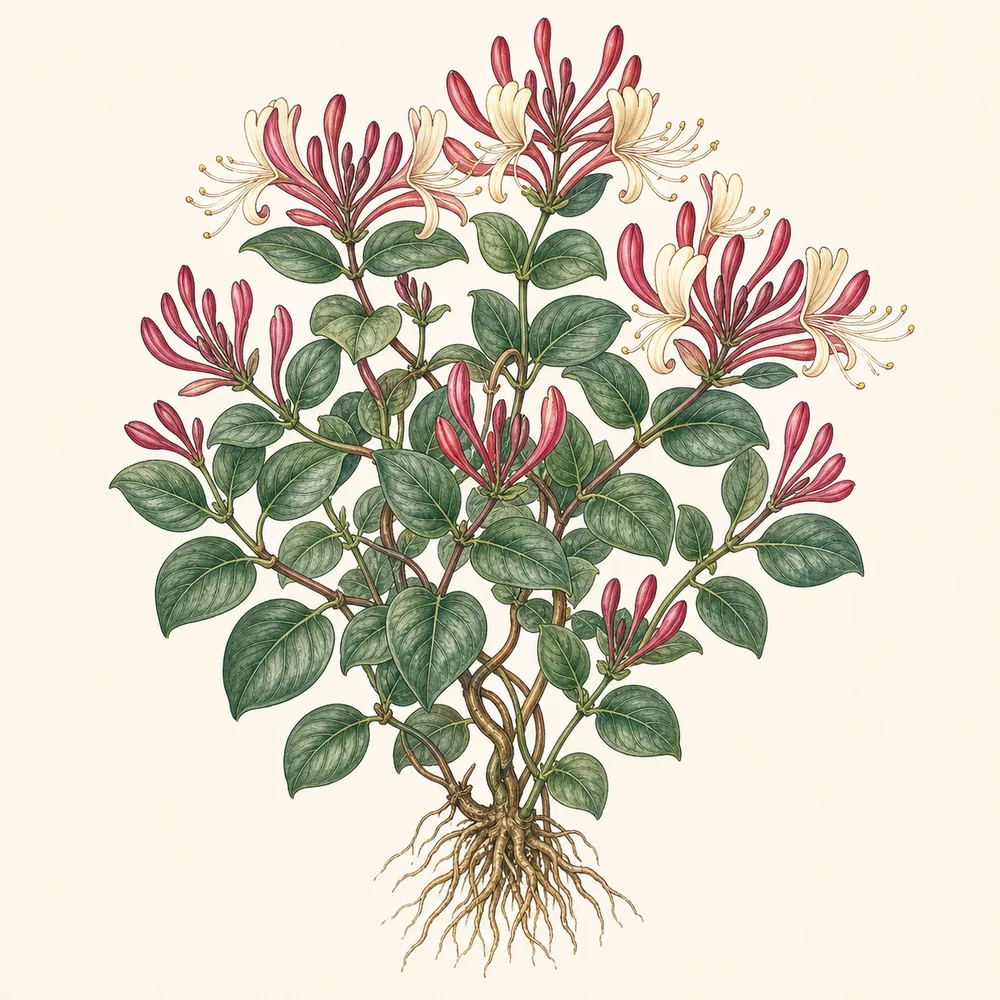
Honeysuckle
The scent that stops you on a warm June evening — honeysuckle earns its place on scent alone, and our native woodbine is an easy, hardy twiner that will smother a fence, arch or old tree in curling flowers. Get the roots cool and shaded and it looks after itself; let them bake and you buy trouble with aphids and mildew.
Toxic if eaten (berries)
Honeysuckle (Lonicera) is on the RHS list of potentially harmful plants. The berries are mildly poisonous, causing vomiting and diarrhoea if eaten in quantity. The scented flowers are the draw, but the bright berries are the hazard for curious pets and children.
Care at a glance
Everything that matters, in six lines. The detail is further down.
Position
Flowers and scent want sun on the top growth, but the roots must stay cool and shaded — a woodland-edge plant at heart. Shade the base with a low shrub, a slab or a leafy neighbour.
Water
Dry roots are the single biggest cause of trouble — a thirsty honeysuckle gets aphids and powdery mildew. Water deeply in dry spells and mulch generously each spring.
Soil
Fertile, humus-rich soil that holds moisture but never waterlogs. Dig in plenty of organic matter at planting and top up with a thick mulch.
Support
Honeysuckle climbs by twining its whole stem, so it needs a trellis, wires, an arch or an old tree to spiral up. It can't grip a flat wall on its own.
Pruning
Tidy and shorten flowered shoots as soon as the blooms fade in summer. Overgrown, bare-based plants can be cut hard in late winter to renovate — you'll lose a season's flowers but gain fresh growth.
Hardiness
Our native woodbine shrugs off British winters unprotected. No fleece, no fuss — hardiness is never the problem with this one.
What to do, and when
New shoots race away — tie the twiners onto their support before they grab a neighbour. Mulch thickly to lock moisture into the roots, and check soft tips for the first aphids of the year.
The main event: scented flowers from June into August, strongest in the evening as moths arrive. Prune straight after the flush fades, and never let the roots dry out — mildew and blackfly follow drought.
Red berries follow the flowers (mildly poisonous to pets and children, so plant thoughtfully near play areas). Take hardwood cuttings now, and plant new honeysuckle into still-warm soil.
Dormant and structural. Check and loosen ties before the gales, and if the plant has become a bare-legged tangle, this is the window for a hard renovation cut.
It twines — so give it something to grip
Honeysuckle climbs by wrapping its whole stem around a support, the way a runner bean does. It has no sucker pads and no clinging tendrils, so it can't scale a bare wall. Give it trellis, horizontal wires, an obelisk, an arch or an old tree and it will spiral up happily; stand it against smooth brick with nothing to hold and it will flop.
The stems twist in one direction and grab fast, so tie in and steer new growth early each spring — left alone, a young plant will lash itself to whatever's nearest, including the plant you didn't want it on.
Cool roots are the whole game
Almost every honeysuckle problem traces back to hot, dry roots. Baked at the base, the plant sulks, drops flowers, and pulls in aphids and powdery mildew like a magnet. Kept cool and moist, the same plant powers through the summer largely trouble-free.
Copy what it does in the wild — climbing out of a shady hedge bottom into the sun. Shade the root zone with a low shrub, a stone or a paving offcut, mulch thickly every spring, and water deeply in droughts. It's cheaper and more effective than any spray.
Prune by the calendar, not the mood
Our native Lonicera periclymenum flowers on the current season's growth, so the safe habit is to prune straight after flowering in summer — shorten the shoots that have bloomed and thin any congestion. That gives the plant the rest of the season to make new wood for next year.
If it's become a bird's nest of bare stems with flowers only at the top, don't tinker — cut the whole thing hard in late winter, down into healthy lower wood. You sacrifice one year's display, but a neglected honeysuckle regrows with real enthusiasm and comes back furnished from the base.
A magnet for moths and birds
Honeysuckle is one of the best wildlife climbers you can plant. The tubular flowers release their scent at dusk to draw in long-tongued moths, which in turn feed bats; bees and butterflies work the blooms by day. It's a genuine nectar station, not just a pretty face.
The autumn berries feed thrushes, blackbirds and warblers — which is exactly why they're a hazard for pets and small children (see the safety note above). Site the plant so wildlife gets the crop and toddlers and dogs don't.
Common problems
White powdery leaves
Powdery mildew, and nearly always a sign of dry roots. Water deeply, mulch to hold moisture, and improve airflow by thinning congested growth. A hard renovation cut resets a badly affected plant.
Sticky shoots crawling with blackfly
Aphids on the soft tips, again worse on stressed, thirsty plants. Squash early colonies, encourage ladybirds and blue tits, and keep the roots moist — a well-watered honeysuckle shrugs most of them off.
Flowers only at the very top
The natural habit of a plant reaching for light, made worse by years without pruning. Cut it hard in late winter to force growth lower down, and prune the flowered shoots each summer to keep it furnished.
Lots of leaf, no scent or flower
Usually too much shade on the top growth, or too rich a feed pushing leaf at the expense of bloom. Give the climbing stems more sun and ease off the nitrogen.
Everything a honeysuckle needs
A support to twine up, cool moist roots, and almost nothing else.
We take no commission on anything in the "save your money" tier — if we don't think you should buy it, we don't link it. How our recommendations work
If you like this, try
Other plants with a similar temperament.
How we checked this
Care cross-checked against the RHS, which lists Honeysuckle (Lonicera) among potentially harmful plants — berries mildly poisonous. If our page and these sources ever disagree, believe them — and tell us.
Sources: RHS · ASPCA — toxic & non-toxic plants
Last reviewed · August 2026