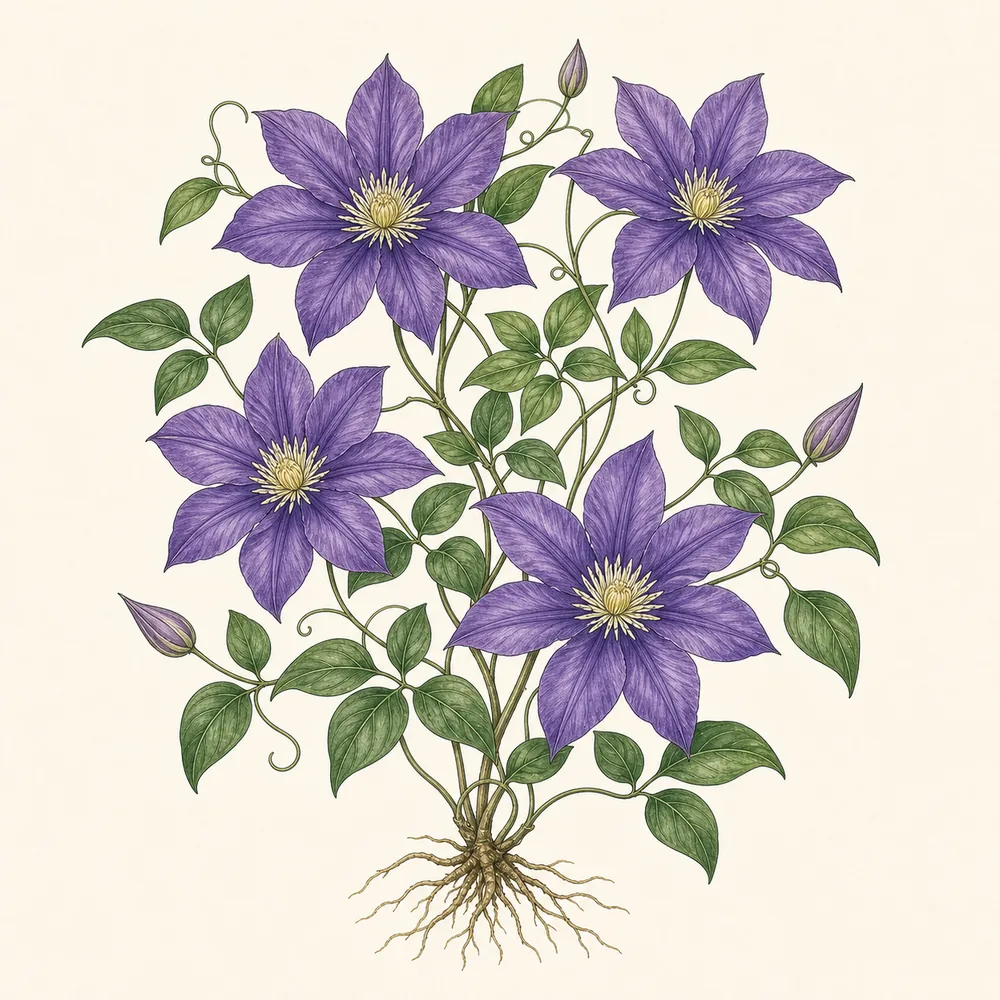
Clematis
The queen of climbers: dinner-plate purples in June, starry species smothering fences in spring, late viticellas flowering into October. Ninety per cent of clematis confusion is one question — when does yours flower? Answer that and pruning solves itself.
Toxic to cats, dogs & horses if eaten
Fresh leaves and stems contain the irritant protoanemonin, causing drooling, vomiting and diarrhoea. It tastes acrid, so pets rarely eat much — and usefully, the toxin is destroyed by drying, so wilted prunings lose their sting. Source: ASPCA.
Care at a glance
Everything that matters, in six lines. The detail is further down.
Position
Flowers want sun; roots want cool. Shade the base with a slab, a stone or a leafy neighbour.
Water
Water deeply while establishing and in dry spells — walls and fences create surprisingly dry soil.
Soil
Plant large-flowered kinds 6cm deeper than the pot — it insures against clematis wilt.
Feeding
High-potash feed as buds form, monthly until flowering. No 'clematis-specific' bottle required.
Pruning
Group 1: after flowering, lightly. Group 2: light tidy in Feb. Group 3: hard to 30cm every Feb.
Hardiness
The common garden kinds shrug off British winters. Evergreen armandii wants a sheltered wall.
What to do, and when
February is decision month: prune by group. Feed with tomato feed as growth races away, and tie in new stems weekly — they grab the wrong things.
The big hybrids flower May–June, viticellas July–September. Deadhead group 2s for a second flush. Keep the roots cool and watered.
Late kinds finish in October. Plant new clematis now — warm soil, no heat stress.
Seedheads stand silver through frost — leave them. Check ties before the gales.
The pruning groups, translated
Group 1 flowers in spring on last year's growth (montana, alpina, armandii): prune only to tidy, straight after flowering. Group 2 is the big May–June dinner-plates ('Nelly Moser', 'The President'): a light tidy to strong buds in February. Group 3 flowers from midsummer on this year's growth (viticellas, 'Jackmanii', texensis): cut the whole thing to 30cm in February, without mercy.
The label tells you the group; if it's lost, the flowering time tells you. Flowers before June = don't cut hard. Flowers after midsummer = cut hard. A group 3 left unpruned becomes a bird's nest on a bare stem; a group 1 pruned hard in February becomes a flowerless green wall. Same secateurs, opposite results.
Wilt, and why deep planting beats worry
Clematis wilt — a whole stem collapsing overnight — looks like death and usually isn't. The classic insurance is planting large-flowered hybrids about 6cm deeper than they sat in the pot, so buds below ground survive to regrow. If wilt strikes, cut the collapsed stem to healthy growth (or the ground), bin it, and keep watering: plants routinely return.
The small-flowered viticella types are effectively wilt-proof, which is one of several reasons they're the best beginner clematis.
Common problems
Never flowers
Pruned at the wrong time for its group, nine times out of ten. Identify the group before touching it again.
A stem collapsed overnight
Clematis wilt. Cut to healthy growth, bin the debris, keep watering — deep-planted specimens regrow.
Flowers smaller and paler each year
Hungry and dry at the root. Feed with high-potash, mulch, and shade the base.
Bare legs, flowers at the top only
Normal habit for many group 2s and 3s. Plant something bushy in front, or switch to a hard-prune viticella.
Everything a clematis needs
Support and feed are real; most of the rest of the shelf isn't.
We take no commission on anything in the "save your money" tier — if we don't think you should buy it, we don't link it. How our recommendations work
If you like this, try
Other plants with a similar temperament.
From the Notebook
Seasonal notes and guides that mention the clematis.
How we checked this
Care guidance cross-checked against the Royal Horticultural Society and NC State Extension. Toxicity confirmed against the ASPCA database (protoanemonin — salivation, vomiting, diarrhoea); the irritant is destroyed by drying. If our page and these sources ever disagree, believe them — and tell us.
Sources: RHS · NC State Extension · ASPCA
Last reviewed · July 2026