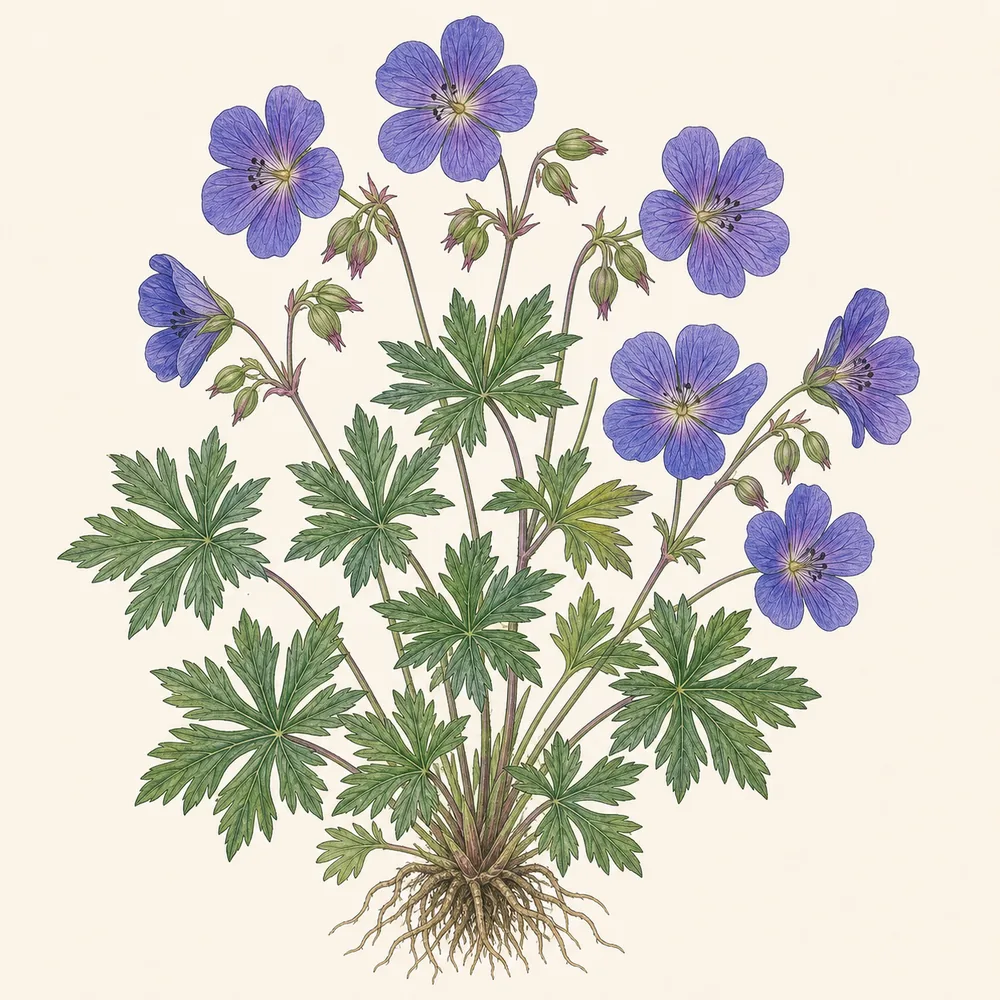
Meadow Cranesbill
The showiest of our native geraniums — clear violet-blue saucers held over deeply cut leaves through high summer. It's a sun-loving perennial that brings real garden-worthy colour to a meadow while feeding bees, and it's just as at home in a sunny border as in long grass.
Not listed by ASPCA
The ASPCA doesn't list the meadow cranesbill, so we don't stamp it safe. It's a UK native wildflower with no recorded serious toxicity to pets, but with no database entry we flag the gap honestly rather than guess.
Care at a glance
Everything that matters, in six lines. The detail is further down.
Light
A true sun-lover — give it an open, sunny spot for the best flowering. It tolerates a little shade but flowers far more freely in the open.
Water
Established plants are drought-tolerant and need no watering. Water new plugs through their first dry spell only.
Temperature
A hardy native perennial, tough right across the UK. It dies back in winter and returns strongly from the crown each spring.
Spacing
It makes a substantial clump, so give it room — around 40–50 cm between plants so each can spread without crowding.
Feeding
Don't feed it in a meadow. Rich soil grows coarse grass that swamps the flowers; lean ground keeps the balance in the flower's favour.
Soil
Happy on most well-drained soils and especially good on chalk and lime. It dislikes ground that stays wet over winter.
What to do, and when
Deeply cut leaves unfurl and clumps fill out fast. A good time to plant plugs or divide an established clump while the soil is moist.
The main display — violet-blue saucers from June to August, busy with bees. Shearing spent stems back can bring a second flush.
Seed is flung from the beak-like pods that give the plant its name. Cut the meadow once flowering is over and rake off the growth.
Fully dormant, dying back to a resting crown. Nothing to do; leave old stems for insects and tidy in spring if needed.
A meadow flower with border-worthy colour
Meadow cranesbill earns its place twice over: it's a genuine British native that feeds bees, and its clear violet-blue flowers are as good as anything in a nursery. That makes it a rare bridge plant — equally at home dotted through long grass or planted in drifts in a sunny border.
It's a sun-lover through and through. Give it the most open, sunniest spot you can and it will flower for weeks through high summer; push it into shade and you get leaves and few flowers.
Sow in autumn, or start with plugs
Like most meadow perennials, cranesbill germinates best after winter cold, so sow fresh seed in autumn onto bare, firmed ground and let the frosts break its dormancy. Sow thinly and don't smother it in rich compost — poor, well-drained soil is exactly what it wants.
It can be slow and erratic from seed, so many gardeners start with pot-grown plants or plugs for a quicker, more reliable result. Established clumps also divide easily in spring or autumn, giving you free plants to spread a drift.
The cut-and-collect regime, and a second flush
In a meadow, manage it like the rest: let it flower and seed, then make a single cut once the season is over and rake every cutting off. Removing the growth year after year keeps the soil lean and the grass in check, which is what lets the flowers persist.
In a border you have another option — shear the whole clump back hard after the first flush of flowers fades and it will often throw up fresh leaves and a second, lighter round of blooms later in summer. Either way, it's a plant that gives a lot for very little.
Common problems
Few flowers, lots of leaf
Usually too much shade or too rich a soil. Move it to full sun and stop feeding; lean ground and open light give the best flowering.
Flops open in the middle after flowering
Normal for a big clump. Shear the whole plant back hard once the first flush fades and it will regrow tidily, often with a second flush.
Rots in a wet winter
It dislikes waterlogged ground over winter. Plant in well-drained soil; on heavy clay, work in grit or choose a raised, drier spot.
Slow or patchy from seed
Seed germination is erratic. Sow in autumn for the winter chill, or sidestep it entirely by starting with plugs or divisions.
Everything a meadow cranesbill needs
Full sun, well-drained low-fertility soil, and room to make a clump.
We take no commission on anything in the "save your money" tier — if we don't think you should buy it, we don't link it. How our recommendations work
If you like this, try
Other plants with a similar temperament.
How we checked this
Care cross-checked against the RHS. The ASPCA does not list the meadow cranesbill, so its pet-safety is unconfirmed and we have not stamped it safe. If our page and these sources ever disagree, believe them — and tell us.
Sources: RHS · ASPCA — toxic & non-toxic plants
Last reviewed · July 2026