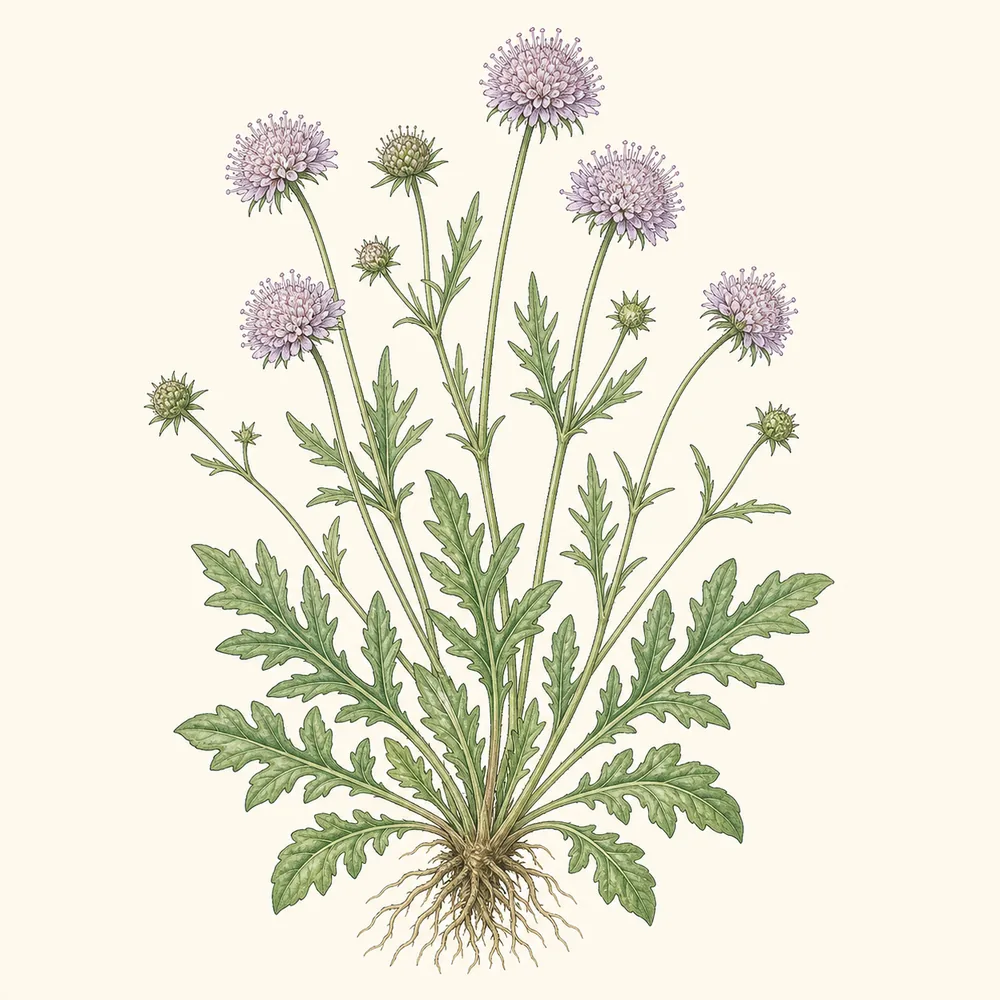
Field Scabious
One of the finest pollinator plants of the British meadow — flat, lilac-blue pincushions held high on wiry stems from summer into autumn. It thrives on poor, dry, sunny ground and hums with bees and butterflies whenever the sun is out.
Not listed by ASPCA
The ASPCA doesn't list field scabious, so we don't stamp it safe. It's a UK native wildflower with no recorded serious toxicity to pets, but with no database entry we flag the gap honestly rather than guess.
Care at a glance
Everything that matters, in six lines. The detail is further down.
Light
A plant of open, sunny grassland — it wants all the sun it can get and flowers poorly in shade.
Water
Deep-rooted and genuinely drought-tough once established. Water only new plants in their first dry summer, then leave it alone.
Temperature
Hardy throughout the UK. It forms an overwintering rosette of leaves and reshoots to flower each year.
Habit
A basal rosette sends up tall, branching wiry stems that hold the flowers well above the grass — good for a meadow's mid-height layer.
Feeding
Never feed it. Field scabious flowers hardest on lean, unimproved ground; rich soil gives leaf and floppy stems instead.
Soil
Loves free-draining, alkaline soils — chalk and limestone especially — but grows on most dry, poor ground. It dislikes wet, heavy clay.
What to do, and when
Overwintered rosettes put on fresh growth and send up flowering stems. A good time to plant plugs or pot-grown plants into a sunny meadow.
The long flowering season begins — lilac-blue pincushions from July, alive with bees, hoverflies and butterflies through the warm months.
Flowering carries on into September and beyond in a mild year. Leave seedheads standing for finches and to let it self-sow.
Dies back to a flat leaf rosette that sits out the cold. Fully hardy and needs no protection; just leave it undisturbed.
A top-tier plant for pollinators
If you plant one wildflower for bees and butterflies on dry, sunny ground, make it field scabious. Those flat, open pincushion flowerheads are the perfect landing pad, and each one is a dense cluster of nectar-rich florets that keeps working for weeks.
It's a favourite of long-tongued bumblebees, honeybees, hoverflies and butterflies alike, and its exceptionally long flowering season — high summer well into autumn — means it feeds them when many meadow flowers are already over.
Sowing on poor, dry ground
Field scabious grows readily from seed sown in autumn, which lets the seed sit through winter cold before germinating in spring. Sow direct onto raked, weed-free ground, or raise plants in trays and plant out — plugs are the surest route into an existing meadow.
The key is low fertility. On rich soil the grasses outcompete it, so strip out any topsoil-boosting compost and never feed. Chalky, thin, sun-baked soil that defeats other flowers is where it shines.
Keeping it going in a meadow
As a perennial, field scabious lives for years, but a mown meadow needs the right regime to keep it. Cut the meadow once flowering and seed-set are over — late summer or autumn — and remove the cuttings so fertility stays low and the grass doesn't smother the rosettes.
Leave some seedheads standing before you cut; the seed feeds goldfinches and lets the plant sow the next generation. A patch left to its own devices will gently spread and thicken over the years.
Common problems
Few or no flowers
Usually too much shade or too rich a soil. Move it into full sun on leaner ground and stop feeding; flowering will follow.
Floppy, leaning stems
Rich soil pushes soft, tall growth that flops. Grow it hard on poor, dry ground where the stems stay wiry and self-supporting.
Rots on wet clay
It hates cold, waterlogged soil in winter. On heavy ground add grit to improve drainage, or grow it in a raised, free-draining spot.
Powdery mildew in a dry summer
A white coating on drought-stressed leaves. It rarely does lasting harm — improve airflow and the plant grows through it.
Everything field scabious needs
Full sun, poor free-draining soil, and no feeding.
We take no commission on anything in the "save your money" tier — if we don't think you should buy it, we don't link it. How our recommendations work
If you like this, try
Other plants with a similar temperament.
How we checked this
Care cross-checked against the RHS. The ASPCA does not list field scabious, so its pet-safety is unconfirmed and we have not stamped it safe. If our page and these sources ever disagree, believe them — and tell us.
Sources: RHS · ASPCA — toxic & non-toxic plants
Last reviewed · July 2026