Masterwort
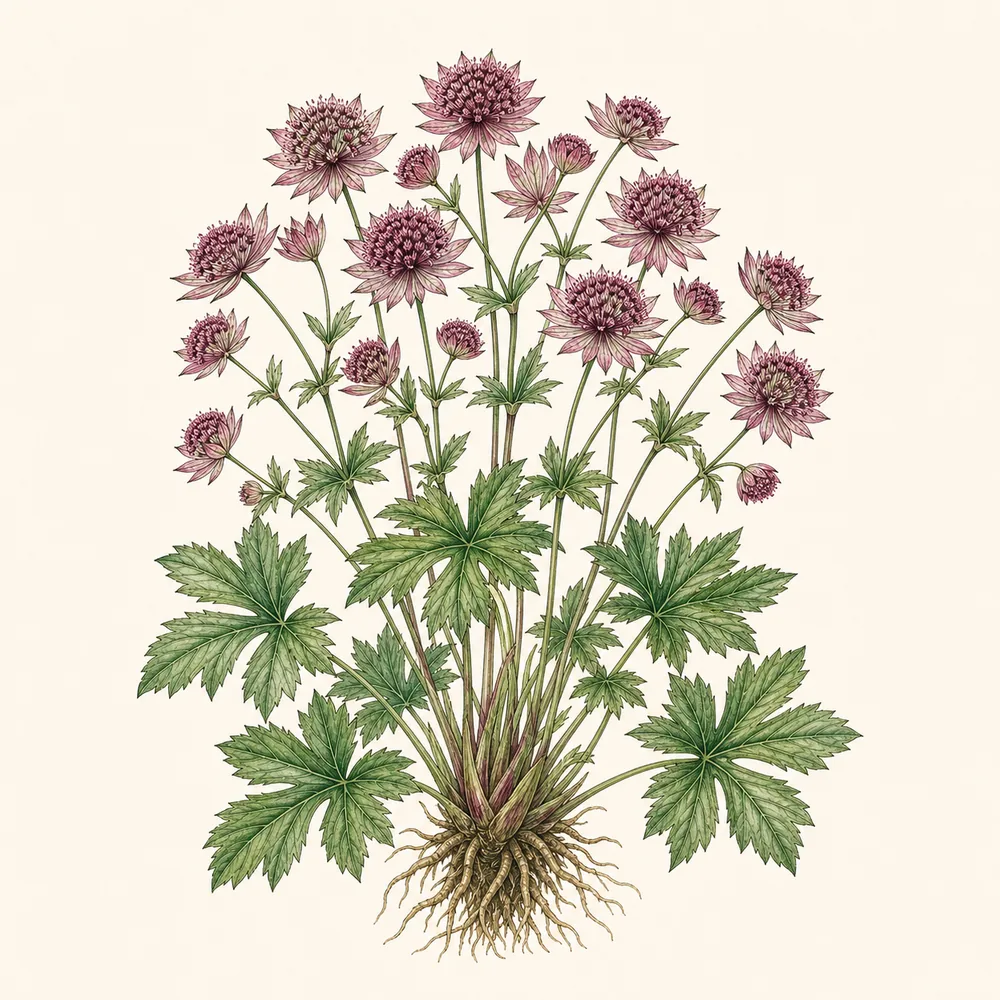
A quietly beautiful cottage-garden perennial with intricate, papery pincushion flowers held on wiry stems above neat clumps of lobed leaves. Astrantia thrives where many plants struggle — cool, moist part-shade — and flowers for weeks, making it a favourite for softening borders and for cutting.
Not listed by ASPCA
The ASPCA doesn't list masterwort (Astrantia), so we don't stamp it safe. It has no recorded serious toxicity. With no database entry we flag the gap honestly rather than guess.
Care at a glance
Everything that matters, in six lines. The detail is further down.
Light
Happiest in dappled or part shade — under the canopy of shrubs or on the cool side of a border. It tolerates full sun only where the soil stays reliably moist.
Water
The one thing astrantia dislikes is dryness. Keep the soil consistently moist through summer; plants in dry ground flower briefly then fade early.
Temperature
Hardy across the UK, dying back in winter and returning each spring. No frost protection needed.
Position
Forms tidy, weed-suppressing clumps 45–75cm tall. Lovely at a path edge, in a woodland-edge planting, or threaded between roses and ferns.
Feeding
A thick mulch of compost or leaf mould in spring feeds the plant and, more importantly, locks in the moisture it needs. Little extra feeding required.
Soil
Loves a fertile soil that stays cool and damp — heavy, moisture-retentive ground suits it well. Improve thin or sandy soil with plenty of organic matter.
What to do, and when
Fresh clumps of lobed leaves push up from March. Mulch generously to hold moisture, and lift and divide congested clumps now — division is the reliable way to make more.
The intricate flowers open from June and carry on for weeks. Keep the soil moist, cut some for the vase, and dead-head or shear back spent stems to encourage a second flush.
A good time to plant new astrantia and to divide established clumps while the soil is still warm. Cut back tired foliage as it dies down.
Fully dormant — the plant retreats to a crown and needs nothing. Leave a light mulch of old leaves over the crown, or tidy off dead stems in a mild spell.
The right plant for cool, moist shade
Astrantia is one of the best perennials for the sort of cool, damp, part-shaded ground that defeats sun-lovers — the border under a north wall, the edge of a woodland planting, or the moist side of a bed. Give it those conditions and it's genuinely easy.
The mistake people make is planting it in hot, dry sun. There it flowers briefly and then scorches and sulks. Match the plant to the spot and you'll be rewarded with weeks of flower and a plant that quietly clumps up year on year.
Flowers that repay a closer look
From a distance the flowers read as simple pincushions, but up close each 'flower' is a tight dome of tiny true flowers surrounded by a papery collar of pointed bracts, like a Victorian posy. That intricate, long-lasting structure makes astrantia superb for cutting, fresh or dried.
It also flowers for an unusually long season, especially if you shear spent stems back. A clump can be in flower from early summer well into autumn, feeding bees and hoverflies the whole time.
Making more by division
Astrantia is easy to increase by dividing the clumps in spring or autumn. Lift a mature plant, split it into several pieces each with roots and a few shoots, and replant into moisture-retentive soil enriched with compost.
Named varieties are best kept true this way rather than from seed, which can be variable. Division every few years also keeps older clumps vigorous and free-flowering.
Common problems
Scorched leaves and brief flowering
The classic sign of too much sun and dry soil. Move it to cooler part-shade or a reliably moist spot, and mulch heavily to hold water around the roots.
Powdery mildew in a dry summer
A white bloom on stressed, dry plants. Keep the soil moist, cut affected growth back, and fresh clean foliage regrows once conditions improve.
Slugs and snails on young growth
The soft spring shoots can be grazed as they emerge. Protect newly planted clumps; established plants generally grow away faster than the damage.
Seedlings that don't match the parent
Astrantia self-seeds, but seedlings of named forms are often a plainer green-white. Divide named varieties to keep them true, and weed out any unwanted seedlings.
Everything a masterwort clump needs
A cool, part-shaded spot, moisture-retentive soil, and a mulch to keep it damp.
We take no commission on anything in the "save your money" tier — if we don't think you should buy it, we don't link it. How our recommendations work
If you like this, try
Other plants with a similar temperament.
How we checked this
Care cross-checked against the RHS. The ASPCA does not list masterwort (Astrantia), so its pet-safety is unconfirmed and we have not stamped it safe. If our page and these sources ever disagree, believe them — and tell us.
Sources: RHS · ASPCA — toxic & non-toxic plants
Last reviewed · August 2026