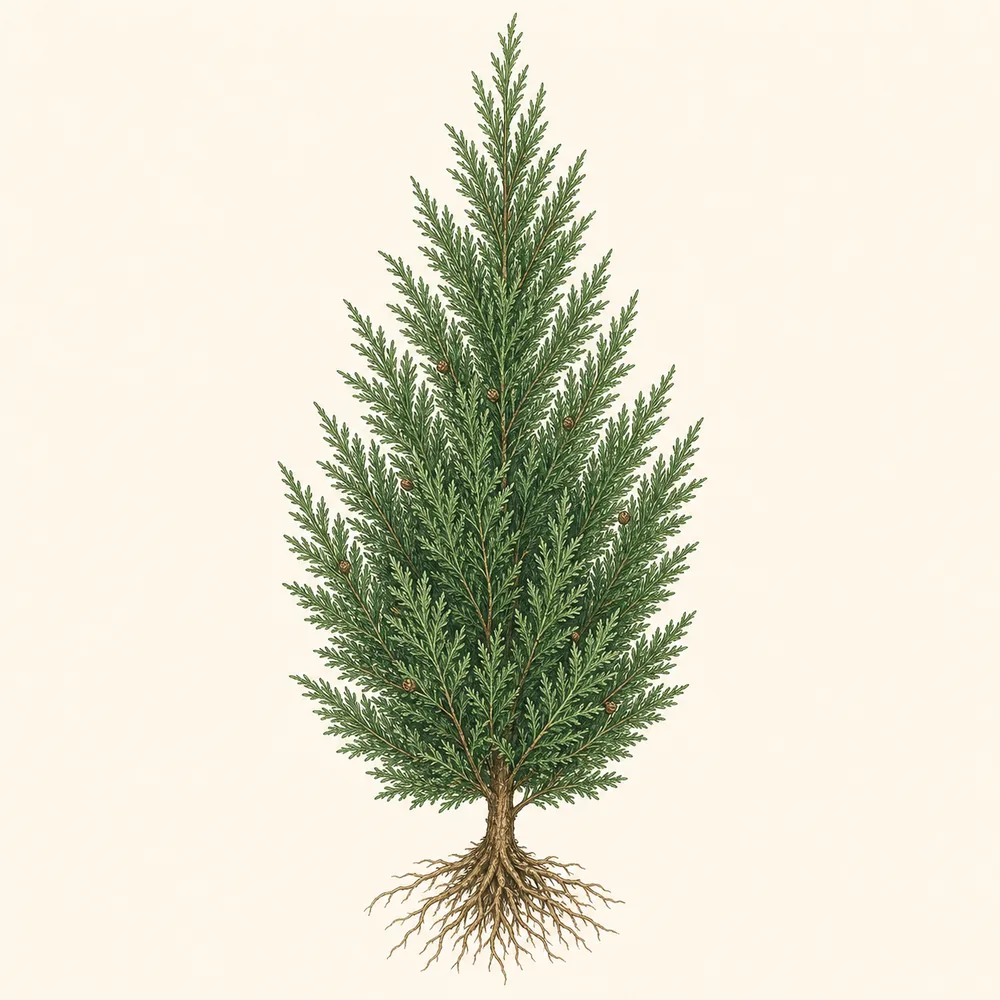
Leylandii
The fastest evergreen screen there is — and the most notorious. Leylandii can put on 75–90 cm a year, so it delivers instant privacy but only stays a good neighbour if you trim it two or three times a season. Crucially, it will not reshoot from old brown wood, so it must never be cut back too hard.
Not listed by ASPCA
The ASPCA doesn't list leylandii, so we don't stamp it safe. Its foliage and sap can irritate skin on handling. With no database entry we flag the gap honestly rather than guess.
Care at a glance
Everything that matters, in six lines. The detail is further down.
Position
Grows almost anywhere, in full sun to part shade. More light gives the densest, most even green screen.
Water
Water well through the first two summers. Once away it's drought-tolerant — often too vigorous for its own good.
Hardiness
Hardy across the UK and wind-firm, which is why it became the default fast screen for exposed sites.
Soil
Unfussy on most soils as long as they aren't permanently wet. Tolerates poor and chalky ground.
Feeding
It grows fast enough already. Feed only young plants on poor soil; feeding an established hedge just makes more work.
Trimming
Trim little and often from May to September, never into bare brown wood — it will not reshoot from old wood.
What to do, and when
Growth restarts fast from May. Give the first trim of the year once the flush is underway, and shape the sides before it runs away.
The main growing season — clip again in June or July, and a final time in late summer. Keep on top of the height now or it gets out of hand.
A last light tidy by September, while growth is still active. Avoid cutting into old wood, which won't green up again.
Growth is slow to stopped; leave trimming alone. A good time to check the hedge isn't shading a boundary or outgrowing its space.
Fast is the point — and the problem
Leylandii exists for one reason: speed. It can add 75–90 cm a year, so it turns an open boundary into a solid green wall faster than anything else. That's exactly why it was planted everywhere, and exactly why it earned its bad name.
Left untrimmed, a leylandii doesn't stop. It keeps racing upward, casting deep shade, drinking the soil dry and, before long, towering over a fence line. Many of Britain's fiercest hedge disputes — and specific 'high hedges' legislation — trace straight back to unmanaged leylandii.
Never cut into brown wood
The golden rule with leylandii: it will not reshoot from old, brown wood. Cut a branch back past the green foliage into the bare inner wood and it stays bare — permanently. There's no recovering a brown patch.
So trim little and often, taking off just the soft green growth each time and keeping the hedge to the size you actually want. If you let it get too wide or too tall, you can't simply cut it hard back to reset it — that leaves ugly dead faces. This is the one big difference from western red cedar, which does regrow from old wood.
Boundaries and neighbours
Because it grows so fast and so tall, leylandii is the classic cause of boundary friction. In England and Wales, councils can act on complaints about evergreen hedges over 2 metres under the high hedges rules, so an unmanaged screen can become a legal headache as well as a gardening one.
Keep it to an agreed, manageable height — many gardeners hold it at around 1.8–2 m — and trim the neighbour's side too. A well-kept leylandii is a perfectly good hedge; it's neglect that causes the trouble. Note too that the foliage and sap can irritate skin, so wear gloves and long sleeves when trimming.
Common problems
Bare brown patches after hard cutting
Leylandii won't reshoot from old wood, so anything cut past the green stays bare for good. Only ever trim into green growth.
Hedge outgrowing its space
It was left untrimmed. Bring it back gradually by clipping the green outer growth two or three times a season; you can't safely slash it hard.
Browning, dieback in patches
Often cypress aphid, which causes brown patches that don't recover, or drought stress. Keep young plants watered and inspect for aphids in spring.
Bare, shaded ground beneath
Vigorous roots and dense shade leave little growing under a leylandii. Keep it lower and narrower to reduce the effect.
Everything a leylandii hedge needs
Fast screen, frequent trimming, and a firm hand on its height.
We take no commission on anything in the "save your money" tier — if we don't think you should buy it, we don't link it. How our recommendations work
If you like this, try
Other plants with a similar temperament.
How we checked this
Care cross-checked against the RHS. The ASPCA does not list leylandii, so its pet-safety is unconfirmed and we have not stamped it safe. If our page and these sources ever disagree, believe them — and tell us.
Sources: RHS · ASPCA — toxic & non-toxic plants
Last reviewed · August 2026