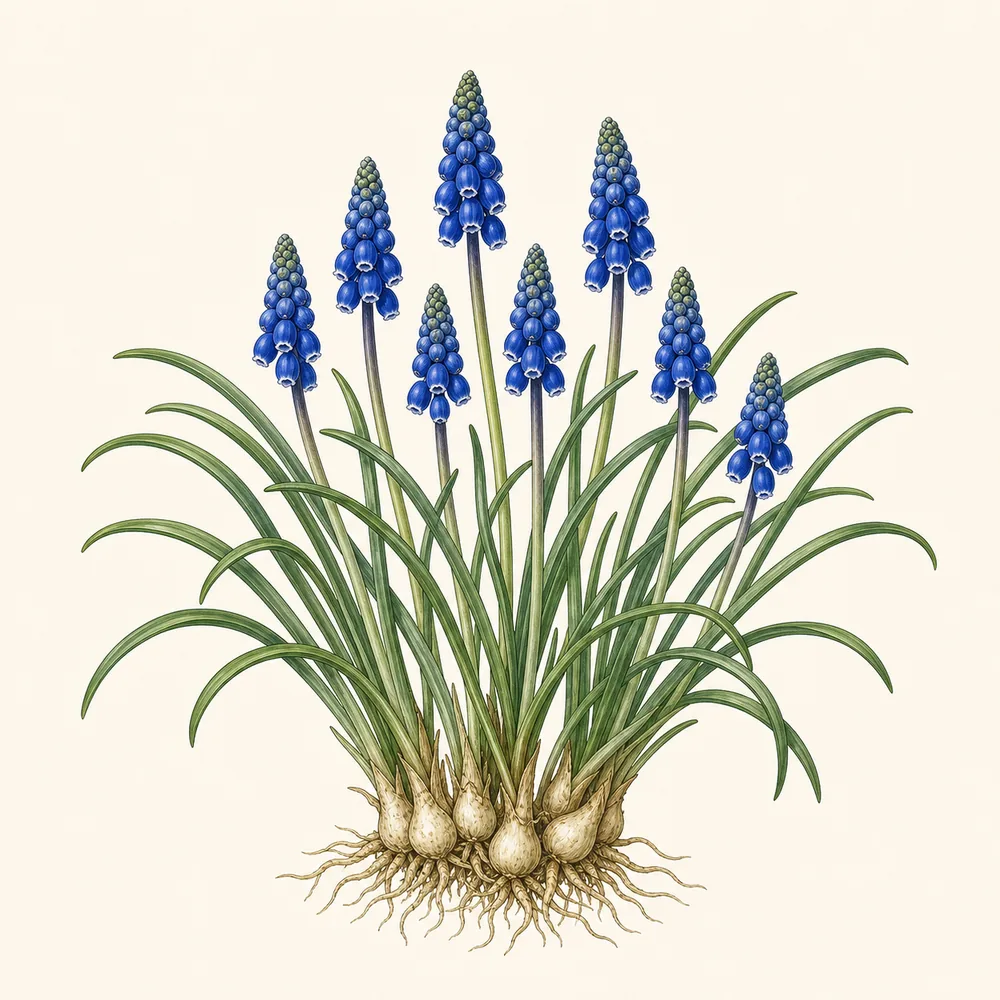
Grape Hyacinth
Dense little spikes of blue that look exactly like an upside-down bunch of grapes, carpeting the ground in early spring. Plant the bulbs in autumn and forget about them — they multiply happily year after year, and they're one of the few spring bulbs that's genuinely pet-safe.
Non-toxic to cats, dogs & horses (ASPCA)
Grape hyacinths (Muscari) are listed as non-toxic to cats, dogs and horses on the ASPCA database — a rare pet-safe spring bulb, unlike most of its bulb neighbours. A reassuring one to naturalise where pets roam.
Care at a glance
Everything that matters, in six lines. The detail is further down.
Light
Happiest in full sun, but perfectly good in the dappled light under deciduous trees and shrubs that hasn't leafed up yet in spring.
Water
Needs no watering once established — the bulbs sit dry and dormant through summer. Only water newly planted bulbs if autumn is unusually dry.
Temperature
Completely hardy across the UK and needs the winter cold to flower well. Plant the bulbs in autumn so they root before the frosts.
Planting depth
Plant bulbs pointed-end up, roughly three times their own depth, and close together in drifts for the best carpet of colour.
Feeding
They thrive on neglect and rarely need feeding. A light scatter of general fertiliser after flowering helps a struggling clump bulk up.
Soil
Undemanding, but the bulbs rot in ground that stays wet. Avoid heavy waterlogged clay; almost anything else suits them.
What to do, and when
The main show — spikes of blue open from March into April. Leave the strappy foliage to die down naturally so the bulbs feed for next year.
Foliage yellows and vanishes; the bulbs rest dry and dormant underground. Lift and divide overcrowded clumps once the leaves have gone.
Prime planting time — get bulbs in from September to October, 8–10 cm deep. New leaves often push up now, which is normal for Muscari.
The grassy leaves sit through the cold, weathering frost and snow untouched. Nothing to do but wait for the spring flush of flower.
The easiest spring bulb there is
If you've never grown bulbs before, start here. Grape hyacinths ask almost nothing: push them into the ground in autumn, roughly three times as deep as the bulb is tall, and they'll flower every spring and slowly spread into fat, generous drifts.
They're brilliant for underplanting deciduous shrubs, edging a path, or filling the gaps between later perennials — the flowers are up and gone before anything else needs the space. For the classic river-of-blue effect, plant them in loose groups of twenty or more rather than dotting them about singly.
Let the foliage flop and fade
Muscari has one quirk: it sends up its leaves in autumn, months before it flowers, so by spring the foliage can look tired and untidy. Resist the urge to cut it — the leaves are feeding the bulb for next year's display.
The same goes after flowering. Snap off the faded flower spikes if you want to stop self-seeding, but leave the leaves to yellow and die back on their own. They'll disappear completely by early summer and you'll never know they were there.
Naturalising — and keeping it in bounds
Grape hyacinths naturalise readily, seeding around and bulking up into ever-larger clumps. In a wild corner, gravel garden or under trees, that's exactly what you want and they'll knit into a self-renewing carpet with no help from you.
In a tidy border they can wander further than you'd like. To keep them in check, deadhead before the seed sets and lift and split congested clumps in summer, replanting the spare bulbs elsewhere or giving them away.
Common problems
Untidy foliage before flowering
The leaves appear in autumn and can look scruffy by spring. It's normal — leave them be. Site the bulbs where later growth will hide the fading leaves.
Spreading too freely
Happy plants self-seed and multiply fast. Deadhead before seed forms, and lift and divide crowded clumps in summer to keep them where you want them.
Few or no flowers
Usually overcrowding or too much shade. Lift, split and replant congested clumps in a sunnier spot, spacing the bulbs out to give each room to build up.
Rotting bulbs
Wet, badly drained soil rots the bulbs over winter. Improve heavy ground with grit before planting, or grow them in pots of free-draining compost instead.
Everything grape hyacinths need
Autumn planting, free-draining ground, and room to drift.
We take no commission on anything in the "save your money" tier — if we don't think you should buy it, we don't link it. How our recommendations work
If you like this, try
Other plants with a similar temperament.
How we checked this
Care cross-checked against the RHS. Non-toxicity taken from the ASPCA database, which lists Grape Hyacinth (Muscari armeniacum) as non-toxic. If our page and these sources ever disagree, believe them — and tell us.
Sources: RHS · ASPCA — toxic & non-toxic plants
Last reviewed · August 2026