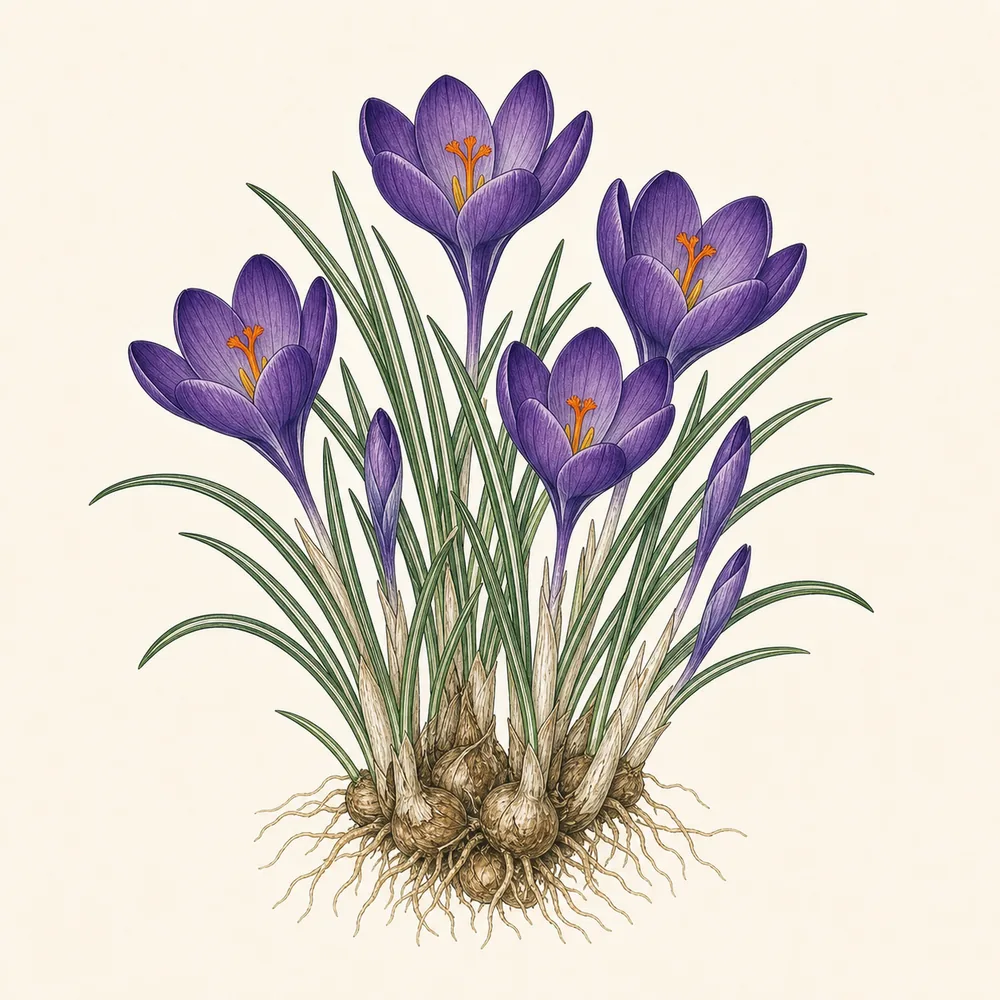
Crocus
One of the first splashes of colour after winter, opening purple, white and gold in the late-winter sun while everything else is still asleep. Plant the corms in autumn, let them naturalise in grass or under trees, and they'll come back thicker every year for almost no effort.
Toxic if eaten (spring crocus)
The spring crocus (Crocus) is listed as toxic on the ASPCA database, causing vomiting and stomach upset if eaten. Important: this is the ordinary garden crocus — the very different autumn crocus (Colchicum) is far more dangerous and can be fatal, so correct identification really matters.
Care at a glance
Everything that matters, in six lines. The detail is further down.
Light
The flowers only open fully in sun, so give them an open spot; in shade the buds stay stubbornly shut and the display is poor.
Water
Autumn and winter rain does the work while they root and flower. They must not sit wet — good drainage matters more than watering.
Planting time
Plant the dry corms September to November, before the ground turns cold. A cold winter is what triggers the spring flowers.
Planting depth
Set the corms pointed end up, about 7–10 cm deep and 5 cm apart. In a lawn, scatter them and plant where they fall for a natural look.
Feeding
In poor soil a low-nitrogen feed after flowering helps the corms bulk up, but in most gardens they thrive with nothing at all.
Soil
Happy in ordinary garden soil as long as it drains freely. On heavy clay, add grit at planting so the corms don't rot over winter.
What to do, and when
The main show — flowers open in the first warm sun of February and March, then fade. Leave the leaves to die back naturally; never cut or mow them off while green.
Dormant and out of sight below ground. Mark where clumps are so you don't dig into them. Lift and divide congested colonies now if flowering has thinned.
Planting season. Get dry corms in the ground from September to November, 7–10 cm deep, in sun. Scatter them through grass or under deciduous trees to naturalise.
The corms are rooting and building buds through the cold — a proper chill is what makes them flower. The earliest species crocuses may open in a mild late winter.
Naturalising in grass
Crocuses are made for growing in a lawn. A drift that opens through the grass in February looks far better than a stiff row in a border, and once established the colony spreads itself a little more each year.
The trick is to scatter the corms and plant them where they land — resist the urge to space them evenly. Lift a flap of turf with a spade or trowel, drop the corm in 7–10 cm deep, and firm the grass back over it.
The golden rule: let the leaves die back
This is where most people go wrong. After flowering, the grassy leaves keep working for several weeks, feeding next year's flower back into the corm. Cut them off or mow them too soon and the display fades away.
If your crocuses are in a lawn, hold off the first mow until the foliage has yellowed and pulled away easily — usually about six weeks after flowering. It looks untidy for a while; the reward is a stronger show next spring.
Spring crocus, not autumn crocus
The ordinary spring crocus here is a true Crocus. There is a separate, unrelated plant called the autumn crocus (Colchicum) that looks similar but flowers in autumn — and it is far more toxic, seriously so.
If you're planting for pollinators or near pets and children, know which you're buying. Spring-flowering Crocus corms go in during autumn; the very different Colchicum is bought and planted in late summer for autumn bloom.
Common problems
Flowers eaten before they open
Mice and squirrels dig up and eat fresh corms, and birds shred the open flowers. Plant a little deeper, lay chicken wire over new plantings until rooted, and choose the less-favoured larger-flowered types if birds are a problem.
Buds that never open
Almost always too little sun. Crocuses only open their flowers in bright light and warmth — move a shaded clump to an open, sunny spot when dormant.
Fewer flowers each year
Usually leaves cut off too early, or a congested clump. Let the foliage die back fully after flowering, and lift and divide overcrowded colonies in summer.
Corms rotting over winter
Waterlogged ground is the killer. Add grit at planting on heavy soil, and never plant in a spot that puddles after rain.
Everything a crocus display needs
Good corms, a sunny spot, and the patience to leave the leaves alone.
We take no commission on anything in the "save your money" tier — if we don't think you should buy it, we don't link it. How our recommendations work
If you like this, try
Other plants with a similar temperament.
How we checked this
Care cross-checked against the RHS. Toxicity taken from the ASPCA database, which lists Crocus (spring) as toxic; note the separate, far more dangerous Autumn Crocus (Colchicum). If our page and these sources ever disagree, believe them — and tell us.
Sources: RHS · ASPCA — toxic & non-toxic plants
Last reviewed · August 2026