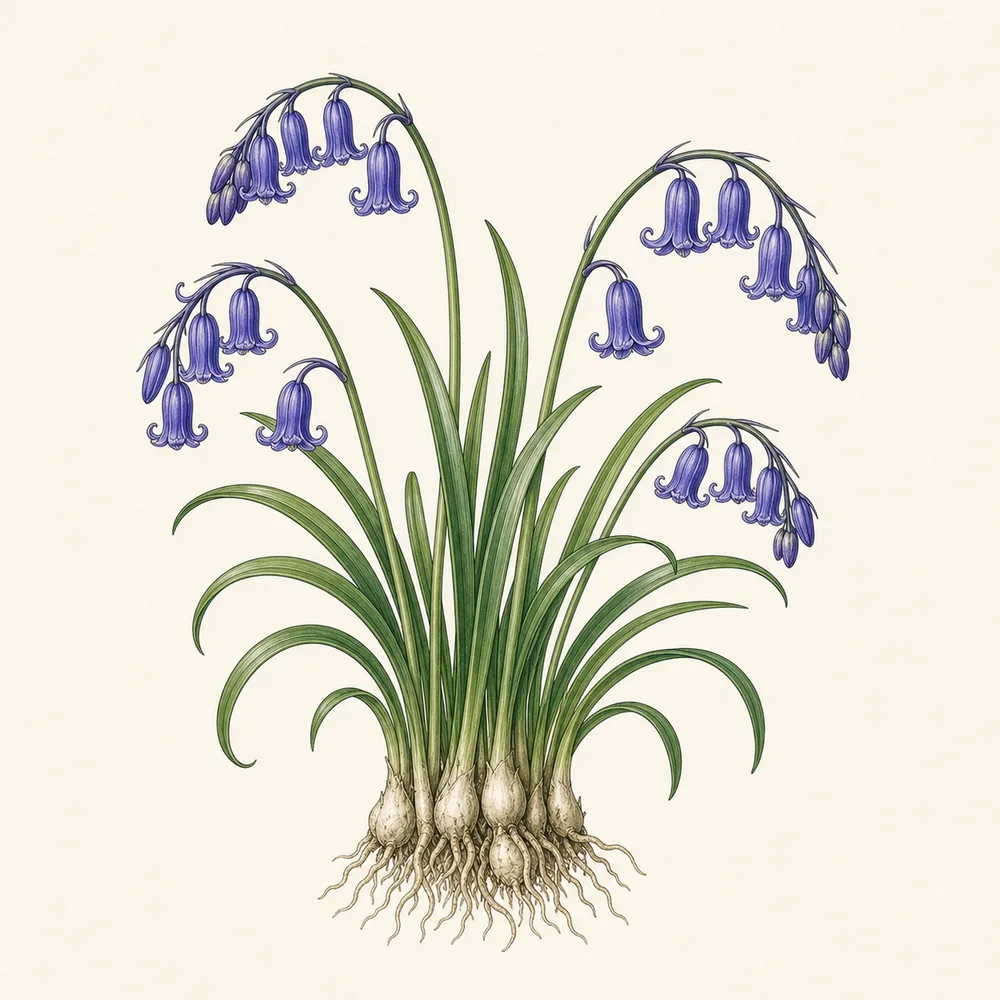
Bluebell
The native English bluebell carpets our woodlands in a haze of deep violet-blue every April and May, its scented flowers all nodding to one side. Grown in dappled shade it naturalises beautifully — but do plant the true native, not the invasive Spanish bluebell that threatens it in the wild.
Toxic if eaten (all parts)
Bluebells (Hyacinthoides) are on the RHS list of potentially harmful plants. All parts contain glycosides that cause vomiting, diarrhoea and, in quantity, heart-rhythm effects. Both the bulbs and the sticky sap are the concern.
Care at a glance
Everything that matters, in six lines. The detail is further down.
Light
Happiest in the light shade beneath deciduous trees and shrubs — sunlit while the canopy is bare in spring, then cool shade through summer.
Water
They want moist soil while growing and flowering, then can dry a little once dormant. Rainfall usually covers it in a shady spot.
Planting time
Like snowdrops, native bluebells establish best planted 'in the green', just after flowering. Dry bulbs can go in during autumn but take less readily.
Planting depth
Set dry bulbs about 10–12 cm deep and 10 cm apart; replant 'in the green' clumps to their previous soil mark. Firm in and water.
Feeding
A yearly mulch of leaf mould or leafy compost feeds them the woodland way. Rich fertiliser isn't needed and pushes soft growth.
Soil
A moisture-retentive, humus-rich woodland soil suits them. They dislike hot, dry, sun-baked ground and solid waterlogged clay.
What to do, and when
The great show — native bluebells flower from mid-April into May, carpeting the ground in scented blue. Plant, lift and divide 'in the green' just after flowering while the leaves are still up.
The foliage yellows and dies back as the plants go dormant. Leave it be — never cut or knot it — and let it feed the bulbs. Mark clumps so you don't dig into them.
You can plant dry native bulbs now, 10–12 cm deep in dappled shade, though 'in the green' in spring is more reliable. Mulch established drifts with leaf mould.
Dormant below ground. The first grey-green leaf tips may start to nose through the leaf litter in a mild late winter, ready for the spring display.
Plant the native, not the Spanish bluebell
This matters. The native English bluebell (Hyacinthoides non-scripta) is a protected woodland treasure, but it's threatened by the vigorous, larger Spanish bluebell (Hyacinthoides hispanica) and the hybrids between them, which escape gardens and swamp the native in the wild.
Buy the true native from a reputable supplier who guarantees it's cultivated, never dug from the wild. Tell them apart in flower: the native has narrow leaves, deep violet-blue flowers all nodding to one side of an arching stem, cream-coloured pollen and a sweet scent. The Spanish is upright, paler blue, flowers all round the stem, has blue pollen and little scent.
Naturalising under trees
Bluebells are woodland plants and want to be grown like woodlanders: in the dappled shade of deciduous trees and shrubs, in a cool, moist, leaf-rich soil. Given the right spot they seed and spread into sweeping drifts over the years.
Plant them in generous groups rather than thin lines, and top-dress with leaf mould each year to feed them the way a woodland floor would. Patience pays — a proper carpet takes a few seasons to build.
Let the foliage die back
As with all spring bulbs, the leaves keep feeding next year's flower long after the blooms fade. Leave the foliage completely alone until it has yellowed and withered — don't cut it, and don't tidy it by knotting or tying it up.
It looks scruffy for a few weeks in early summer, which is the price of a strong show. Interplant with later perennials like ferns and hardy geraniums to hide the dying leaves if the untidiness bothers you.
Common problems
Spanish bluebells taking over
The vigorous Spanish species and its hybrids crowd out and cross with the native. Plant only true Hyacinthoides non-scripta, and remove any pale, upright, unscented interlopers before they set seed.
Sparse flowering, all leaf
Too much shade or overcrowding, or foliage cut off too soon. Give them dappled (not deep) shade, let the leaves die back fully, and divide congested clumps 'in the green'.
Dry bulbs failing to establish
Native bluebell bulbs dry out easily and stored bulbs often take poorly. Plant 'in the green' just after flowering for far better results.
Struggling in a hot, dry spot
Bluebells sulk in baking sun and dry soil. Move them into cool, moist, humus-rich shade and mulch generously with leaf mould.
Everything a bluebell drift needs
True native bulbs, dappled shade, and a leaf-mould mulch.
We take no commission on anything in the "save your money" tier — if we don't think you should buy it, we don't link it. How our recommendations work
If you like this, try
Other plants with a similar temperament.
How we checked this
Care cross-checked against the RHS, which lists Bluebell (Hyacinthoides) as a potentially harmful plant — glycosides in all parts. If our page and these sources ever disagree, believe them — and tell us.
Sources: RHS · ASPCA — toxic & non-toxic plants
Last reviewed · August 2026