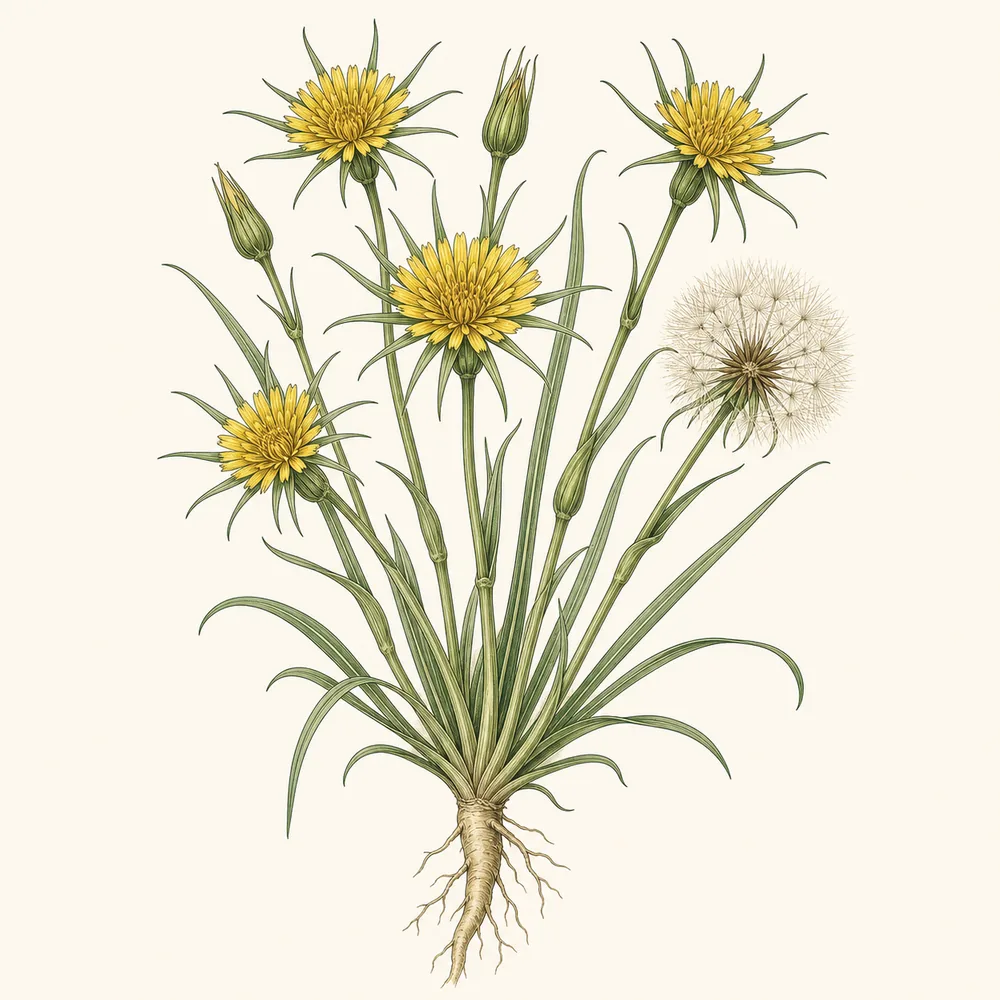
Goat's-beard
A meadow biennial with a party trick: its large yellow dandelion-like flowers open in the morning and close by midday, earning the old name Jack-go-to-bed-at-noon. Then come huge, architectural seed-clocks like giant dandelion heads. Easy on any sunny, well-drained patch.
Not listed by ASPCA
The ASPCA doesn't list goat's-beard, so we don't stamp it safe. It's a UK native wildflower with no recorded serious toxicity to pets, but with no database entry we flag the gap honestly rather than guess.
Care at a glance
Everything that matters, in six lines. The detail is further down.
Light
Needs an open, sunny spot — the flowers only open in bright morning light and stay shut on dull days or in shade.
Water
A plant of dry grassland with a long taproot; it needs no watering once growing and shrugs off summer dry spells.
Temperature
Hardy across the UK. As a biennial it makes a leafy rosette the first year, flowers and seeds the second, then dies.
Spacing
Set or thin plants a hand's width apart in the sward so each grassy rosette and tall flower stem has room to develop.
Feeding
Never feed or add compost. It's a plant of lean grassland; rich soil grows rank grass that shades out its rosettes and seedlings.
Soil
Thrives on free-draining, neutral to chalky soil — verges, banks and dry meadows. It dislikes heavy, wet ground in winter.
What to do, and when
Grassy, blue-green rosettes and stems grow up. Second-year plants build their tall flower stalks; nothing to do but let them come.
The show: big yellow flowers open on sunny mornings and close by noon, then swell into giant dandelion-clock seedheads that blow away.
The seed has flown and second-year plants die off, having done their job. Let seed drop for next year, then cut and clear the patch.
First-year rosettes sit low and dormant, ready to flower next summer. Little to do; sow fresh seed now onto bare, well-drained soil.
Jack-go-to-bed-at-noon
Goat's-beard's charm is its timing. The big yellow flowers, like a refined dandelion, open with the morning sun and close up again by around midday — which is exactly how it earned the wonderful old name Jack-go-to-bed-at-noon. On dull, overcast days they may barely open at all.
Then comes the second act: each flower turns into an enormous, perfectly spherical seed-clock, far bigger than a dandelion's, that catches the light and drifts away on the wind. Even out of flower, those seedheads make it one of the most sculptural plants in a meadow.
Growing a biennial
Goat's-beard is a biennial: from seed it makes a grassy rosette in its first year, flowers and seeds in its second, then dies. That's not a problem — it simply means you keep it going by letting it self-seed, so there's always a new generation coming behind the one that's flowering.
Sow in two consecutive autumns to start with, and after that a self-sustaining patch looks after itself. Each year's plants scatter those big clocks of seed, and fresh rosettes appear to flower the following summer.
Sowing on lean, sunny ground
Sow in autumn straight onto the ground where it's to grow — a sunny, free-draining, unimproved spot, with no added compost. The seed germinates better after winter cold, and the long taproot wants open, poor soil it can drive down into.
Scatter the seed thinly onto bare or scalped patches and press it in. Avoid rich, damp ground: goat's-beard is built for dry, lean grassland, and it's on exactly that kind of unpromising soil that it does best.
Cut, but let it seed first
The one thing you must not do is cut a goat's-beard patch before it has set and shed seed — with a biennial that has no running roots, next year's plants come only from this year's seed. Let the clocks form and blow, then do the meadow cut.
Once the seed has gone, shear the patch down and rake off and remove all the cuttings to keep fertility low and the grass in check. Cutting too early is the surest way to lose the plant entirely from your meadow within a couple of seasons.
Common problems
Vanishes after cutting too early
As a biennial with no creeping roots, it depends wholly on self-seeding. Never cut until the seed-clocks have fully formed and blown away.
Flowers stay shut
The blooms open only in bright morning sun and close by noon or in dull weather. Grow it in full sun and enjoy it earlier in the day.
Crowded out by rank grass
Rich soil grows lush grass that shades the rosettes and seedlings. Keep the ground poor, never feed, and cart off the hay after cutting.
Rots on heavy wet soil
The taproot and winter rosette dislike cold, waterlogged ground. Grow it on free-draining, sunny soil, adding grit to open heavy clay.
Everything a goat's-beard patch needs
Poor, sunny, well-drained soil and a cut only after seeding.
We take no commission on anything in the "save your money" tier — if we don't think you should buy it, we don't link it. How our recommendations work
If you like this, try
Other plants with a similar temperament.
How we checked this
Care cross-checked against the RHS. The ASPCA does not list goat's-beard, so its pet-safety is unconfirmed and we have not stamped it safe. If our page and these sources ever disagree, believe them — and tell us.
Sources: RHS · ASPCA — toxic & non-toxic plants
Last reviewed · August 2026