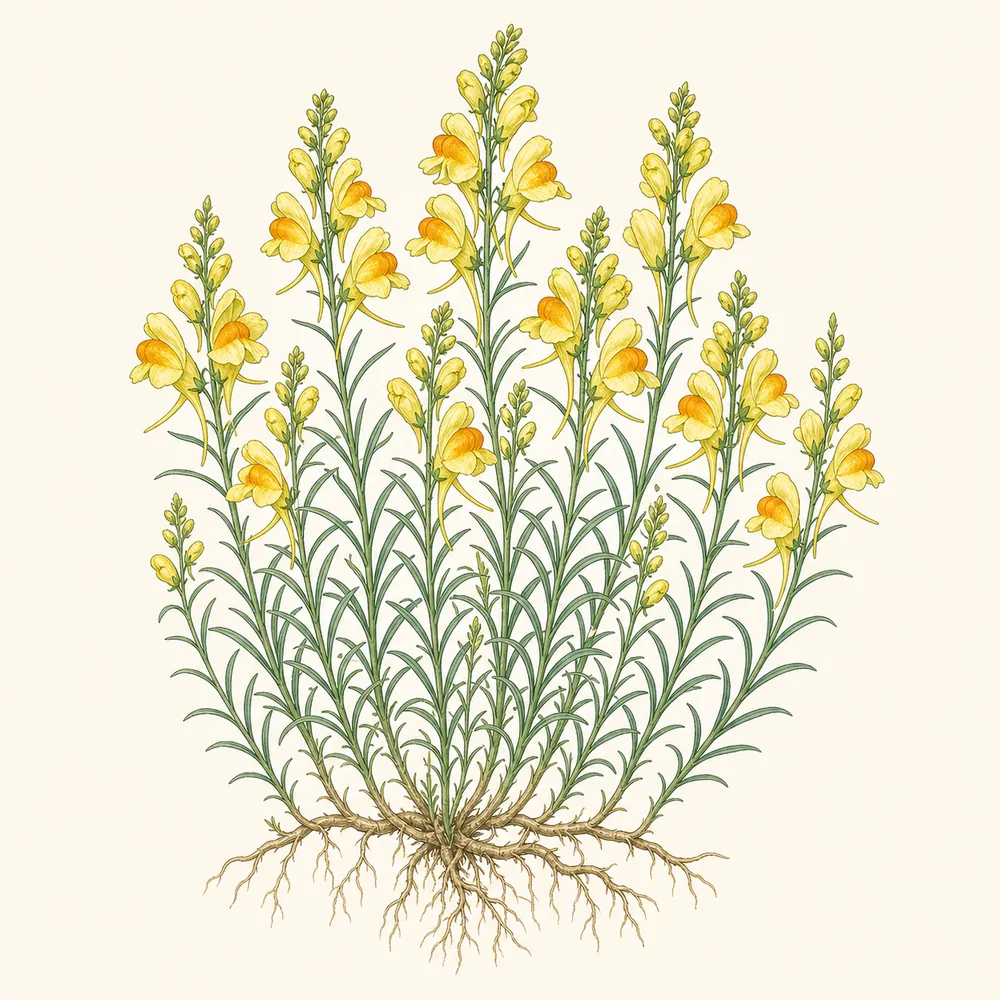
Common Toadflax
Spikes of little snapdragon-like flowers in two-tone yellow and orange — the reason for its old name, butter-and-eggs. It spreads by creeping runners and self-seeds happily, so it's genuinely easy; the only real decision is giving it room to roam. Long-tongued bumblebees adore it.
Not listed by ASPCA
The ASPCA doesn't list common toadflax, so we don't stamp it safe. It's a UK native wildflower with no recorded serious toxicity to pets, but with no database entry we flag the gap honestly rather than guess.
Care at a glance
Everything that matters, in six lines. The detail is further down.
Light
Flowers best in an open, sunny spot. In shade it grows lax and leggy and throws far fewer of its two-tone spikes.
Water
A plant of dry banks and verges that needs no watering once settled. Its running roots find their own moisture in poor ground.
Temperature
Hardy right across the UK. It dies back in winter and reappears from its perennial creeping roots each spring.
Spread
Give it space — it travels on creeping runners and can form a drifting patch. Site it where a bit of wandering is welcome.
Feeding
Never feed. It's a colonist of lean, disturbed ground; rich soil just makes soft growth and lets grasses crowd it out.
Soil
Happiest on poor, well-drained, sandy or gravelly soil — the kind of ground where little else thrives. It dislikes heavy wet clay.
What to do, and when
Grey-green shoots run up from the creeping roots. Nothing to do — let the patch fill out and the flower stems build through late spring.
The butter-and-eggs spikes open from June and keep going for weeks, worked over by long-tongued bumblebees all through high summer.
Flowering tails off into round seed capsules. Leave some to self-sow, then cut the patch back and clear the top growth away.
Dies down to the roots and rests. Cut any old stems to the ground; the creeping rootstock sits dormant, ready to run again in spring.
The bee plant with a hidden reward
Toadflax flowers are like tiny yellow snapdragons, closed by a hinged lower lip with an orange 'egg-yolk' patch as a landing guide — and a long spur behind holding the nectar. Only a strong, long-tongued bumblebee can force the lip open and reach right in, which makes it a specialist favourite when it's in bloom.
That closed-mouth design is exactly why it's such good value in a wildlife patch. Where shorter-tongued insects can't get in, the big garden and common carder bumblebees have it largely to themselves through July and August.
It spreads — plant it accordingly
Toadflax is a runner. It travels underground on creeping roots and self-seeds freely, so a single plant becomes a drifting colony. In the right place — a dry bank, a gravelly corner, a wild strip — that's exactly what you want.
In a tidy border it can be a thug, muscling among neighbours. Either give it a spot of its own where wandering is welcome, or grow it somewhere the roots are naturally contained, like a gravel bed backed by paving.
Sowing on poor, open ground
Sow in autumn straight onto bare, poor soil — a sunny, free-draining patch, not enriched with compost. Autumn cold helps the seed break dormancy, and toadflax is a natural colonist of disturbed, stony ground, so it takes readily where the soil is lean and open.
Scatter the fine seed thinly and press it in without burying it. Once a few plants take, they'll do the rest themselves by root and by seed — you rarely need to sow twice.
Managing the patch
Left alone, a toadflax patch flowers for weeks, but keeping it going long-term means keeping the ground poor. Never feed it, and do the meadow cut once flowering is over: shear the patch down and rake off every bit of the cuttings so the soil stays lean and grasses don't take hold.
If it starts to wander further than you'd like, simply pull up the outrunners in spring while the ground is soft — the running roots come away easily and it's an easy plant to keep within bounds.
Common problems
Spreads further than wanted
Creeping roots and free seeding carry it into neighbours. Site it where it can roam, or pull up outrunners each spring and dead-head to limit self-seeding.
Leggy and shy to flower
Too much shade or too-rich soil gives soft, floppy growth and few flowers. Move it to full sun on poor, free-draining ground.
Crowded out by coarse grass
Fertile soil lets grasses swamp it. Keep the ground lean, never feed, and always cart off the hay after the late cut.
Rots on heavy wet soil
Cold, waterlogged clay in winter kills the roots. Grow it on a dry bank or gravelly bed, adding grit to open up heavy ground.
Everything a toadflax patch needs
Poor, sunny, free-draining ground and room to spread.
We take no commission on anything in the "save your money" tier — if we don't think you should buy it, we don't link it. How our recommendations work
If you like this, try
Other plants with a similar temperament.
How we checked this
Care cross-checked against the RHS. The ASPCA does not list common toadflax, so its pet-safety is unconfirmed and we have not stamped it safe. If our page and these sources ever disagree, believe them — and tell us.
Sources: RHS · ASPCA — toxic & non-toxic plants
Last reviewed · August 2026