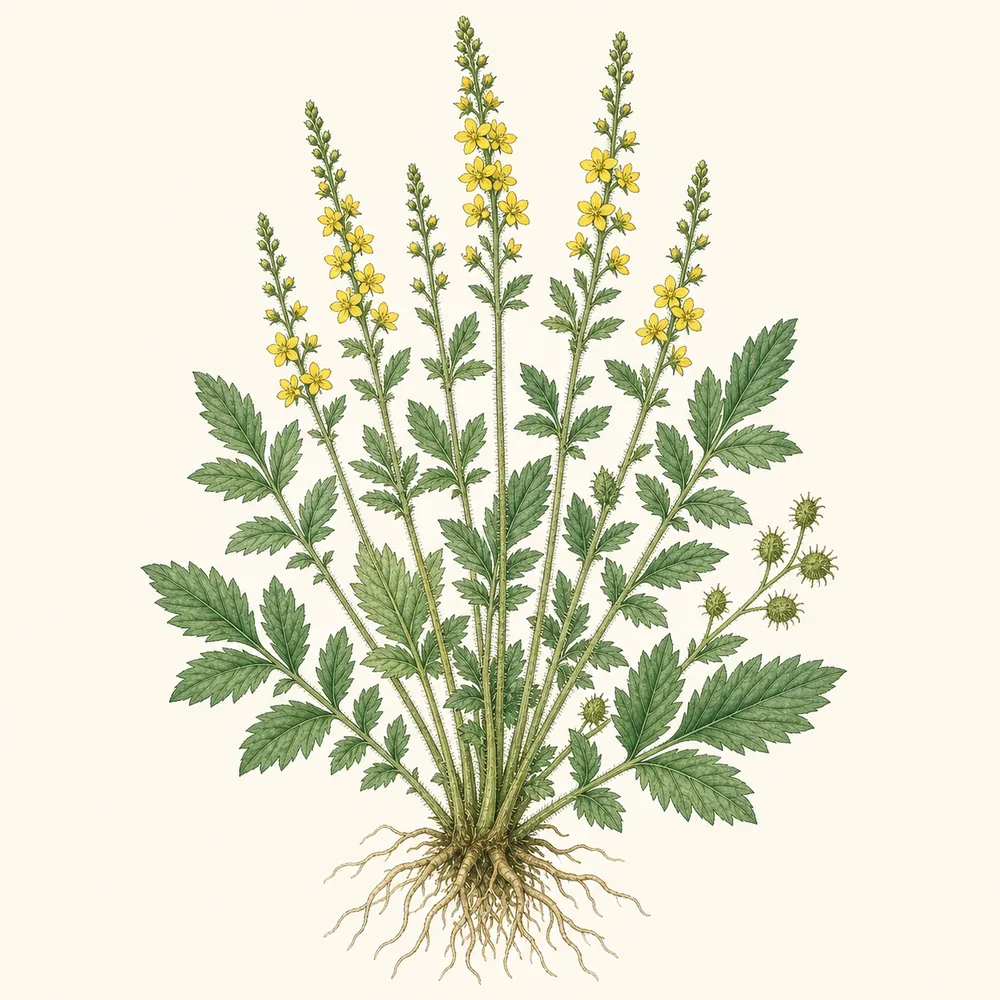
Agrimony
A tall, slender spire of small yellow star-flowers that stands above the grass all summer, with softly hairy, ferny leaves below. It's one of the easiest natives to grow on a sunny meadow edge — undemanding, drought-tolerant once settled, and quietly good for bees and hoverflies.
Not listed by ASPCA
The ASPCA doesn't list agrimony, so we don't stamp it safe. It's a UK native wildflower with no recorded serious toxicity to pets, but with no database entry we flag the gap honestly rather than guess.
Care at a glance
Everything that matters, in six lines. The detail is further down.
Light
Wants an open, sunny spot to flower well. It tolerates a little light shade at a hedge base but flowers thin out and the spires flop.
Water
Once its deep root is down it copes with dry summers and needs no watering. Only nurse young first-year plants through a real drought.
Temperature
A tough UK native, hardy across the country. It dies back to a low rosette in winter and comes again from the crown each spring.
Spacing
Scatter or plant so plants stand a hand's width or more apart, letting the flower spikes rise clear of the grasses around them.
Feeding
Never feed or add rich compost. Fertility makes the grasses romp away and swamp it; agrimony belongs on lean, unimproved ground.
Soil
Happiest on free-draining, neutral to chalky soil — verges, banks and meadow edges. It dislikes wet, heavy ground that sits cold.
What to do, and when
Low ferny rosettes push up as the meadow greens. Nothing to do — leave it alone among the growing grasses and let the spikes build.
The flower spires open from June, a long yellow candle of tiny stars visited by bees and hoverflies through July and August.
Flowers give way to little burred seed-hooks that catch on fur and socks. Leave them to ripen, then cut the patch and clear the hay.
Dormant as a flat rosette at ground level. Cut grass short over winter if you didn't in autumn; sow fresh seed now if establishing a patch.
Where agrimony wants to be
Agrimony is a plant of the dry meadow edge — sunny banks, verges, the lean strip along a fence or path. Give it full sun and free-draining soil and it more or less looks after itself, sending up its tall yellow spires year after year from a deep, drought-proof root.
The one thing it won't stand is rich, damp ground. On fertile soil the grasses grow lush and simply out-muscle it, and on cold wet clay the crown can rot. If your ground is heavy, work in grit or choose a raised, sunnier edge for it.
Sowing on poor ground
Sow in autumn straight onto the ground where it's to grow. The seed benefits from the cold of winter to break its dormancy, so autumn sowing usually gives far better germination than spring.
Clear a patch of bare soil, scatter the seed thinly, and press it in with your foot or the back of a rake — don't bury it deep and don't add compost. On an existing meadow, scalp the turf hard in a few spots first so the seedlings meet soil, not a mat of grass.
Living in a meadow patch
Agrimony grows tall enough to hold its own among meadow grasses, which makes it one of the more forgiving natives to establish. Dotted through longer grass on a sunny edge, the spires rise clear and flower for weeks.
The whole point of a meadow is that you leave it be through the growing season — no mowing, no feeding, no watering. Your only real job is the one late cut, once the flowers have set and shed their seed.
The cut-and-collect regime
A meadow lives or dies by how you cut it. Once agrimony and its neighbours have flowered and dropped seed — usually late summer into early autumn — cut the whole patch down to around 5–8 cm with shears or a strimmer.
Then rake off and remove every scrap of the cuttings. Left lying, they rot down and feed the soil, and that extra fertility is exactly what lets coarse grasses take over. Carting the hay away keeps the ground lean and the wildflowers in the mix. Leaving the cut hay on the surface for a day or two first lets any remaining seed shake down before you clear it.
Common problems
Swamped by coarse grass
Rich soil lets vigorous grasses smother it. Never feed or mulch, always cart off the hay after cutting, and if grass dominates, cut a little harder to knock it back.
Poor germination from spring sowing
The seed wants a cold winter to trigger it. Sow in autumn onto bare soil and let frost do the work, rather than sowing in spring and losing most of it.
Flops and flowers poorly in shade
Too little sun gives weak, leaning spires and few flowers. Move it, or clear back overhanging growth, so it gets an open, sunny position.
Crown rot on wet clay
Cold, waterlogged soil in winter rots the resting rosette. Grow it on a free-draining bank or edge, adding grit to heavy ground before planting.
Everything a meadow-edge patch needs
Poor, free-draining soil, autumn-sown seed, and one late cut.
We take no commission on anything in the "save your money" tier — if we don't think you should buy it, we don't link it. How our recommendations work
If you like this, try
Other plants with a similar temperament.
How we checked this
Care cross-checked against the RHS. The ASPCA does not list agrimony, so its pet-safety is unconfirmed and we have not stamped it safe. If our page and these sources ever disagree, believe them — and tell us.
Sources: RHS · ASPCA — toxic & non-toxic plants
Last reviewed · August 2026