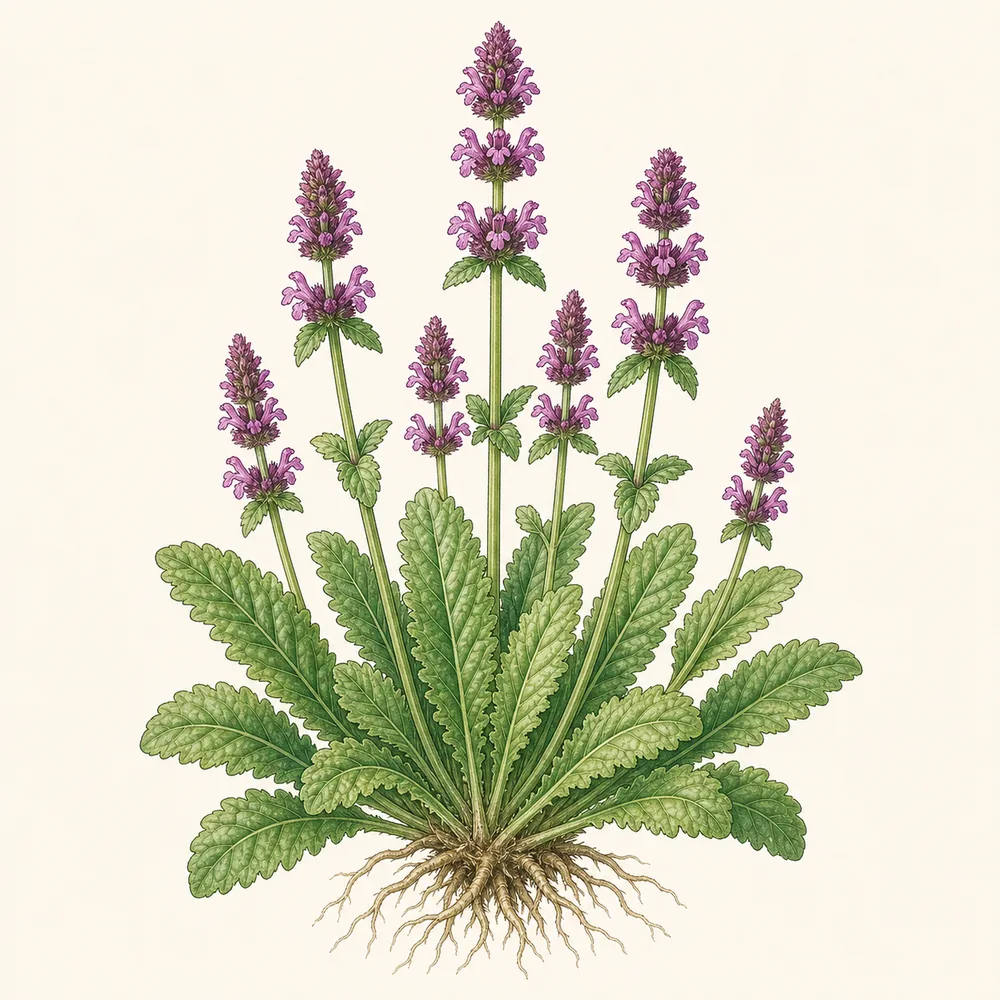
Betony
An upright grassland perennial with neat rosettes of scalloped leaves and spikes of rich magenta-purple flowers through high summer. It thrives on poor soil, feeds the bees, and asks almost nothing once established — an easy, honest choice for a meadow or wildlife border.
Not listed by ASPCA
The ASPCA doesn't list betony, so we don't stamp it safe. It's a UK native wildflower with no recorded serious toxicity to pets, but with no database entry we flag the gap honestly rather than guess.
Care at a glance
Everything that matters, in six lines. The detail is further down.
Light
Flowers best in an open, sunny spot but tolerates light or dappled shade, as it does on woodland edges and hedgebanks in the wild.
Water
Water new plants through their first dry spell to settle them in. After that it's drought-tolerant and rarely needs watering.
Season
A fully hardy native perennial. Rosettes stay low through winter and send up flower spikes across high summer.
Spacing
Set plants or plugs a hand's width apart in drifts so the rosettes knit together into a natural, grassland look.
Feeding
Never feed it. Rich, fertile ground makes it floppy and lets grasses swamp it; lean soil keeps it compact and free-flowering.
Soil
Happy on ordinary or poor soil, from mildly acid to neutral, as long as it drains. Avoid rich, heavily improved beds.
What to do, and when
The overwintered leaf rosettes green up and spread. A good time to plant plugs or divide established clumps into a meadow or border.
The main event — tall spikes of magenta-purple flowers from June, alive with bees. Deadhead a few for tidiness or leave them for seed.
Flowering fades and seed ripens. In a meadow, cut and collect the growth once seed has dropped to keep the ground lean.
The plant dies back to a low, semi-evergreen rosette that sits out the cold. Fully hardy and needs no protection.
A wildflower for lean, unimproved ground
Betony is a plant of old grassland, heaths, hedgebanks and open woodland — places where the soil is poor and the grass is thin. That's the key to growing it well: it wants competition kept low and fertility kept down.
On rich garden soil it grows lush and floppy, and vigorous grasses quickly out-compete it. Give it the leanest, sunniest spot you have, resist the urge to feed or improve the ground, and it will settle into a long-lived, self-reliant clump.
A real pollinator plant
The magenta flower spikes are held above the foliage from June to September, exactly when many bees and other pollinators are most active. Long-tongued bumblebees in particular work the tubular flowers hard.
For wildlife value, plant it in generous drifts rather than as single specimens — a mass of flower spikes is far more useful to foraging insects, and far more striking in a meadow or wildlife border.
The cut-and-collect meadow regime
In a wildflower meadow, betony is managed like the grassland it comes from. Let it flower and set seed through summer, then in late summer or autumn cut the whole sward and remove the clippings.
Taking the cut material away is the important bit — leaving it to rot returns fertility to the soil, which favours coarse grasses over the wildflowers. Cut, rake off, and let seed drop before you clear, and the meadow stays lean and flower-rich year on year.
Common problems
Lush, floppy growth and few flowers
Soil too rich. Stop feeding, and if you can, grow it on leaner ground where the grass is thinner.
Swamped by grasses
Vigorous grass out-competing it on fertile ground. Cut and remove the sward in autumn to reduce fertility and keep grasses in check.
Rosettes rotting off in winter
Waterlogged soil. Betony wants free drainage — improve heavy ground with grit or grow it on a slight rise.
Slow to establish from seed
Native perennials take time. Sowing fresh seed in autumn or using plug plants gives a quicker, more reliable start.
Everything betony needs
Lean soil, an open spot, and the patience to leave it be.
We take no commission on anything in the "save your money" tier — if we don't think you should buy it, we don't link it. How our recommendations work
If you like this, try
Other plants with a similar temperament.
How we checked this
Care cross-checked against the RHS. The ASPCA does not list betony, so its pet-safety is unconfirmed and we have not stamped it safe. If our page and these sources ever disagree, believe them — and tell us.
Sources: RHS · ASPCA — toxic & non-toxic plants
Last reviewed · August 2026