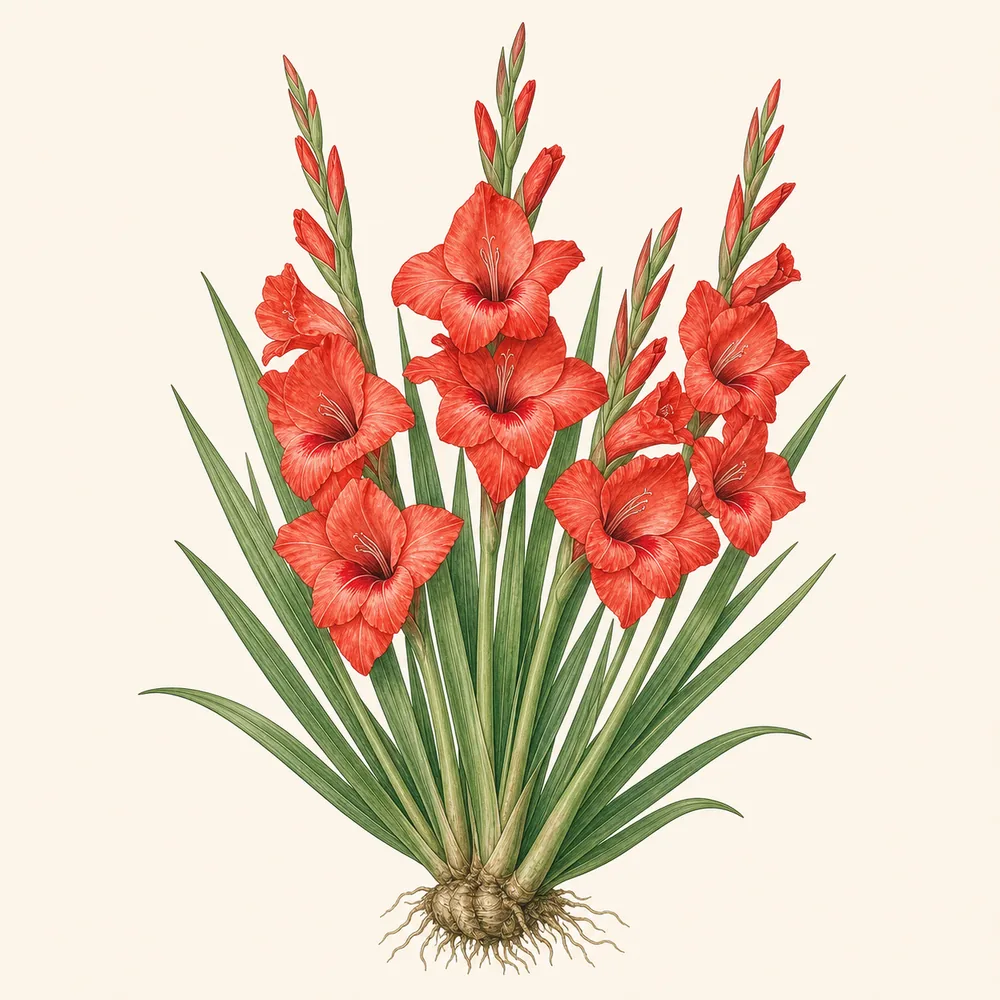
Gladiolus
Grown from a flat corm planted in spring, gladioli send up tall, one-sided spikes of showy funnel flowers through summer. They are easy and generous, but the large-flowered kinds are only half-hardy and need lifting before frost in colder gardens.
Toxic to cats & dogs if eaten
Gladiolus is listed as toxic to cats and dogs on the ASPCA database, with the underground corms the most toxic part. Eating them causes drooling, vomiting and lethargy. Keep pets from the corms in particular.
Care at a glance
Everything that matters, in six lines. The detail is further down.
Position
Full sun for strong spikes, with some shelter from wind — the tall stems catch a gust and topple.
Water
Water well through the growing season and especially as the flower spikes form in dry spells.
Hardiness
Large-flowered types won't survive a cold, wet winter in the ground — lift and store. Hardy nanus types can stay in mild areas.
Soil
Rich but well-drained. On heavy ground add grit, as corms sit and rot in wet soil.
Feeding
A high-potash feed once the flower spikes appear supports strong blooms.
Flowering
Plant in succession from spring for a run of spikes rather than one short burst.
What to do, and when
Plant corms 10–15 cm deep from April into May, a few every couple of weeks, to stagger the flowering.
Peak flowering — stake tall spikes, water in dry spells, feed with potash, and cut blooms for the vase as they open.
Once leaves yellow and before the first hard frost, lift the corms in cold areas, dry them off and store somewhere frost-free.
Corms rest in store — check them over for rot and damp; mulch any hardy nanus types left outside in mild gardens.
Plant in succession, stake early
Gladioli flower for a couple of weeks, so plant corms in small batches every fortnight from mid-spring — that turns a single flush into a long summer supply of spikes.
The stems are tall and top-heavy: push a cane in at planting time, before the roots are there to damage, and tie the spike in as it grows so a summer storm doesn't flatten it.
Lifting and storing the corms
In all but the mildest gardens the large-flowered types are lifted before the first frost. Cut the stems, ease the corms up, and let them dry off for a couple of weeks somewhere airy.
Snap off the old shrivelled corm underneath, dust off soil, and store the new corms dry and frost-free in paper bags or trays until spring.
Common problems
Spikes flopping over
Wind and top-heavy stems. Plant in a sheltered spot, set them a little deeper, and stake at planting time.
Few or no flowers
Small or immature corms, planting too shallow, or thrips damage. Feed with potash and buy good-sized corms.
Silvery streaks and flecked petals
Gladiolus thrips, which also carry over on stored corms. Dust corms before storing and destroy badly affected ones.
Soft, rotting corms in store
Lifted too wet or stored too warm and damp. Dry thoroughly first and keep them cool, airy and frost-free.
Everything a gladiolus needs
Full sun, a stake in early, and a frost-free shelf for the corms.
We take no commission on anything in the "save your money" tier — if we don't think you should buy it, we don't link it. How our recommendations work
If you like this, try
Other plants with a similar temperament.
How we checked this
Care cross-checked against the RHS. Toxicity confirmed against the ASPCA database, which lists Gladiolus as toxic to cats and dogs — the underground corms are the most toxic part and can cause drooling, vomiting and lethargy if eaten. If our page and these sources ever disagree, believe them — and tell us.
Sources: RHS · ASPCA — toxic & non-toxic plants
Last reviewed · July 2026