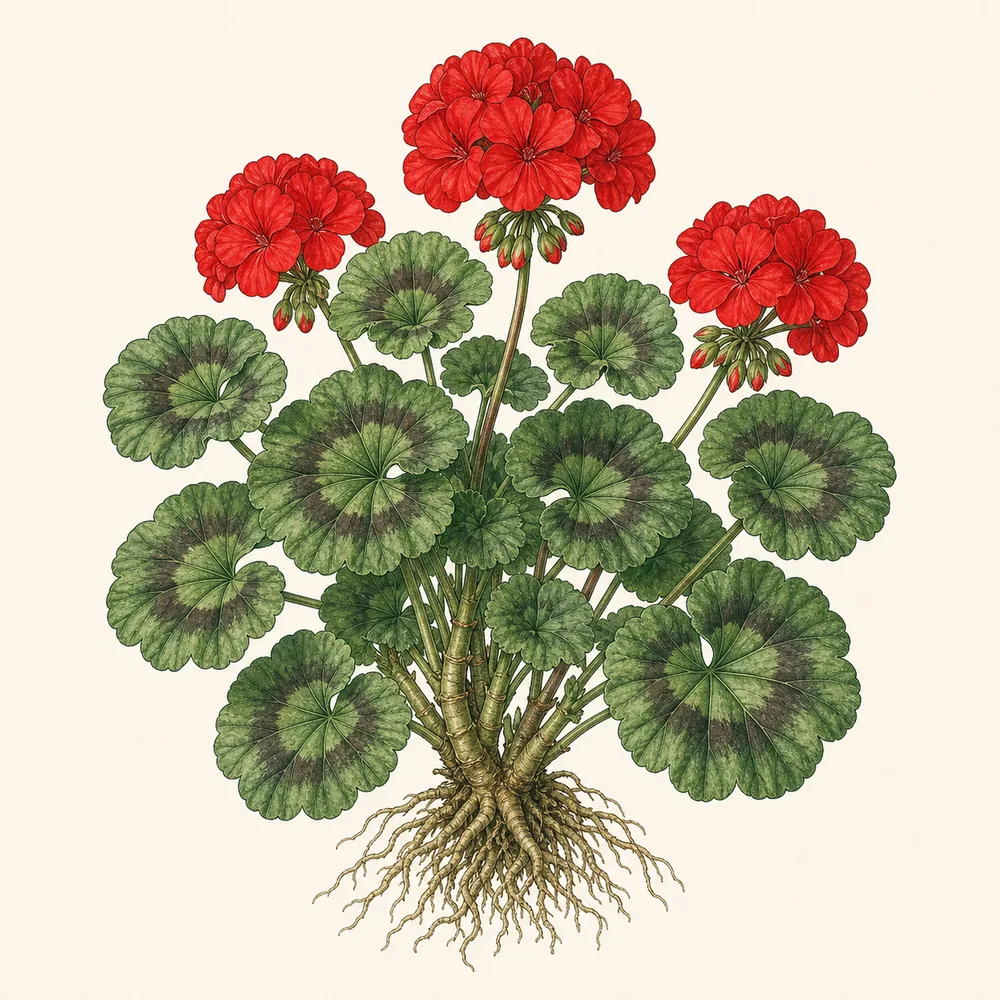
Geranium (Pelargonium)
The red-flowered stalwart of every British windowsill, pot and hanging basket — which is botanically a pelargonium, not a true geranium. Sun-loving, drought-proof and in flower from May until the frosts, it asks only that you never overwater it.
Toxic to cats & dogs if eaten
Pelargoniums contain geraniol and linalool, which can cause vomiting, low mood, loss of appetite and skin irritation in cats and dogs — mild and short-lived in most cases, but hanging baskets at nose height make nibbling easy. (The ASPCA entry for 'geranium' covers these bedding pelargoniums.) Source: ASPCA.
Care at a glance
Everything that matters, in six lines. The detail is further down.
Position
The sunniest spot you own — a south-facing pot, basket or windowsill. Shade means leaves, not flowers.
Water
Let the compost dry between drinks. More pelargoniums die of kindness with a watering can than of anything else.
Feeding
High-potash (tomato) feed from June keeps pots flowering to October.
Compost
Any peat-free multipurpose with a handful of grit or perlite. Pots must have drainage holes.
Deadheading
Snap whole spent flowerheads off at the base of their stalk — thirty seconds a week doubles the show.
Hardiness
Frost kills them. Outside after the last frost only; overwinter cuttings or plants somewhere frost-free.
What to do, and when
Buy or pot up after the last frost — mid-May for most of Britain. Pinch growing tips once for bushier plants.
Full production: sun, lean watering, fortnightly tomato feed, weekly deadheading. They shrug off holidays that kill fuchsias.
Before the first frost: take cuttings (they root in weeks) or bring whole pots into a frost-free porch, cutting them back by half.
Overwintered plants want light, barely any water, and no feed. Bone-dry neglect at 5–10°C suits them fine.
Why yours flowers less than the ones in Mediterranean photos
Three levers control pelargonium flowering, and they're all free: more sun (there is no such thing as too much in Britain), less water (constantly moist compost grows soft leaves and few flowers), and relentless deadheading (a plant allowed to set seed winds down production).
Feeding is the fourth lever, and the only one that costs money: a high-potash tomato feed every fortnight from June. Nitrogen-rich general feeds do the opposite of what you want — lush foliage, sparse flowers.
The free plants trick: cuttings
Pelargoniums root from cuttings more willingly than almost any garden plant. In late August, snip 10cm shoot tips just below a leaf joint, pull off the lower leaves and any flower buds, and push them into a pot of gritty compost on a bright windowsill. No propagator, no rooting hormone, no plastic bag — they root in three to four weeks.
Six cuttings on a windowsill through winter replace next year's entire bedding order. It's also the space-saving way to overwinter: cuttings take a windowsill; parent plants take a greenhouse.
Common problems
Yellow lower leaves, rotting base
Overwatering. Let it dry right out, and water half as often as instinct says.
Leggy stems, few flowers
Not enough sun. Move the pot — no feed can substitute for light.
Brown corky patches under leaves
Oedema, from erratic watering. Cosmetic; steady the watering and new growth comes clean.
Fluffy grey mould on stems
Botrytis in cool damp air. Remove affected parts, water in the morning, improve airflow.
Everything a pelargonium needs
One of the cheapest plants to do brilliantly. Most of the cost is optional.
We take no commission on anything in the "save your money" tier — if we don't think you should buy it, we don't link it. How our recommendations work
If you like this, try
Other plants with a similar temperament.
How we checked this
Care guidance cross-checked against the Royal Horticultural Society and NC State Extension. Toxicity confirmed against the ASPCA database entry for geranium/Pelargonium (geraniol, linalool — vomiting, anorexia, depression, dermatitis). Note: true hardy geraniums (cranesbills) are a different genus with a different safety profile — this page covers bedding pelargoniums. If our page and these sources ever disagree, believe them — and tell us.
Sources: RHS · NC State Extension · ASPCA
Last reviewed · July 2026