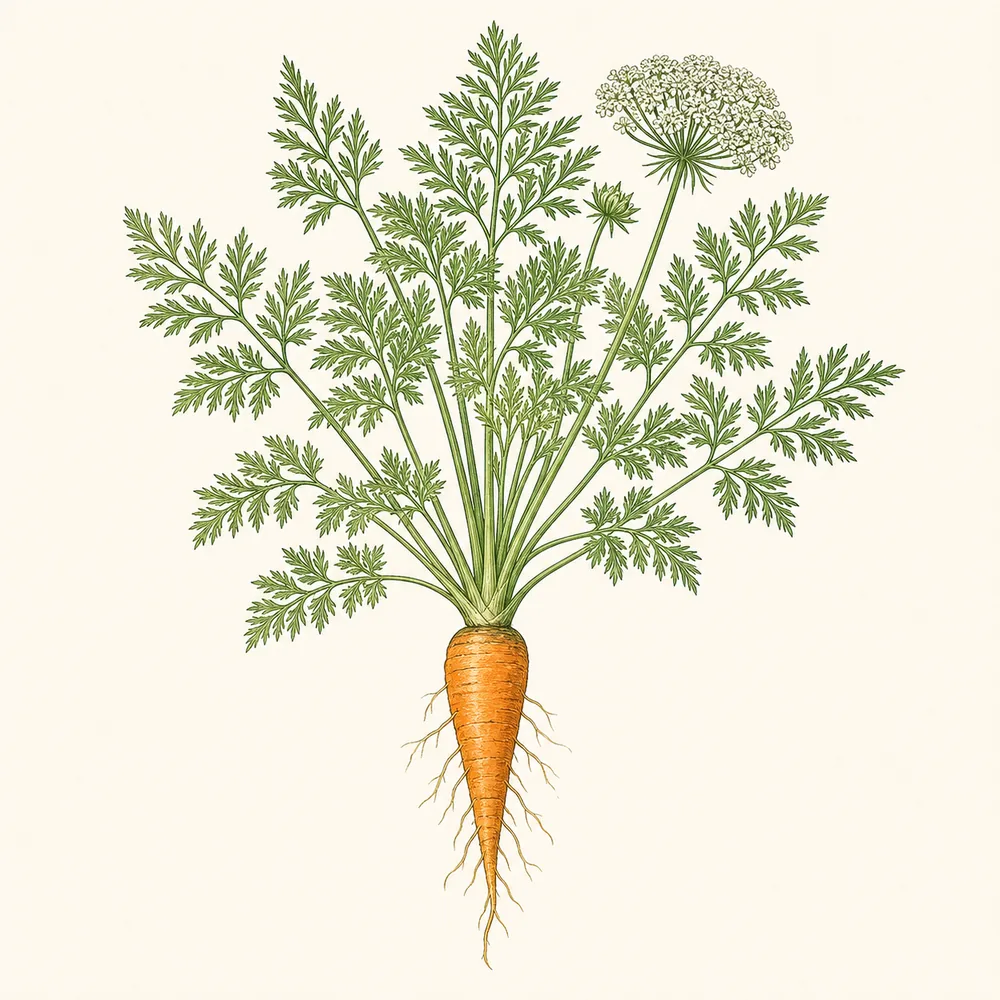
Carrot
Sweet, crisp roots that taste nothing like the shop-bought version when pulled fresh. The knack is light, stone-free soil, sowing thinly, and outwitting the carrot fly — get those right and they're genuinely easy.
Not listed by ASPCA
The ASPCA doesn't list the carrot as toxic or non-toxic, so we don't stamp it safe. Carrots are widely fed to pets in moderation with no known serious toxicity, but with no database entry we flag the gap honestly rather than guess.
Care at a glance
Everything that matters, in six lines. The detail is further down.
Light
An open, sunny spot gives the sweetest, best-shaped roots; deep shade gives leafy tops and poor carrots.
Water
Keep the soil evenly moist — a heavy soak after a dry spell makes the roots split. Little and often is better.
Temperature
Sow outdoors from March under fleece, then in succession to autumn; roots stand in the ground into winter under cover.
Spacing
Sow thinly and thin seedlings to a few centimetres apart so each root has room to swell without crowding.
Feeding
Never grow in freshly manured ground; it forks and splits the roots. Carrots crop fine in unimproved soil.
Soil
Loose, sandy, stone-free soil is ideal; on heavy or stony ground, grow stump-rooted types in deep containers instead.
What to do, and when
Start sowing from March under fleece or cloches for early roots. Sow thinly straight into the ground where they are to grow.
Sow in succession every few weeks for a continuous supply. Water evenly and keep the mesh on against carrot fly.
Lift maincrop carrots or leave them in the ground under a straw mulch to pull as needed through the cold months.
Roots store well in the ground under cover, or in boxes of dry sand in a cool shed. Sow nothing outdoors now.
It all comes down to the soil
Carrots have one big demand: light, loose, stone-free soil. Roots that hit a stone or a lump of fresh manure fork, split and twist into the strange shapes that put people off growing their own.
If your ground is heavy clay or full of stones, don't fight it — sow short, stump-rooted varieties in deep containers or a raised bed of sieved compost and sand. You'll get straight, clean roots every time.
Sow thinly, thin carefully
Carrot seed is tiny and it's tempting to sow it thickly, but crowded seedlings need thinning — and thinning is exactly what attracts carrot fly. Mix the fine seed with a little dry sand and sow as thinly as you can so you barely need to thin at all.
If you must thin, do it on a still, damp evening, firm the soil back afterwards and remove the thinnings from the plot. The bruised foliage releases the scent that draws the fly in.
Outwitting the carrot fly
Carrot fly is the pest that defeats most people. The females fly low to lay their eggs, and the larvae tunnel rusty-brown scars through the roots. The good news is they're easy to exclude.
Cover the crop with fine insect mesh from sowing, or build a barrier around 60 cm high around the bed — the flies won't climb over it. Sowing thinly to avoid thinning, and choosing resistant varieties like 'Resistafly', both help too.
Common problems
Carrot fly
Rusty-brown tunnels through the roots. Cover with fine mesh from sowing, avoid thinning where you can, and grow resistant varieties.
Forked or split roots
Stones, fresh manure, or erratic watering. Sow in light, stone-free, unmanured soil and keep moisture even and steady.
Green tops on the roots
Shoulders exposed to light turn green and bitter. Draw a little soil over the crowns as the roots swell.
Poor or patchy germination
Carrot seed needs warmth and constant moisture. Wait until the soil warms, keep the drill damp, and don't let it dry out while germinating.
Everything a carrot bed needs
Light stone-free soil, fine mesh, and thin sowing.
We take no commission on anything in the "save your money" tier — if we don't think you should buy it, we don't link it. How our recommendations work
If you like this, try
Other plants with a similar temperament.
How we checked this
Care cross-checked against the RHS. The ASPCA does not list the carrot, so its pet-safety is unconfirmed and we have not stamped it safe. If our page and these sources ever disagree, believe them — and tell us.
Sources: RHS · ASPCA — toxic & non-toxic plants
Last reviewed · July 2026