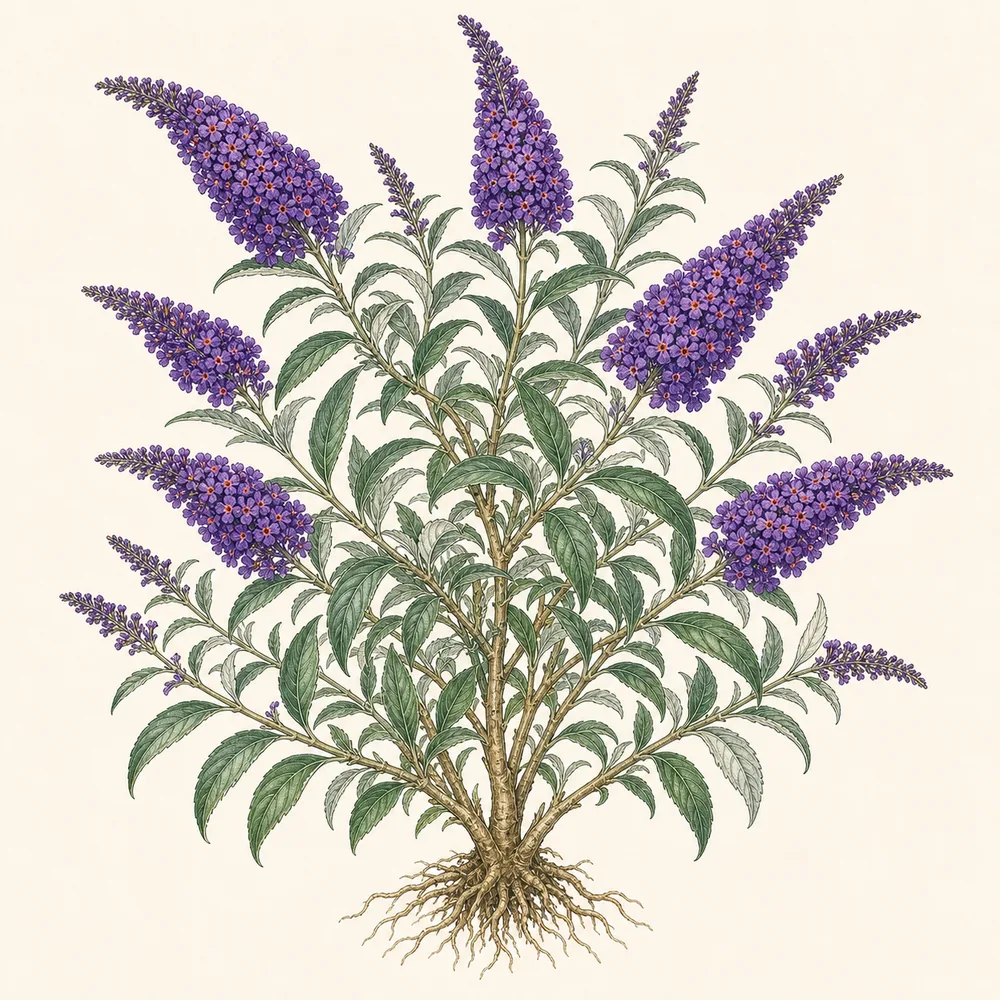
Butterfly Bush
A magnet for butterflies and bees, smothered in cones of scented summer flowers. Almost absurdly easy — so easy it self-seeds into walls and waste ground — so the real skill is keeping this vigorous shrub in check.
Not listed by ASPCA
The ASPCA doesn't list the butterfly bush (Buddleja), so we don't stamp it safe. With no database entry we flag the gap honestly rather than guess.
Care at a glance
Everything that matters, in six lines. The detail is further down.
Position
Wants full sun for the best flowering and the most butterfly traffic. It flowers poorly and grows lax in shade.
Water
Water new plants their first summer, then leave them. Established buddleias thrive on dry, poor ground and hot walls.
Hardiness
Thoroughly hardy. Even if a hard winter cuts it back, it bounces straight up from the base the following spring.
Soil
Grows almost anywhere — poor, stony, chalky or dry. It famously colonises old walls and rubble, so it asks for nothing.
Feeding
Don't feed it. Extra richness only fuels an already vigorous shrub into more growth you'll have to prune off.
Pruning
Flowers on new wood. Cut hard back to a low framework in March, then deadhead through summer to stop self-seeding.
What to do, and when
Hard-prune in March, cutting last year's stems back to a low framework — this drives strong new flowering growth.
The show — scented cones open from July, alive with butterflies and bees. Deadhead spent spikes to keep it going.
Flowering fades. Keep deadheading and cut off seedheads before they scatter, as buddleia self-seeds freely.
Dormant and hardy. Leave the top growth on until spring; it gives a little frost protection to the base.
Hard prune in spring for a better show
Buddleja flowers on the current year's growth, which makes pruning easy and forgiving. Left alone it becomes a tall, bare-legged tangle that flowers high out of reach; cut back hard and it rewards you with bigger blooms lower down.
In March, cut all the previous year's stems back to a low permanent framework, a couple of buds above the older wood — roughly knee height. It looks severe, but the shrub races away and flowers all the better for it.
The best butterfly plant you can grow
There's a reason for the common name. Few garden plants pull in butterflies and bees like a buddleia in full flower — peacocks, tortoiseshells and red admirals crowd the nectar-rich cones on a warm summer day.
For the longest show, deadhead spent flower spikes regularly: it keeps fresh blooms coming into autumn and — importantly — stops the plant setting seed. Varieties like the compact 'Buzz' series suit smaller gardens and pots.
Keep it in check — it self-seeds
The flip side of that vigour is that buddleja spreads. It self-seeds prolifically into walls, pavements, railway sidings and waste ground, and in the UK it's widely regarded as invasive — you'll have seen it colonising derelict buildings.
You don't need to stop growing it, but do garden it responsibly: deadhead before seed sets, pull up stray seedlings while they're small, and never dump prunings or spent flowers where they can spread into the wild.
Common problems
Tall, bare and flowering out of reach
It hasn't been pruned. Cut hard back to a low framework each March to keep it compact and flowering at eye level.
Seedlings popping up everywhere
Buddleja self-seeds freely and is invasive-ish in the UK. Deadhead before seed sets and pull stray seedlings while small.
Few flowers, lots of leaf
Usually too much shade or over-feeding. Move to full sun and don't feed — it flowers best on poor, dry ground.
Wilting or die-back on some stems
Often frost damage or capsid bug. Cut damaged stems back to healthy wood at the spring prune and it recovers fast.
Everything a buddleia needs
Full sun, poor soil, and a hard prune plus regular deadheading to keep it in bounds.
We take no commission on anything in the "save your money" tier — if we don't think you should buy it, we don't link it. How our recommendations work
If you like this, try
Other plants with a similar temperament.
How we checked this
Care cross-checked against the RHS. The ASPCA does not list the butterfly bush (Buddleja), so its pet-safety is unconfirmed and we have not stamped it safe. If our page and these sources ever disagree, believe them — and tell us.
Sources: RHS · ASPCA — toxic & non-toxic plants
Last reviewed · August 2026