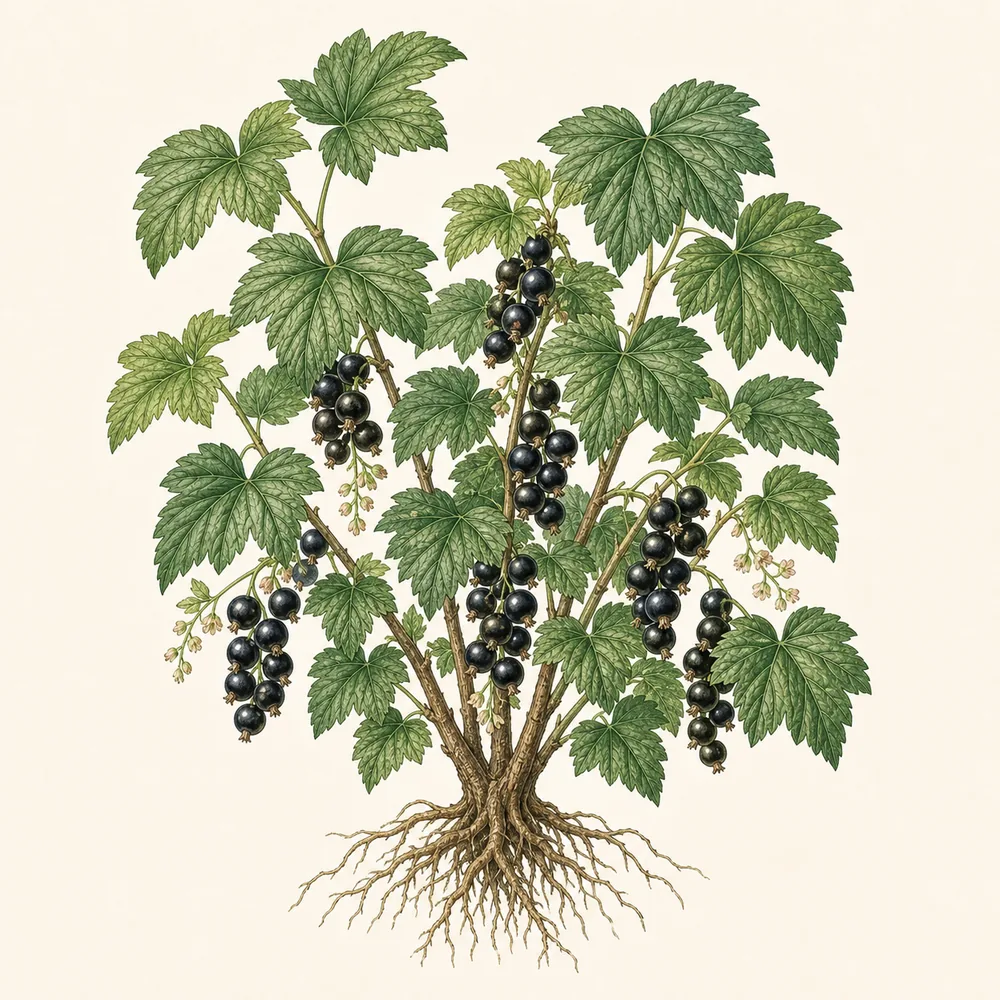
Blackcurrant
A hardy, generous soft-fruit bush that crops for years with almost no fuss. Plant it deep, feed it well, and prune out the old wood — and you'll pick pounds of vitamin-C-packed berries every July.
Not listed by ASPCA
The ASPCA doesn't list the blackcurrant (Ribes), so its pet-safety is unconfirmed. There's no evidence of serious toxicity, but with no database entry we don't stamp it safe.
Care at a glance
Everything that matters, in six lines. The detail is further down.
Light
Crops best in full sun but tolerates a little shade — one of the few fruits that still fruits on a north-facing wall.
Water
Water steadily while the berries swell in late spring and early summer; a dry spell then means small, sparse fruit.
Temperature
Thrives across the UK and actually needs winter cold to fruit well; late frosts can catch the early flowers.
Spacing
Give each bush room for air to move through — crowded, still air invites mildew on the leaves.
Feeding
Blackcurrants are hungry. Mulch with compost or well-rotted manure and feed in late winter for strong new wood.
Soil
A heavy, fertile soil that holds moisture suits them best; work in plenty of organic matter before planting.
What to do, and when
New shoots and flowers appear — protect the blossom from late frost with fleece, and keep the roots watered as berries set.
Pick ripe trusses from early July. Prune out the oldest fruited stems straight after harvest to make room for new wood.
Bare-root planting season begins. Set new bushes deep and mulch established ones with compost.
Fully dormant — the ideal time for planting and for the main pruning of established bushes.
Plant deep — deeper than you think
Unlike most fruit, blackcurrants are planted deep: set the bush two or three centimetres lower than it grew in the pot, so the base of the stems sits below the soil. This buried section throws up a thicket of new shoots from the roots — a 'stooled' bush that fruits far more heavily than a single-stemmed one.
After planting, cut every stem down to two buds above the ground. It feels brutal, but it forces the plant to build a strong framework rather than fruit weakly in year one.
Fruit comes on young wood
Blackcurrants crop best on wood made the previous year, so the aim of pruning is a constant supply of young stems. Each winter, cut out roughly a third of the branches — the oldest, darkest, thickest ones — right down to the base.
That keeps the bush open, lets light and air in, and channels the plant's energy into vigorous new growth that will carry next year's berries.
Feed them like the hungry plants they are
Blackcurrants are among the greediest soft fruits. A generous spring mulch of well-rotted manure or garden compost feeds the roots and locks in the moisture the swelling berries need.
If growth looks weak or leaves pale, a high-nitrogen feed in late winter perks them up — nitrogen drives the leafy new wood that fruit forms on.
Common problems
Big Bud mite
Buds swell round and fail to open, spreading reversion virus. Pick off and bin swollen buds in winter; replace badly affected bushes with certified stock.
American gooseberry mildew
A white powdery coating on leaves and shoots in a crowded, still spot. Prune for airflow, avoid over-feeding with nitrogen, and space bushes well.
Birds stripping the fruit
Blackbirds will clear a bush overnight as berries ripen. Net the plants or grow them in a fruit cage from late June.
Poor, sparse cropping
Usually old, unpruned wood or a dry spell as fruit set. Renew a third of the branches each winter and water through late spring.
Everything a blackcurrant needs
A sunny spot, rich soil, and a sharp pair of loppers each winter.
We take no commission on anything in the "save your money" tier — if we don't think you should buy it, we don't link it. How our recommendations work
If you like this, try
Other plants with a similar temperament.
How we checked this
Care cross-checked against the RHS. The ASPCA does not list the blackcurrant, so its pet-safety is unconfirmed and we have not stamped it safe. If our page and these sources ever disagree, believe them — and tell us.
Sources: RHS · ASPCA — toxic & non-toxic plants
Last reviewed · July 2026