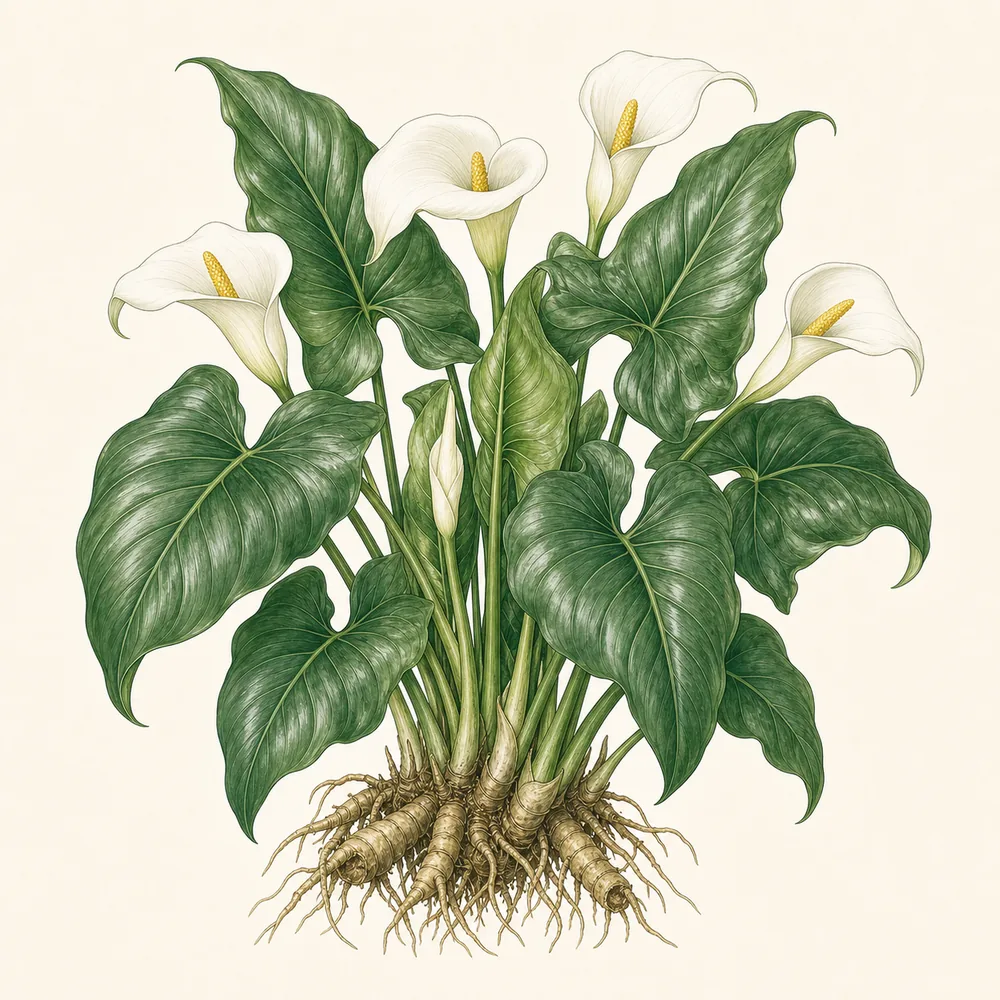
Arum Lily
A striking pond-margin plant with glossy arrow-shaped leaves and pure white flared spathes through summer. Give it permanently wet feet at the water's edge and it's genuinely easy — the only real job is getting it through a hard winter in cold gardens.
Toxic if chewed (oxalate crystals)
Arum or calla lily (Zantedeschia) is listed as toxic to cats, dogs and horses on the ASPCA database. The leaves and stems are packed with insoluble calcium oxalate crystals that cause intense mouth burning, drooling and swelling if chewed. Unpleasant rather than usually life-threatening, but distressing.
Care at a glance
Everything that matters, in six lines. The detail is further down.
Light
Flowers best in full sun but tolerates light shade; give it an open, bright spot at the pond edge for the most spathes.
Water
It wants permanently moist soil or to stand in up to 15–30 cm of water at the margin. Never let the roots dry out.
Temperature
Fine in mild and coastal gardens; in cold areas it needs winter protection or the crown can be killed by hard frost.
Planting
Plant in a mesh aquatic basket of heavy loam topped with gravel, then stand it in the shallows or sink it in the boggy margin.
Feeding
A pellet or two of aquatic plant feed pushed into the basket in spring keeps flowers coming; avoid loose feeds that foul the water.
Soil
Grows in heavy, moisture-retentive loam or clay at a pond edge or in a bog bed; not for dry borders that bake in summer.
What to do, and when
Plant new clumps or divide congested ones as growth restarts. Push a pellet of aquatic feed into the basket, and in cold gardens lift plants back up to the shallows once hard frosts have passed.
The white spathes open from late spring right through summer. Keep the roots wet at all times and snap off spent flowers to keep it looking tidy and encourage more.
Flowering tails off as the light drops. Let the foliage die back naturally, but clear collapsed leaves out of the pond before they rot down and foul the water.
In mild areas it can stay put in the margins. In cold gardens move the basket to deeper water below the ice line, or mulch a bog-grown crown thickly to shield it from penetrating frost.
A pond-edge plant, not a border one
The single thing that makes or breaks an arum lily is water. This is a marginal — it evolved in wet ground and wants its roots permanently soaked, either in boggy soil or standing in a few centimetres of pond water. Planted in an ordinary border it will sulk and scorch the moment summer turns dry.
Give it that wet edge and it more or less looks after itself, throwing up those clean white spathes for months on end above bold, arrow-shaped leaves.
Planting it in a basket
The tidy way to grow marginals is in a mesh aquatic basket. Line it with hessian if the mesh is coarse, fill with heavy garden loam or aquatic compost — never light multipurpose, which floats away — and firm the crown in so the growing point sits at the surface.
Top the basket with a layer of gravel to stop fish stirring up the soil, then lower it into the shallows so the rim sits just below the water. Growing it this way also makes it far easier to lift for dividing or winter protection.
Getting it through a cold winter
Zantedeschia aethiopica is only borderline hardy in the UK. In mild, coastal and city gardens it usually sails through where it's grown as a permanent marginal — the surrounding water buffers the roots against the worst frost.
In colder inland gardens, play safe. Sink the basket into deeper water so the crown sits below the ice line, or lift it into a frost-free shed for the winter and stand it back out in spring. A bog-grown plant benefits from a thick mulch over the crown.
Common problems
Plenty of leaves but no flowers
Usually too much shade, or a young plant still settling in. Move it to a sunnier margin and be patient — established clumps in good light flower freely.
Crown killed over winter
Hard frost reaching the growing point in a cold garden. Sink the basket below the ice line, mulch bog-grown crowns thickly, or overwinter the basket in a frost-free shed.
Foliage collapses in summer
Almost always drought — the roots have dried out. Keep the plant standing in water or reliably boggy soil; this is not a plant that forgives dry spells.
Skin irritation when handling
The sap and tissue carry calcium oxalate crystals that can irritate skin and are toxic to pets if chewed. Wear gloves when dividing, and site it where grazing cats, dogs or horses can't reach the leaves.
Everything an arum lily needs
Wet feet at the pond edge, a basket to grow it in, and winter protection in cold gardens.
We take no commission on anything in the "save your money" tier — if we don't think you should buy it, we don't link it. How our recommendations work
If you like this, try
Other plants with a similar temperament.
How we checked this
Care cross-checked against the RHS. Toxicity taken from the ASPCA database, which lists Calla/Arum Lily (Zantedeschia) as toxic — insoluble calcium oxalates. If our page and these sources ever disagree, believe them — and tell us.
Sources: RHS · ASPCA — toxic & non-toxic plants
Last reviewed · August 2026