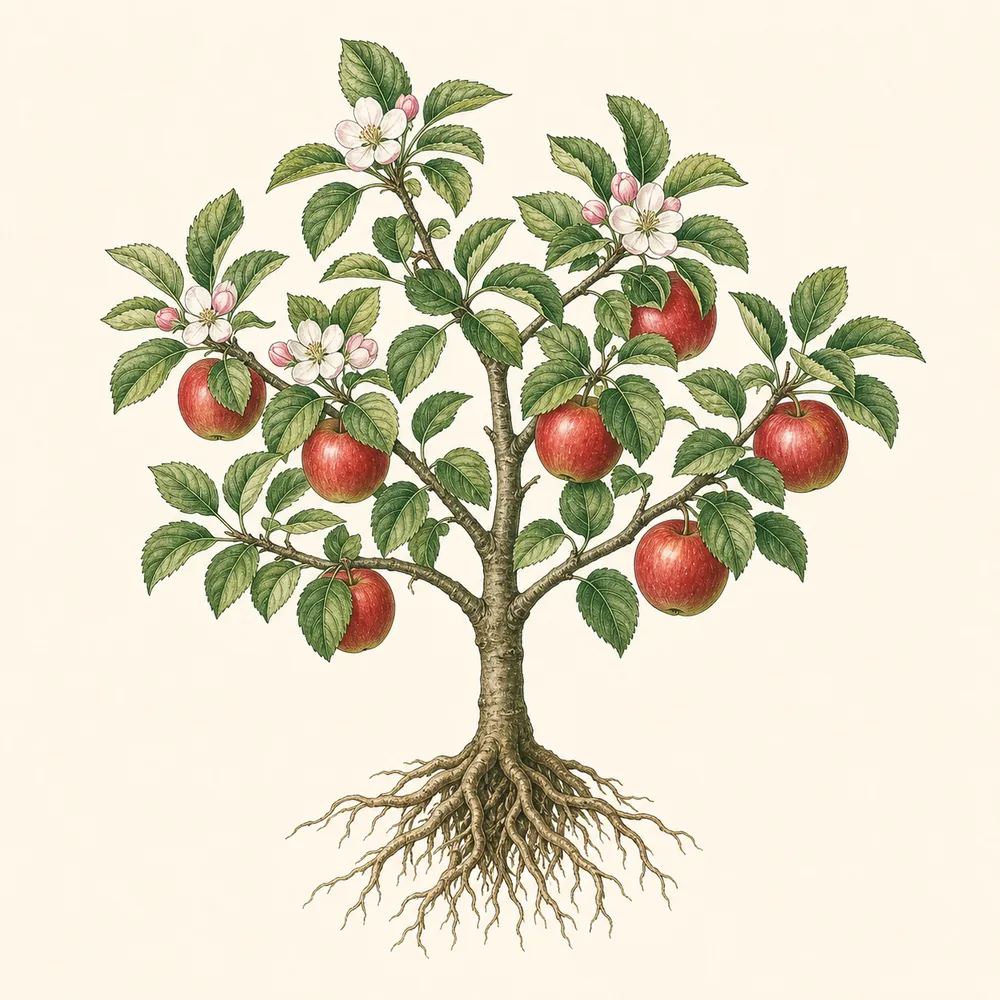
Apple
The quintessential British fruit tree, and more achievable than people think — modern rootstocks give trees small enough for a patio pot or a courtyard, cropping within a few years. Choose the right rootstock and a pollination partner, and an apple tree feeds you (and the birds, and the bees) for a lifetime.
The fruit is fine — the pips, leaves and bark aren't
The apple you eat is perfectly safe, but the rest of the tree isn't. The ASPCA lists apple (Malus) as toxic to cats, dogs and horses because the stems, leaves and seeds contain cyanogenic glycosides — most dangerous when the foliage is wilting, which is a real risk to horses and livestock near hedgerow or prunings. For pets the flesh is a fine treat; the concern is a dog crunching lots of seeds, or animals getting at wilted prunings. Bin or compost prunings out of reach, and don't let horses browse wilting apple leaves. Source: ASPCA.
Care at a glance
Everything that matters, in six lines. The detail is further down.
Position
Sun ripens the fruit and keeps disease down; shelter helps the pollinating insects do their work in spring.
Soil
Most decent soils suit apples. They dislike waterlogging and very thin, dry chalk.
Water
Keep newly planted and container trees well watered for the first years and through droughts; mature trees cope alone.
Feeding
A mulch of compost and a general feed in spring. Pot-grown trees need feeding more regularly through the season.
Pruning
Prune most apples while dormant (winter) to shape and open the canopy. Bag or compost prunings away from grazing animals.
Hardiness
Completely hardy, and needing winter cold to fruit. Late frosts can damage the blossom — shelter helps.
What to do, and when
Blossom time — protect early flowers from hard frost and hope for pollinating weather. Mulch and feed; water young and potted trees.
Fruit swells. Thin heavy clusters in early summer for bigger, better apples ('June drop' does some of this for you). Keep watered.
Harvest — pick when a gently lifted apple parts easily from the branch. Early varieties eat now; late keepers store for months.
The pruning and planting season: shape dormant trees, and plant new bare-root trees now for the best establishment and value.
Rootstock and pollination — the two decisions that matter
The secret to a manageable apple tree isn't the variety on the label, it's the rootstock it's grafted onto, which controls the eventual size. A tree on a dwarfing rootstock (look for M27, M9 or M26) stays small enough for a large pot or a tiny garden and fruits young; the same variety on a vigorous rootstock becomes a full orchard tree. Always check the rootstock before buying, and match it to your space.
The second essential is pollination. Most apples need a compatible second variety flowering nearby to set a good crop — a neighbour's tree or a crabapple often does the job in a town, but in an isolated garden you may need two trees, or a self-fertile 'family' tree with several varieties grafted on one trunk. Get rootstock and pollination right and everything else is straightforward.
Eat the apple, respect the tree
It's worth being clear, because it surprises people: the fruit is completely safe — for you and, in moderation, as a treat for a dog — but the woody parts of the tree are not. The leaves, bark and pips carry cyanogenic compounds, and they become more available as foliage wilts, which is why wilting apple prunings are a genuine hazard to horses and livestock in particular.
In an ordinary garden the precautions are small: don't leave heaps of prunings where animals graze, don't let a dog make a habit of crunching cores full of seeds, and keep horses off wilting hedgerow trimmings. None of that is a reason to hesitate — it's simply the same honest principle the whole site runs on: which part, and to whom.
Common problems
Blossom but no fruit
Usually no pollination partner in range, or frost caught the blossom. Plant a compatible variety or crabapple nearby.
Scabby, spotted fruit and leaves
Apple scab, worse in wet springs. Choose resistant varieties, rake up fallen leaves, and prune for airflow.
Maggoty apples
Codling moth. Hang pheromone traps in late spring to cut the damage; it rarely ruins the whole crop.
Tree too big / too vigorous
Wrong rootstock for the space. Summer-prune to curb vigour; next time choose a dwarfing rootstock.
Everything an apple tree needs
Choose well once and the tree does the rest for decades.
We take no commission on anything in the "save your money" tier — if we don't think you should buy it, we don't link it. How our recommendations work
If you like this, try
Other plants with a similar temperament.
From the Notebook
Seasonal notes and guides that mention the apple.
How we checked this
Care guidance cross-checked against the Royal Horticultural Society and NC State Extension. Toxicity confirmed against the ASPCA database, which lists apple (Malus) as toxic to cats, dogs and horses via cyanogenic glycosides in the stems, leaves and seeds — the risk greatest as foliage wilts; the ripe fruit flesh is safe. If our page and the ASPCA ever disagree, believe them and tell us. If our page and these sources ever disagree, believe them — and tell us.
Sources: RHS · NC State Extension · ASPCA
Last reviewed · July 2026