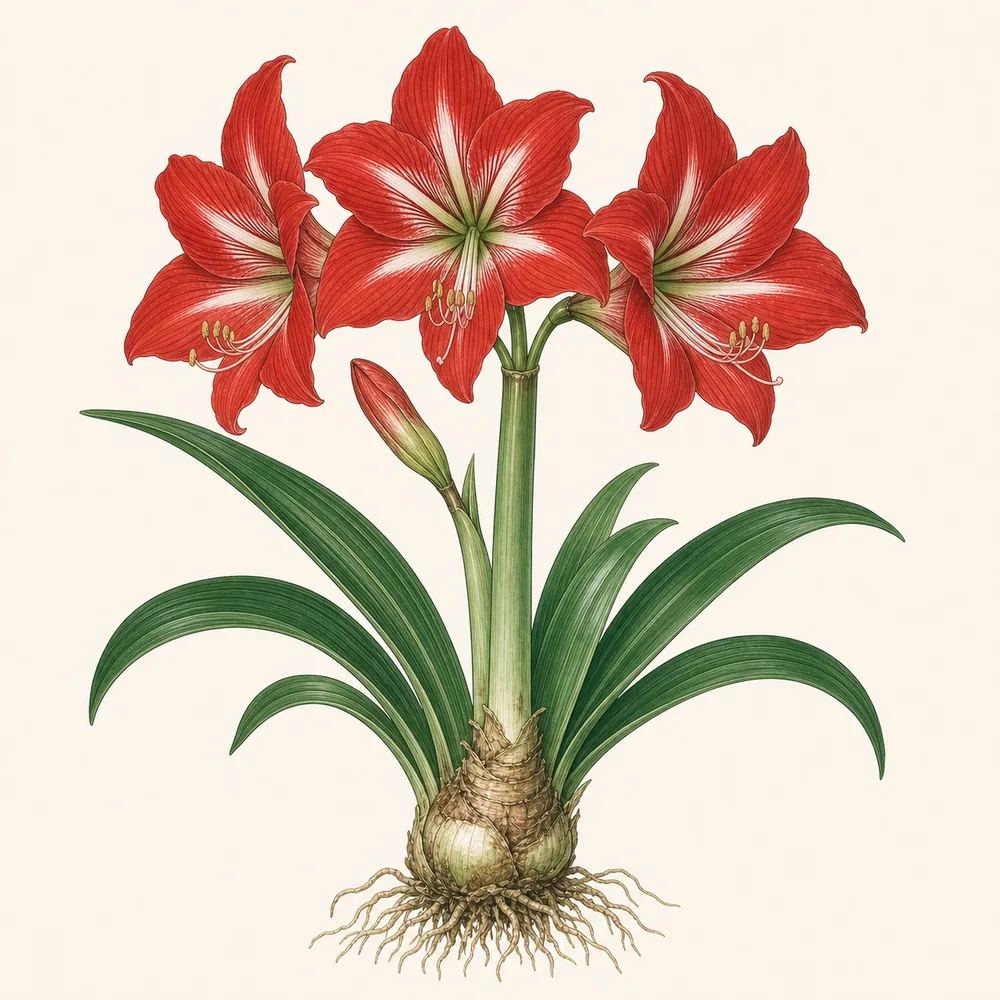
Amaryllis
The great Christmas bulb: a fat bulb on a windowsill that throws up a thick stem and enormous trumpet flowers in the depths of winter, when you need them most. Genuinely easy to flower once — and toxic enough that curious pets and the bulb both need watching.
Toxic to cats, dogs and horses
The bulb, leaves and flowers contain lycorine and related alkaloids, with the bulb the most concentrated. The ASPCA lists vomiting, drooling, diarrhoea, abdominal pain, loss of appetite and tremors — unpleasant and worth a vet call, especially if a pet has gnawed the bulb, though rarely life-threatening. Keep the planted bulb and any spares out of reach of cats and dogs. Source: ASPCA.
Care at a glance
Everything that matters, in six lines. The detail is further down.
Light
A bright windowsill. Turn the pot every few days or the tall stem leans hard towards the light.
Water
Water lightly after potting, then more freely once the stem is growing. Never let it stand waterlogged.
Temperature
Warmth kicks it into growth. Once in flower, cooler rooms make the blooms last longer.
Compost
Pot with the top third of the bulb above the compost, in a pot only slightly wider than the bulb.
Feeding
Feed fortnightly once flowering ends and leaves grow — that's what builds next year's flower.
Rebloom
To flower again it needs a summer growing on, then a dry, dark dormancy in autumn. See below.
What to do, and when
Post-Christmas bulbs are growing leaves now. Feed fortnightly and give good light — the leaves are refuelling the bulb for next winter.
Keep it in leaf, fed and watered, in a bright spot or stood outside in a sheltered place. This is the year's real work.
The rest: stop watering, let the leaves die back, and keep the dry bulb cool and dark for 8–10 weeks to trigger the next flower.
Restart a rested bulb (or a new one) — repot, water, warmth — for flowers roughly 6–8 weeks later. The classic Christmas show.
Why it flowers so easily the first time
A boxed amaryllis is sold to you with next to no effort required, because the flower is already fully formed inside the bulb — all that stored energy needs is warmth and a little water to unfurl. Pot it up with the top third of the bulb proud of the compost, water sparingly until the stem appears, then more freely, turning the pot so it grows straight. Six to eight weeks later, the show arrives.
That's why the first flowering is nearly foolproof and the reason cheap bulbs are worth it: you're buying a battery that's already charged.
Getting a second year (the bit people miss)
Reblooming is where amaryllis defeats people, because it needs something counter-intuitive: a proper rest. After flowering, cut off the spent stem (not the leaves), then grow the plant on all spring and summer — fed, watered, in good light — so the leaves recharge the bulb.
Then, in early autumn, force it to sleep: stop watering, let the leaves yellow and die, and keep the bare bulb somewhere cool and dark for eight to ten weeks. Bring it back into warmth and water after that and it flowers again. Skip the dormancy and you get leaves but no flower — the single commonest reason a saved amaryllis disappoints.
Common problems
Leaves but no flower next year
It didn't get its autumn rest. Give the bulb 8–10 weeks cool, dark and dry before restarting.
Stem flopping over
Growing towards the light, and top-heavy in flower. Turn the pot regularly and stake the tall stem.
Bulb soft or mouldy
Overwatering, especially before the roots are active. Water sparingly at the start; ensure the pot drains.
Red streaks on stem and leaves
Red blotch (a fungal disease). Remove badly affected parts; keep water off the bulb's neck and improve airflow.
Everything an amaryllis needs
For one winter's flowers, barely anything. To rebloom, mostly patience.
We take no commission on anything in the "save your money" tier — if we don't think you should buy it, we don't link it. How our recommendations work
If you like this, try
Other plants with a similar temperament.
From the Notebook
Seasonal notes and guides that mention the amaryllis.
How we checked this
Care guidance cross-checked against the Royal Horticultural Society and NC State Extension. Toxicity confirmed against the ASPCA database (Amaryllis spp. — lycorine and others; vomiting, depression, diarrhoea, abdominal pain, hypersalivation, anorexia, tremors). Note: the Christmas 'amaryllis' sold in boxes is botanically Hippeastrum; the ASPCA entry covers this group. If our page and the ASPCA ever disagree, believe them and tell us. If our page and these sources ever disagree, believe them — and tell us.
Sources: RHS · NC State Extension · ASPCA
Last reviewed · July 2026