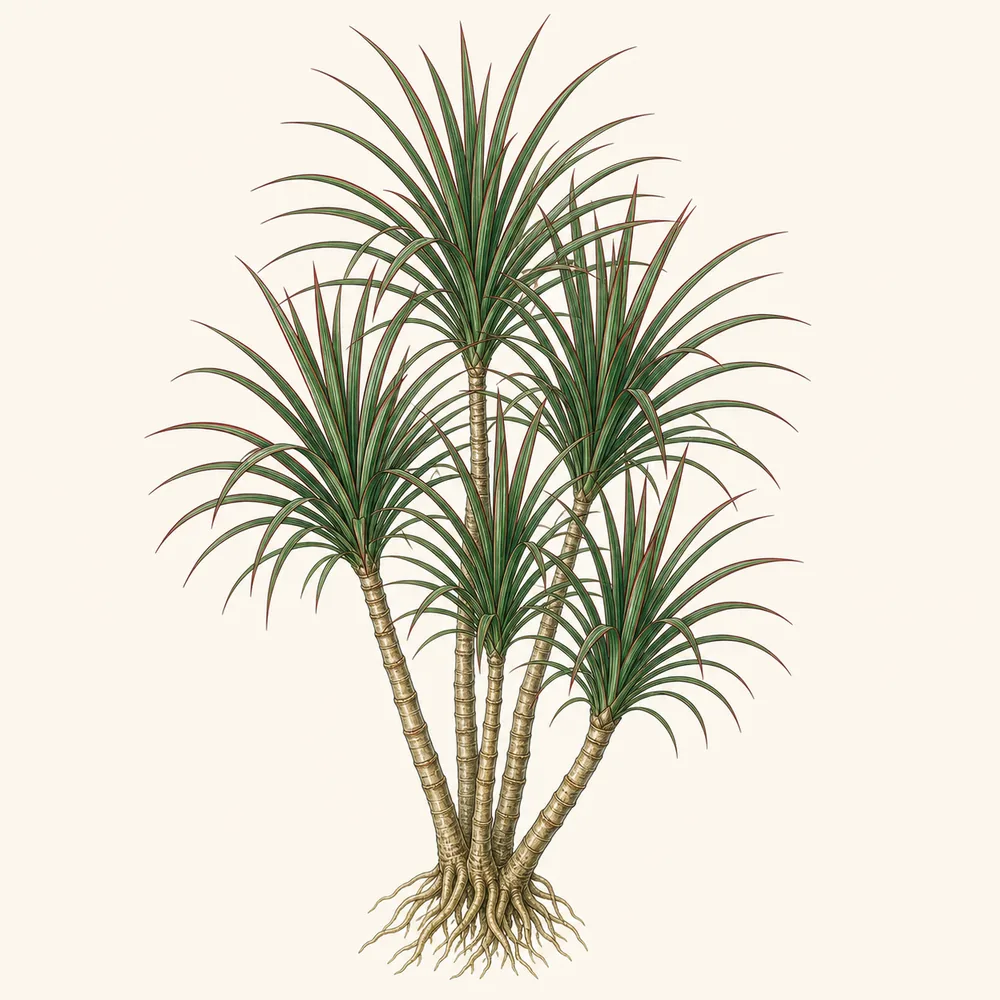
Dragon Tree
Spiky fountains of red-edged leaves on sculptural cane stems — the houseplant that looks architectural and lives on neglect. It tolerates low light, forgets to be watered gracefully, and grows character (bends, branches) as it ages.
Toxic to cats & dogs if chewed
Like its cousin the snake plant, Dracaena marginata contains saponins. The ASPCA lists vomiting (sometimes with blood), depression, loss of appetite and drooling — and dilated pupils in cats. Rarely serious, but the grassy leaf tips are exactly what bored cats chew, so give it height or give it a miss. Source: ASPCA.
Care at a glance
Everything that matters, in six lines. The detail is further down.
Light
Happiest in bright indirect light; tolerates gloomy corners with slower, thinner growth. No hot direct sun.
Water
Every 10–14 days in summer, monthly-ish in winter. It forgives forgetting far better than fussing.
Temperature
Normal rooms suit it. Keep it off freezing windowsills behind curtains in winter.
Humidity
Dry household air is fine; brown tips owe more to water quality than humidity.
Feeding
A weak feed monthly through summer is plenty. None in winter.
Soil
Standard houseplant mix with perlite. Repot every 2–3 years at most.
What to do, and when
Growth restarts. Resume normal watering, give the first weak feed, and prune any leggy cane — it re-sprouts below the cut.
Steady watering as the top half dries, an occasional weak feed, and wipe or shower the leaves clean.
Slow everything down with the light. Last feed in September.
Water monthly at most, keep above 12°C, and ignore it — winter fussing is how dragon trees die.
Brown tips and fluoride: the dragon tree's one grievance
Dracaenas are famously sensitive to fluoride and the salts in softened tap water — the classic result is dry brown leaf tips on an otherwise healthy plant. Before blaming humidity or yourself, switch to rainwater or filtered water for a few months and let the new growth vote.
Trim existing brown tips to a point with scissors, staying just inside the dead tissue. The old leaves won't heal — dracaenas shed their lowest leaves continually anyway, leaving the snakeskin-patterned cane that gives the plant its look.
Pruning for shape (yes, you're allowed)
A dragon tree that's hit the ceiling, or grown lopsided towards the window, takes hard pruning better than almost any houseplant: cut the cane cleanly at whatever height you like and it sprouts one to three new heads just below the cut, turning a lanky pole into a branched tree.
The removed top is a free plant — let the cut end dry for a day, then stand it in water or push it into gritty compost. Spring is the kind season for both operations.
Common problems
Brown leaf tips
Fluoridated or softened tap water, or long droughts. Try rainwater; trim tips to a point.
Yellow, drooping lower leaves
A few at the bottom is normal shedding. Many at once, with damp compost — that's overwatering.
Leggy, bare stems
Low light stretches it, and age bares the cane naturally. Prune in spring to force bushier regrowth.
Sticky leaves, brown bumps
Scale insects. Wipe stems and leaf bases with a damp cloth weekly until clear.
Everything a dragon tree needs
Very little — that's rather the point.
We take no commission on anything in the "save your money" tier — if we don't think you should buy it, we don't link it. How our recommendations work
If you like this, try
Other plants with a similar temperament.
How we checked this
Care guidance cross-checked against the Royal Horticultural Society and NC State Extension. Toxicity confirmed against the ASPCA database entry for the Madagascar dragon tree (saponins — vomiting sometimes with blood, depression, anorexia, hypersalivation, dilated pupils in cats). If our page and these sources ever disagree, believe them — and tell us.
Sources: RHS · NC State Extension · ASPCA
Last reviewed · July 2026