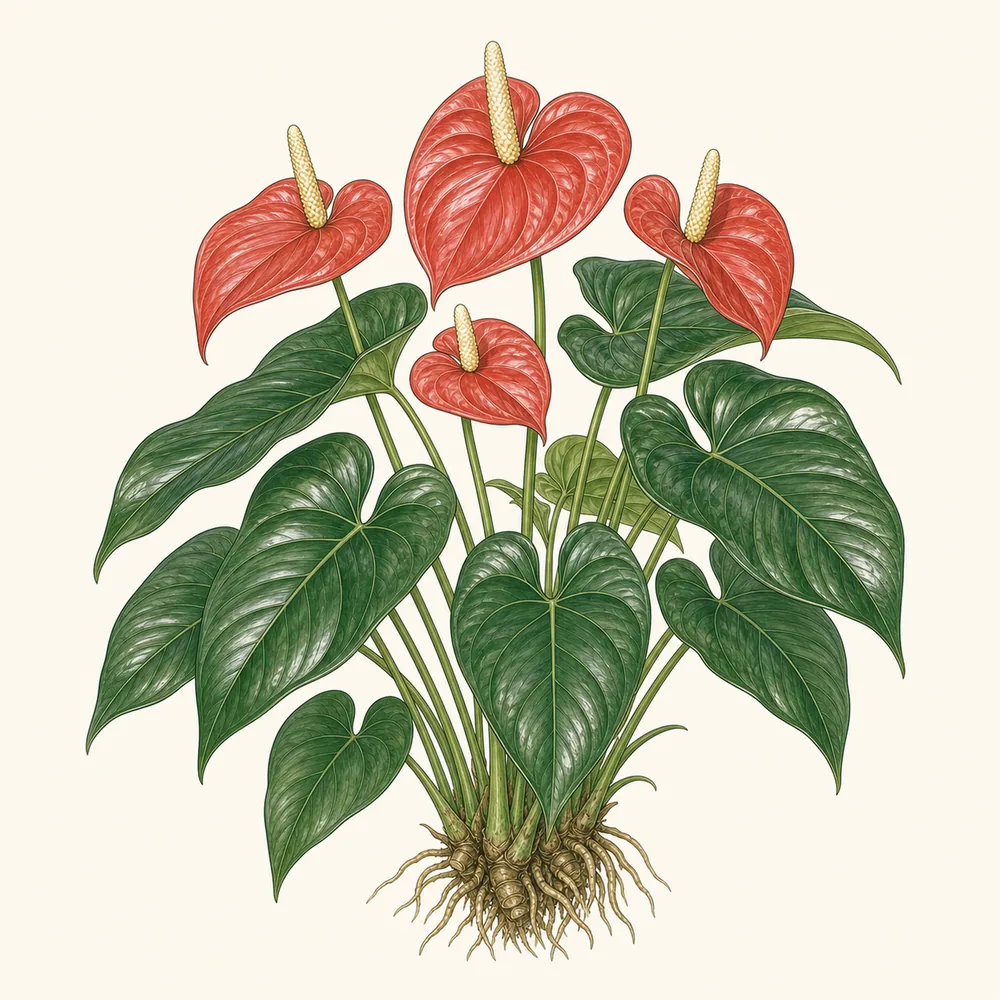
Anthurium
Those glossy, heart-shaped red “flowers” that seem almost too shiny to be real — and it can bloom nearly all year in a warm, bright room. Like the peace lily, the colourful part is a spathe, not a petal.
Mildly toxic to cats, dogs & horses if chewed
An aroid — leaves and spathes contain insoluble calcium oxalate crystals, so chewing causes mouth irritation, drooling and sometimes vomiting. Mild and self-limiting, but keep those tempting red spathes away from pets that nibble. Source: ASPCA.
Care at a glance
Everything that matters, in six lines. The detail is further down.
Light
Plenty of bright indirect light drives flowering. No harsh direct sun.
Water
Moderate and even; let the surface dry between drinks. Don’t leave it standing wet.
Temperature
Warmth-loving; keep it above 15 °C and away from cold draughts.
Humidity
A humid spot keeps it flowering and the leaves glossy; dry air browns the tips.
Feeding
A weak feed (higher in phosphorus) every few weeks spring to summer for continuous flowers.
Soil
Bark and perlite — the roots are semi-epiphytic and want air.
What to do, and when
Flowering picks up. Repot into fresh chunky mix if congested and resume feeding.
Peak flowering. Keep it bright, warm, humid and fed for a steady succession of spathes.
Ease off feed as growth slows; keep humidity up as heating returns.
Slower, but often still flowering in a warm room. Water less; avoid cold draughts.
The “flower” is a leaf
Like its cousin the peace lily, an anthurium’s showy red part is a spathe — a modified, waxy leaf — wrapped around the true flowers, which are the little bumps on the central spike (the spadix). That’s why it lasts for weeks and looks almost artificial.
The upside for us: give it the right conditions and it produces spathe after spathe, often for much of the year.
Warmth, humidity and an airy mix
Anthuriums are warm-tropical plants with semi-epiphytic roots, so they want three things: steady warmth (above 15 °C, no cold draughts), decent humidity, and a chunky, airy compost rather than dense soil — a houseplant or orchid mix loosened with bark and perlite is ideal.
Get those right, water when the top dries, and feed regularly, and continuous flowering becomes the norm rather than a fluke.
Common problems
No flowers
Too little light or feed. Move it brighter and feed through the growing season.
Brown leaf tips
Dry air or tap-water salts. Raise humidity; try rainwater.
Yellowing leaves
Usually overwatering or a dense, wet mix. Ease off; use an airy compost.
Faded or scorched leaves
Too much direct sun. Move to bright, indirect light.
Everything an anthurium needs
Warmth, humidity and an airy mix keep it in flower.
We take no commission on anything in the "save your money" tier — if we don't think you should buy it, we don't link it. How our recommendations work
If you like this, try
Other plants with a similar temperament.
How we checked this
Care cross-checked against the RHS and NC State Extension. Toxicity confirmed against the ASPCA flamingo flower (Anthurium) entry — insoluble calcium oxalates; oral irritation, drooling, vomiting (mild). If our page and these sources ever disagree, believe them — and tell us.
Sources: RHS · NC State Extension · ASPCA — Anthurium
Last reviewed · July 2026