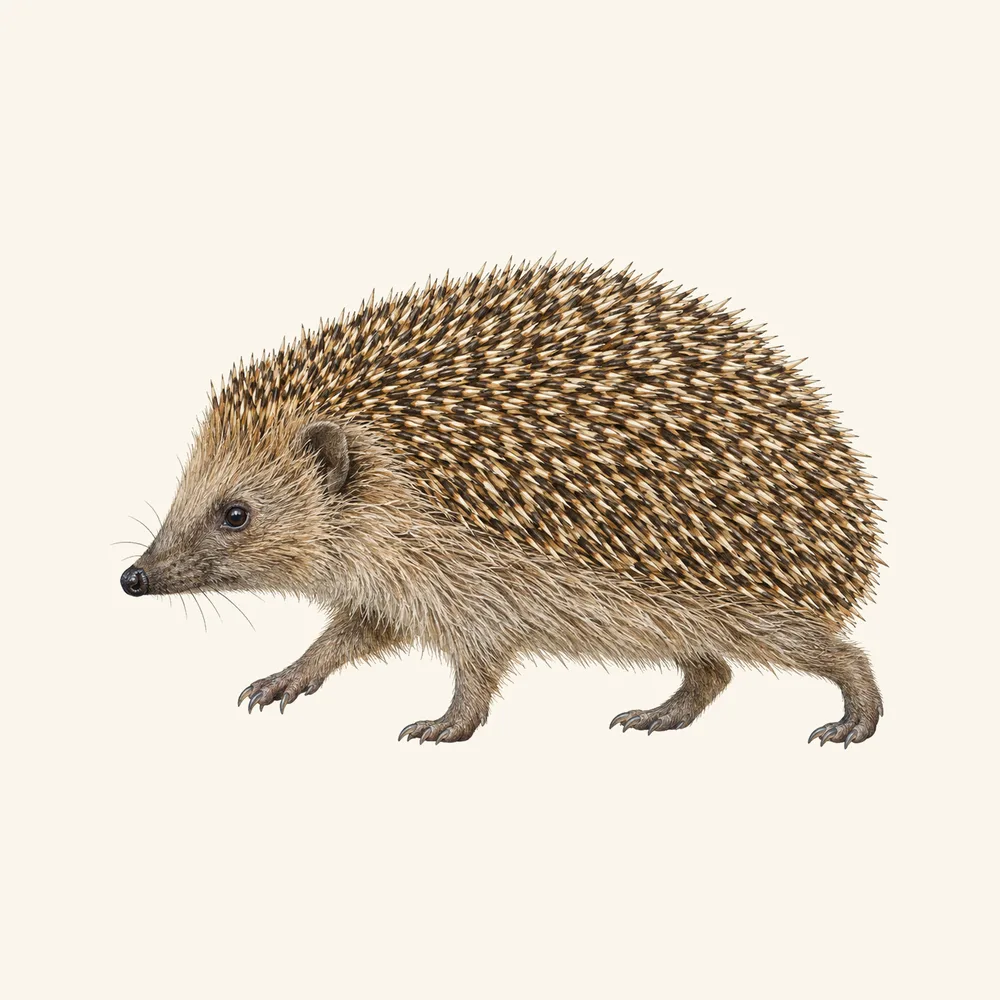
Hedgehog
Erinaceus europaeus
Vulnerable on the GB Red List. A 13cm hole in your fence does more for it than anything you can buy.
Occasional visitor
Still widespread in UK gardens but far scarcer than a generation ago. PTES estimates a GB population of around 879,000 and states that roughly a third of the national population has been lost since the millennium, with rural declines of 30-75% since 2000 and tentative signs of recovery in urban and suburban areas.
At risk
Assessed as at risk of extinction in Great Britain.
The IUCN Red List for Great Britain records this species as “IUCN Red List (GB): Vulnerable”, with a UK population trend of around a third of the national population lost since the millennium. The Vulnerable classification comes from the Red List for British Mammals published by the Mammal Society in July 2020 and is quoted by PTES on its hedgehog facts page; Hedgehog Street reports rural declines of between 30% and 75% since 2000 alongside signs of recovery in urban and suburban areas, so the national figure hides two very different stories. Source.
- Wildlife and Countryside Act 1981, Schedule 6 (with section 11) — Method-based protection, not full protection. Section 11(2) makes it an offence to use against a Schedule 6 animal "any trap ... for the purpose of killing or taking or restraining", or "any electrical device for killing or stunning" or "any poisonous, poisoned or stupefying substance", along with nets, certain firearms, artificial lights, gas and pursuit by vehicle. Hedgehog Street summarises the listing as making it "illegal to kill or capture wild hedgehogs", but the offence in the Act attaches to the listed methods rather than to killing by any means at all. law
- Wild Mammals (Protection) Act 1996, section 1 — "If, save as permitted by this Act, any person mutilates, kicks, beats, nails or otherwise impales, stabs, burns, stones, crushes, drowns, drags or asphyxiates any wild mammal with intent to inflict unnecessary suffering he shall be guilty of an offence." law
- Natural Environment and Rural Communities Act 2006, section 41 — The hedgehog is a species of principal importance for the conservation of biodiversity in England. Hedgehog Street describes this as conferring "a 'duty of responsibility' to public bodies" — it is a duty on public authorities, not an obligation on a private gardener. law
At a glance
-
Size
Far bigger than a robin — a well-grown adult is roughly the size and weight of a small guinea pig, and needs to reach about 450g before hibernation.
-
Active when
Strictly nocturnal. A hedgehog out and about in daylight is a sign of distress, not a treat.
-
What it eats
Ground-dwelling invertebrates — worms, beetles, slugs, caterpillars, millipedes and earwigs — plus carrion, eggs and fallen fruit.
-
Where it shelters
Day nests under hedge bottoms, log piles, sheds and dense cover; a separate leaf-built hibernaculum for winter.
-
Breeding season
Mating from spring, with most litters of four or five hoglets born in June and July.
-
Status
IUCN Red List (GB): Vulnerable. Around a third of the national population lost since the millennium (PTES).
Not to be confused with
- Brown rat — Heard rather than seen, and the noise is genuinely similar — both rustle loudly through a border at night. The clincher is the silhouette against a light: a hedgehog is a low, rounded, tailless dome that stops dead when you look at it, while a rat is lean, long-tailed and moves off fast and low along a wall or fence line.
- Hoglet — A hoglet is simply a young hedgehog, not another species, and its spines are shorter, whiter and softer-looking. It matters because a very small hedgehog seen out in late autumn may be too light to survive hibernation — that is a call to a rescue, not a case for a different identification.
Through the year
Spring
Hedgehogs emerge from hibernation around March or April, thin and hungry, and mating begins. Put water out, check bonfire material and long grass before you touch it, and get your fence holes open now rather than in June.
Summer
Most litters arrive in June and July. Strimmers and hedge trimmers are the season's real danger — check long grass, nettle patches and hedge bottoms by hand before any blade goes in, and leave nesting cover alone entirely.
Autumn
The critical weight-gain period. Leave leaf litter where it falls, keep food and water going, and move any bonfire pile to fresh ground on the day you light it. A very small hedgehog out late in the year is a call to a rescue.
Winter
Hibernation usually runs from about November to March or April, depending on the weather, in a leaf-built nest under a hedge, shed or log pile. Leave those places undisturbed. Animals do wake and move about in mild spells, so keep water available.
The hole in the fence is the whole point
A hedgehog covers one to two kilometres a night across a home range of roughly ten to twenty hectares. No garden is a hedgehog's territory; it is one room in a much larger house. Modern close-board fencing on concrete gravel boards turns a street of connected gardens into a row of sealed boxes, and that fragmentation is the single change a gardener can actually undo. Hedgehog Street's specification is precise and modest: "13cm by 13cm square is sufficient for any hedgehog to pass through." You can remove a brick from the bottom of a wall, cut a hole in a fence panel, or dig a channel under a wall, fence or gate. Be honest about the economics here — a jigsaw and ten minutes costs nothing, and the branded plastic highway plates sold to frame the gap are decorative. They make the hole look deliberate to a neighbour, which is not worthless, but they do not make it work better. Talk to the people either side first; one hole into a sealed garden is a dead end.
What to put out, and what the mealworm argument is actually about
Meaty wet cat or dog food, dry cat or kitten biscuits, or a proprietary hedgehog food with real meat content — with a shallow dish of fresh water beside it, which matters as much as the food in a dry spell. Never milk: hedgehogs are lactose intolerant. Skip bread, which Hedgehog Street calls "low in energy and fairly worthless to them". Mealworms deserve a straight answer rather than the confident one you will read elsewhere. Wildlife rescues advise against them because mealworms are rich in phosphorus and poor in calcium, and rescue staff report seeing the results in hedgehogs that have been living on them; the major charities respond by recommending meat-based foods instead, framed positively rather than as a warning. What does not exist is a published study establishing the link. So the honest position is that this is clinical observation, taken seriously by people who see a great many hedgehogs — enough to keep mealworms to an occasional scattering, not enough to state a cause and effect as fact.
A hedgehog out in daylight is an emergency
Hedgehogs are strictly nocturnal. One out in the open during the day — wandering, sunbathing, lying still, or moving slowly and aimlessly — is a sign of distress, and it is urgent: ring the British Hedgehog Preservation Society on 01584 890801 or your nearest wildlife rescue for advice straight away.
The things that kill them in gardens
Most hedgehog casualties in a garden come from ordinary jobs done at speed. Strimmers and brushcutters cause appalling injuries because a hedgehog's response to a noise is to curl up and stay put rather than run, so it is still there when the blade arrives — check long grass, nettle patches and hedge bottoms by hand first, every time. Bonfire heaps are day nests by the afternoon you built them, so move the pile to fresh ground on the day you light it rather than checking it in situ. Football and sports netting, and loose pea netting left slack at ground level, tangle them badly; lift it out of season or keep it taut and clear of the soil. Ponds with sheer sides drown them, so a sloping edge, a partly submerged plank or a few stacked stones at one corner gives a way out. And slug pellets remove the invertebrates a hedgehog is there to eat in the first place. None of this is expensive. It is mostly a habit of looking before you cut, burn or clear.
Plant this for it
- hostaThe slugs and snails that go for hostas are exactly what a hedgehog hunts at night — which is the practical argument for accepting a bit of leaf damage rather than reaching for pellets that strip out the food supply.
- appleLeaf litter and windfalls under an apple tree hold the worms, beetles and millipedes that make up the bulk of a hedgehog's diet, and the fallen fruit itself is taken.
Guides
- Foxes in the garden: what they're doing, what deters them, and what the law allows
- Hedgehog houses: do they work, and where to put one
- Hedgehog out in the day: when to worry and who to call
- Leave the leaves: what to tidy in autumn and what to leave for wildlife
- Trail cameras: seeing what visits your garden at night
- What to feed hedgehogs (and what never to)
- When do hedgehogs hibernate, and what to do in your garden now
How we checked this
- PTES: Hedgehog — facts and figures
- PTES: European Hedgehog species information sheet
- Hedgehog Street: Link your garden
- Hedgehog Street: Feeding hedgehogs
- Hedgehog Street: What do wild hedgehogs eat?
- Hedgehog Street: Legal protection for hedgehogs
- Hedgehog Street: UK hedgehogs 'vulnerable to extinction'
- British Hedgehog Preservation Society
- Wildlife and Countryside Act 1981, section 11
- Wild Mammals (Protection) Act 1996, section 1
Checked against the sources above. Reviewed on 2026-09-20. Legal position checked 2026-09-20.