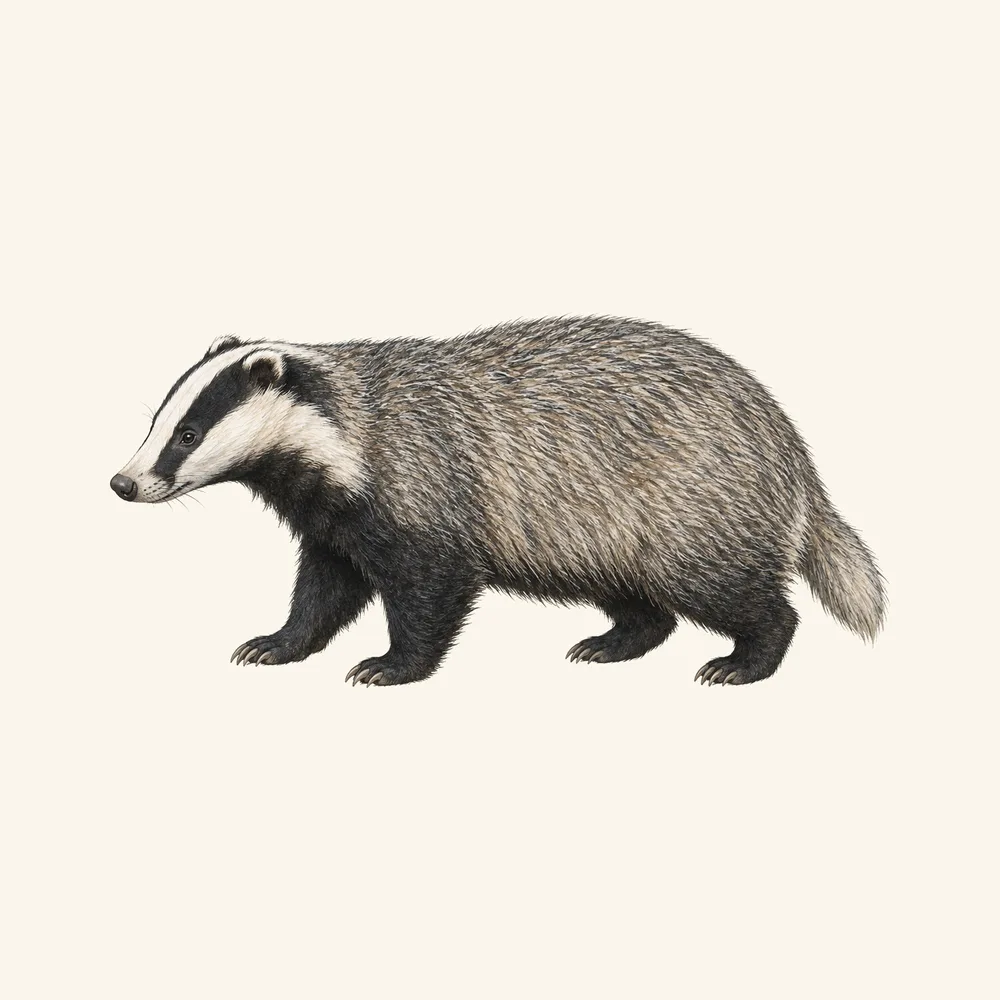
Badger
Meles meles
Britain's largest land predator, and a regular garden visitor. Its sett has stronger legal protection than the animal itself.
Occasional visitor
Widespread across most of the UK and a genuine garden visitor where setts are nearby, especially on the edges of towns and villages. The Wildlife Trusts list gardens among its habitats alongside grassland, woodland, farmland and heathland.
Not assessed
No conservation assessment exists for this species. That is not the same as being fine.
No assessment scheme records this species as “No Great Britain Red List assessment verified for this species. Its strong statutory protection under the Protection of Badgers Act 1992 is a legal status, not a conservation assessment.”. Source.
- Protection of Badgers Act 1992, section 1 — "A person is guilty of an offence if, except as permitted by or under this Act, he wilfully kills, injures or takes a badger." The Act also restricts possession of a dead badger or any part of one. law
- Protection of Badgers Act 1992, section 3 — "A person is guilty of an offence if, except as permitted by or under this Act, he interferes with a badger sett by doing any of the following things — (a) damaging a badger sett or any part of it; (b) destroying a badger sett; (c) obstructing access to, or any entrance of, a badger sett; (d) causing a dog to enter a badger sett; or (e) disturbing a badger when it is occupying a badger sett, intending to do any of those things or being reckless as to whether his actions would have any of those consequences." Recklessness is enough — you do not have to have meant it. law
- Wild Mammals (Protection) Act 1996, section 1 — "If, save as permitted by this Act, any person mutilates, kicks, beats, nails or otherwise impales, stabs, burns, stones, crushes, drowns, drags or asphyxiates any wild mammal with intent to inflict unnecessary suffering he shall be guilty of an offence." law
At a glance
-
Size
The UK's largest land predator and far bigger than a robin: 75-100cm long with a 15cm tail, weighing 8-12kg.
-
Active when
Mainly nocturnal, emerging after dusk, though badgers will forage in daylight when food is short.
-
What it eats
Earthworms above all — several hundred in a night — plus small animals, birds' eggs, fruit and plant material.
-
Where it shelters
A communal underground sett dug by a family group, kept clean and marked by piles of discarded dry grass and leaf bedding.
-
Breeding season
Cubs are born in January or February and stay underground for their first weeks, emerging in spring.
-
Status
No verified Great Britain Red List assessment. Strongly protected in law by the Protection of Badgers Act 1992.
Not to be confused with
- Red fox — Both are dog-sized and nocturnal, and both dig lawns. Everything else separates them: a badger is low, broad and grey with a black-and-white striped face and a stumpy tail, while a fox is rangy, russet and carries a long bushy brush. The digging differs too — badger snuffle holes are small, neat cones scattered across turf; fox digging is scrappier and often a single hole with soil thrown back. Badger or Red fox?
- Badger sett vs fox earth — Worth knowing before you assume which animal is under the shed, because the legal consequences differ enormously. A sett has several large, D-shaped entrances at least 25cm across, huge spoil heaps, well-worn paths between them, and discarded dry grass and leaf bedding at the mouth. A fox earth is usually a single rounder hole, often smelly, with food remains scattered nearby and no bedding.
Through the year
Spring
Cubs emerge above ground from around April. Badgers are hungry after a lean winter and lawn snuffle holes peak. Do not carry out work near a sett — cubs are dependent and disturbance is an offence.
Summer
Foraging is easiest and family groups are active. Dry spells push badgers into gardens looking for water and soft ground to dig; a shallow dish of water is more welcome than food.
Autumn
Badgers feed heavily on fruit, nuts and worms to build fat. Windfalls will go overnight. Check hedge and fence lines before doing any clearance work.
Winter
Badgers do not hibernate but become much less active in hard weather. Cubs are born underground in January or February, so the sett is at its most sensitive exactly when the garden looks empty.
The sett is the legal line
Most people know it is illegal to harm a badger. Far fewer know that the sett is protected more broadly than the animal, and that is where gardeners get into trouble. Section 1 of the Protection of Badgers Act 1992 makes it an offence to wilfully kill, injure or take a badger. Section 3 goes further: it is an offence to damage or destroy a sett, to obstruct access to or any entrance of a sett, to cause a dog to enter one, or to disturb a badger occupying one — and, critically, the offence is committed by someone "intending to do any of those things or being reckless as to whether his actions would have any of those consequences". Recklessness is enough. Blocking a hole under a shed, running a digger over a bank, laying foundations or stacking hardcore over an entrance can all qualify. If you think there is a sett on or beside your property, stop and take advice from the statutory nature conservation body before any groundwork.
Reading the damage
Badger damage in a garden is distinctive and usually tells you exactly what happened. Shallow conical holes scattered across a lawn, each a few centimetres across, are snuffle holes: the badger is following earthworms, which come to the surface in mild damp weather, and the Wildlife Trusts note a badger can eat several hundred worms in a night. Turf rolled back in strips is a different problem and means chafer grubs or leatherjackets underneath — the badger is a symptom. Gaps punched under fences at the same spot every time mark a route that predates your fence; badgers follow fixed paths through a landscape and will simply keep using them. Windfall fruit disappearing overnight, sweetcorn flattened, and strawberries taken just before you were going to pick them are all badger signatures. So is a strong musky smell near a dug hole. None of it is malice and none of it is personal.
Living with one, practically
You have two workable options and one that is not worth attempting. The first is to accept the route: if badgers are crossing your garden, a gate or gap they can use causes far less damage than a fence they have to break, and it puts the wear in a place you choose. The second is to protect specific things rather than the whole garden — a fruit cage with a properly buried skirt, raised beds, netting pegged down hard. Electric fencing is used for this, though it needs setting up properly and is a commitment. What is not worth attempting is a general deterrent. Badgers are strong, heavy and determined; chemical repellents are largely useless and some of what gets recommended online risks an offence under the Wild Mammals (Protection) Act 1996. Removing an animal achieves nothing either, because the territory is not left vacant. Do not attempt to block, trap, move or deter a badger yourself — where there is a genuine conflict, the route is licensed advice from the statutory agency.
Plant this for it
Guides
How we checked this
- The Wildlife Trusts: Badger
- Protection of Badgers Act 1992, section 1
- Protection of Badgers Act 1992, section 3
- Wild Mammals (Protection) Act 1996, section 1
Checked against the sources above. Reviewed on 2026-09-20. Legal position checked 2026-09-20.