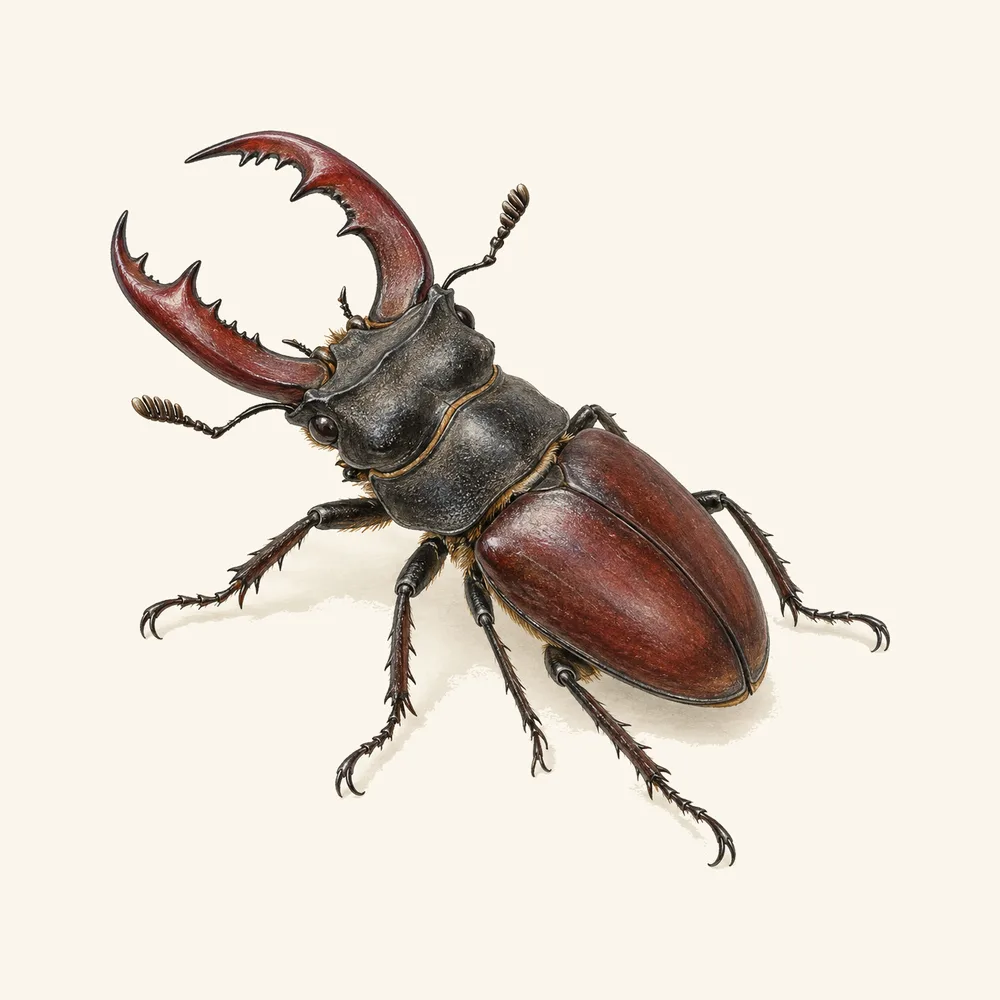
Stag beetle
Lucanus cervus
Britain's largest beetle. The male's antler jaws are unmistakable. Larvae spend years in buried dead wood, so a log pile is the answer.
Occasional visitor
Strongly regional. PTES records it in "woodland edges, hedgerows, traditional orchards, parks and gardens throughout Europe, including Britain, but not Ireland", concentrated in southern England. In the right part of the country a garden log pile can hold a population; elsewhere you will never see one.
Not assessed
No conservation assessment exists for this species. That is not the same as being fine.
No assessment scheme records this species as “No Great Britain Red List assessment verified. Buglife lists its conservation status as "Near Threatened" without stating the geographic scope of that assessment, and PTES describes it as "a Priority Species for Conservation". Neither is a verified GB Red List category, so we record it as not assessed rather than guess.”. Source.
- Wildlife and Countryside Act 1981, Schedule 5 (in respect of section 9(5) only) — Schedule 5 lists "Beetle, Stag" expressly "in respect of section 9(5) only". Section 9(5) makes it an offence if a person "sells, offers or exposes for sale, or has in his possession or transports for the purpose of sale, any live or dead wild animal included in Schedule 5, or any part of, or anything derived from, such an animal", or advertises doing so. In plain terms this is protection against trade in specimens. It is worth being precise here, because the species is often described online as simply "protected": the section 9(1) offence of intentionally killing, injuring or taking a Schedule 5 animal does not apply to the stag beetle. law
At a glance
-
Size
Males 4–8cm, females 3–5cm (PTES) — Britain's largest beetle, and unmistakable at that size.
-
Flying season
Adults emerge from mid-May, most have died by the end of August. Best seen on warm, sunny evenings in May and June.
-
What it needs
Decaying broadleaved wood in contact with soil — and a lid on the water butt, because they drown in them.
-
Where it nests
No nest. Larvae live underground in rotting wood for three to five years before pupating in a cocoon in the soil.
-
Look-alikes
Lesser stag beetle and cockchafer. Matt all-black body means lesser stag beetle, not stag beetle.
-
Status
No Great Britain Red List assessment verified. Schedule 5 protection against sale only; PTES calls it a priority species.
Not to be confused with
- Lesser stag beetle — Colour, and a matt finish. A stag beetle has a shiny black head and thorax with distinctly chestnut-brown wing cases; a lesser stag beetle is dull black all over, including the wing cases, with no brown at all. The lesser stag beetle is also smaller, and even the male has short jaws rather than antlers — so a black, antler-less, brown-free beetle about 3cm long is almost always a lesser stag beetle, and is the one most commonly reported as a female stag beetle.
- Female stag beetle — Worth separating from the male explicitly, because people assume a stag beetle must have antlers and misreport the female as something else. She is 3–5cm, with the same shiny black front end and chestnut wing cases, but short, thick jaws instead of antlers. Those jaws are the strong ones — the male's antlers are for wrestling other males, not for biting.
- Cockchafer — The antennae and the shape. A cockchafer has a fan of flattened plates at the end of each antenna, a pointed tail tip and a hairy, brownish body, and it blunders into lit windows in May. A stag beetle has elbowed antennae with a small comb at the tip, a smooth blunt rear end, and a glossy two-tone black-and-chestnut body.
Through the year
Spring
Larvae are still underground. Build or top up a log pile now, before the adults emerge from mid-May.
Summer
Adults fly from mid-May, peaking on warm evenings in May and June; most have died by the end of August. Keep the water butt lidded and do not disturb log piles.
Autumn
Larvae are feeding in buried dead wood. Leave stumps in the ground rather than grinding them out, and add broadleaved logs to the pile.
Winter
Everything is underground. Avoid digging over the ground around old stumps and log piles, and never lay plastic sheeting over them.
What the law actually says
The stag beetle is often described online as "protected", which is true but much narrower than it sounds. Schedule 5 of the Wildlife and Countryside Act 1981 lists "Beetle, Stag" expressly "in respect of section 9(5) only", and section 9(5) is the trade provision: it is an offence to sell, offer for sale, possess or transport for sale, or advertise, a live or dead specimen. The offence of intentionally killing, injuring or taking a Schedule 5 animal, in section 9(1), does not apply to it. PTES separately describes it as "a Priority Species for Conservation", which is a conservation designation directing public bodies' attention rather than a criminal prohibition on a gardener. So: you are not committing an offence by having one in your garden, and the real protection this species gets from you is habitat, not law.
Dead wood is the whole of it
A stag beetle spends three to five years underground as a larva, eating decaying broadleaved wood, and only a few weeks as the adult anyone ever sees. That ratio is the entire conservation story. PTES advises using "wood from any broadleaved tree" — not conifer — and logs "at least as thick as an adult's arm", partially buried "in the soil so that they don't dry out", sited "in partial shade if possible". Vertical logs buried around 50cm deep work well. Leave soil packed between them rather than stacking them like firewood, so larvae can move through. And leave tree stumps in the ground when a tree comes down instead of paying to have them ground out: a rotting stump is better stag beetle habitat than anything you can build. Do not take wood from woodland to do it, as that removes habitat elsewhere.
Cover the water butt
This is the smallest, cheapest and most overlooked action on this page. PTES states it directly: "keep a lid on your water butt as stag beetles are known to fall in and drown." Adult males fly heavily and clumsily at dusk, and an open butt is a trap they cannot climb out of. The same applies to buckets, watering cans left standing, uncovered rainwater tanks and steep-sided ponds — a pond wants a shallow, gently sloping edge or a plank ramp so anything that falls in can get out. PTES also warns against laying polythene sheeting or weed matting over ground where larvae are developing, because emerging adults cannot get through it, and against using chemicals around log piles. None of this costs anything, and in a garden that already has a log pile it is the difference between producing beetles and drowning them.
Seeing one, and what not to do
PTES gives the window precisely: "adults spend the winter underground and usually emerge from mid-May onwards. By the end of August, most of them will have died. You're most likely to see adults on warm, sunny evenings in May and June." So stand outside at dusk on a warm still evening in June and watch. A flying male is unmistakable — large, noisy, low, with the body hanging almost vertical under the wings. If you find one on a path or lawn, leave it alone; it is not lost, and adults are short-lived by design rather than by misfortune. If it is in genuine danger, on a road or a driveway, move it the shortest distance to nearby cover and leave it. Record the sighting with PTES, since garden records are how the species is monitored.
Plant this for it
Guides
How we checked this
- PTES: About stag beetles
- PTES: How to build a log pyramid for stag beetles
- Buglife: European Stag Beetle
- Wildlife and Countryside Act 1981, Schedule 5
- Wildlife and Countryside Act 1981, section 9
Checked against the sources above. Reviewed on 2026-09-20. Legal position checked 2026-09-20.