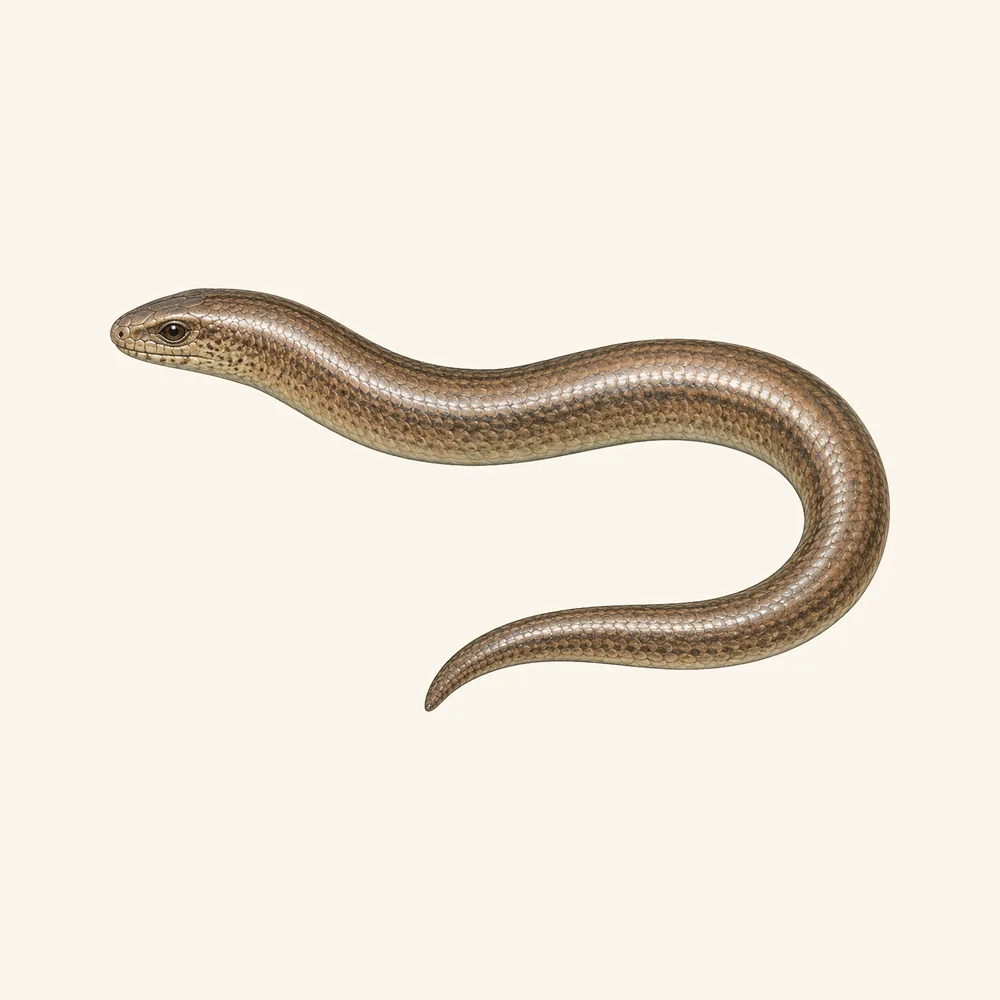
Slow-worm
Anguis fragilis
Not a snake. A legless lizard with eyelids that blink — and the most useful thing living in your compost heap.
Occasional visitor
Widespread in Britain and genuinely a garden animal, but easily missed because it spends most of its time under cover rather than basking in the open. Compost heaps and sheets of old corrugated iron are where people usually find them.
Not assessed
No conservation assessment exists for this species. That is not the same as being fine.
No assessment scheme records this species as “No Great Britain Red List assessment verified for this species. Froglife notes that the effectiveness of reptile protection is itself "awaiting assessment", which is not the same as a Red List category.”. Source.
- Wildlife and Countryside Act 1981, Schedule 5 (partial), with section 9 — The slow-worm is listed on Schedule 5 in respect of section 9(5), and was further listed by the Wildlife and Countryside Act 1981 (Variation of Schedules) Order 1988, which provides that the slow-worm, viviparous lizard and grass snake "are hereby further listed in respect of section 9(1) so far as it relates to killing and injuring". Section 9(1) provides that "if any person intentionally kills, injures or takes any wild animal included in Schedule 5, he shall be guilty of an offence" — for the slow-worm that offence bites on killing and injuring. Section 9(5) separately prohibits sale. Note that this protection is real and goes further than the common frog's or common toad's, both of which are listed for sale only. law
- Wildlife and Countryside Act 1981, section 9(5) — "If any person — (a) sells, offers or exposes for sale, or has in his possession or transports for the purpose of sale, any live or dead wild animal included in Schedule 5 ... he shall be guilty of an offence." law
At a glance
-
Size
Long but slender — up to about 50cm, so longer than a blackbird but no thicker than a pencil.
-
Active when
March to October, mostly hidden under cover during the day. Hibernates over winter underground or in a heap.
-
What it eats
Invertebrates, especially slugs and snails — Froglife lists "slugs, snails and other garden pests".
-
Where it shelters
Under stones, wood, sheets of metal and in compost heaps, preferring shaded cover to open basking spots.
-
Breeding season
Mating in April and May; females incubate eggs internally and give birth to live young, about 4cm long, in late summer.
-
Status
No verified GB Red List assessment. Protected under WCA 1981 Schedule 5 against intentional killing, injuring and sale.
Not to be confused with
- Grass snake — The clincher, and the whole point of this page: a slow-worm is a legless lizard, not a snake. It has eyelids and blinks — no snake can — and the head is blunt and rounded, barely wider than the neck, where a grass snake has a distinct head with a yellow-and-black collar behind it. A slow-worm's scales are smooth, shiny and uniform, giving it a polished, almost metallic look with no pattern; a grass snake is olive-green with dark bars down the flanks. Size settles any remaining doubt: a grass snake reaches well over a metre, a slow-worm barely half that and never thicker than a pencil.
- Adder — Causes real alarm and is almost never the right answer in a garden. An adder has a bold dark zigzag stripe down the whole length of its back and a vertical, cat-like pupil in a red eye; a slow-worm has no pattern at all and a round pupil with a blinking eyelid. Adders are thicker-bodied and found on heath, moor and open woodland rather than compost heaps.
- Earthworm — Not a joke — a juvenile slow-worm is about 4cm long, very slender and often taken for a large worm when a heap is turned. Look for the eyes and the flick of movement: a worm is soft, segmented and ringed, while even a newborn slow-worm has scales, a discernible head and a darting escape.
Through the year
Spring
Slow-worms emerge from hibernation around March and are most active in April and May, when mating takes place. Take particular care turning a compost heap now — this is peak season for accidentally injuring one.
Summer
Females carry developing young internally and give birth to live young around 4cm long in late summer, often inside a compost heap. Leave heaps unturned from midsummer if you can, and check by hand before any fork goes in.
Autumn
Feeding hard before hibernation, and still using warm cover on sunny days. Leave refuge material and log piles exactly where they are, and delay major clearance until spring.
Winter
Hibernating underground, in compost or under deep cover, usually from about October to March. The heap you turn in January may be full of them, so if you must turn one, do it gently and by hand.
It is a lizard, and here is how you know
The single most useful fact on this page is that the slow-worm is not a snake. It is a legless lizard, and three features prove it. It has eyelids and blinks — Froglife notes it has "a visible eyelid" and "can blink" — and no snake in the world can do that. Its head is blunt and rounded and barely wider than the neck, without the defined, wedge-shaped head of a snake. And its scales are smooth, shiny and completely uniform, giving a polished, almost metallic look with no pattern, no keel and no collar. Two more lizard traits confirm it: a flat forked tongue rather than a snake's deeply cleft one, and the ability to shed its tail if attacked, which leaves a blunt stump and is something no British snake does. That last trait is where the scientific name comes from — Anguis fragilis, the fragile snake. This matters in practice because the alternative identifications, grass snake and adder, are what make people panic, and panic is how slow-worms get killed.
The compost heap is the habitat
Slow-worms do not sunbathe in the open the way a common lizard does. Froglife's account is precise: they shelter "under stones, wood, sheets of metal, and in compost heaps", preferring shaded microhabitats to open basking spots. They warm up by pressing themselves against the underside of something the sun has heated, which is why a sheet of corrugated iron, a piece of old carpet or a flat board laid on rough grass is the standard way herpetologists survey for them — and the standard way to host them. A compost heap does the same job and better, because it generates its own warmth and is full of the slugs, snails and other invertebrates they eat. The practical advice follows directly. Site a heap where it gets sun. Lay a board or a sheet beside or on it. Then leave both alone — the cost of a slow-worm colony is not money but restraint, and the commonest way people destroy one is by turning a heap with a fork in spring or late summer, when young are being born inside it.
Protection, and what it means for a gardener
The slow-worm's legal position is stronger than most garden amphibians' and it is worth stating accurately, because a lot of published advice blurs it. The slow-worm is on Schedule 5 of the Wildlife and Countryside Act 1981, and the 1988 Variation of Schedules Order further listed it, together with the viviparous lizard and grass snake, "in respect of section 9(1) so far as it relates to killing and injuring". Section 9(1) makes it an offence to intentionally kill, injure or take a Schedule 5 animal; for the slow-worm, killing and injuring are covered. Section 9(5) separately makes it an offence to sell one. The common frog and common toad, by contrast, are on Schedule 5 in respect of section 9(5) only — sale. For a gardener this is about intent and care: a genuine accident is not the issue, but a fork driven into a heap you know holds slow-worms is a different matter. Check before you cut, turn, burn or clear.
Guides
How we checked this
- GOV.UK — Reptiles: protection, surveys and licences
- Froglife: Slow-worm
- Wildlife and Countryside Act 1981, section 9
- Wildlife and Countryside Act 1981, Schedule 5
- The Wildlife and Countryside Act 1981 (Variation of Schedules) Order 1988
Checked against the sources above. Reviewed on 2026-09-20. Legal position checked 2026-09-20.