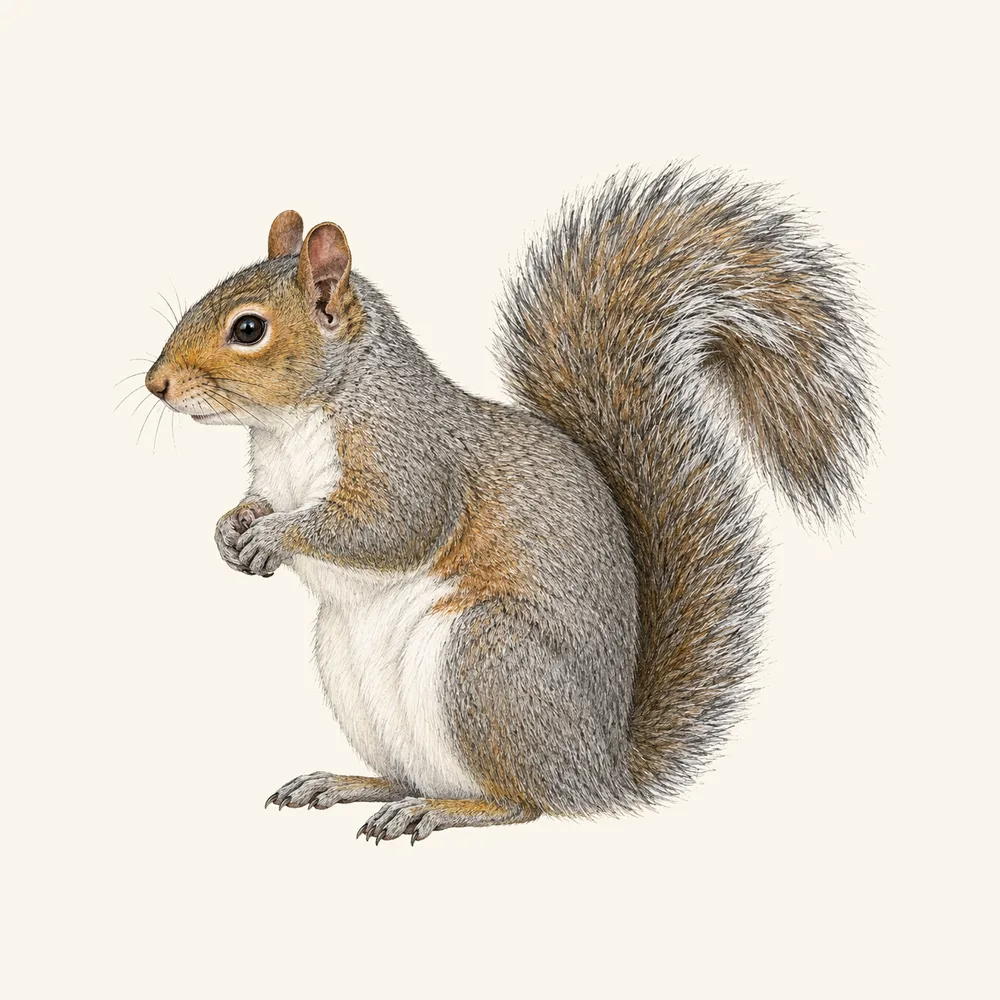
Grey squirrel
Sciurus carolinensis
If you live-trap one, you may not lawfully let it go. The law almost nobody mentions, and what it means in practice.
In most gardens
Present in the great majority of UK gardens with trees, and one of the most frequently seen mammals in the country. Introduced in the 1800s and classified by the Wildlife Trusts as an invasive non-native species.
Not assessed
No conservation assessment exists for this species. That is not the same as being fine.
No assessment scheme records this species as “Not assessed — and correctly so. Great Britain Red List assessments are made for native species; the grey squirrel is, in the Wildlife Trusts' wording, "classified as an invasive non-native species", introduced in the 1800s.”. Source.
- The Invasive Alien Species (Enforcement and Permitting) Order 2019 — In England and Wales the grey squirrel is listed as an invasive alien species. GOV.UK sets out what that means: you must not "release them into the environment", "let them breed or escape", "keep them in your house, garden or business" or "transport them within the UK". The practical consequence is that a person who live-traps a grey squirrel may not lawfully release it — not in their own garden, and not in a wood down the road. Older pages cite Schedule 9 of the Wildlife and Countryside Act 1981; the grey squirrel entry there was omitted for England and Wales on 1 December 2019, when the 2019 Order took over. Scotland has its own rules. law
- Wild Mammals (Protection) Act 1996, section 1 — "If, save as permitted by this Act, any person mutilates, kicks, beats, nails or otherwise impales, stabs, burns, stones, crushes, drowns, drags or asphyxiates any wild mammal with intent to inflict unnecessary suffering he shall be guilty of an offence." This applies to the grey squirrel as to any other wild mammal, non-native status notwithstanding. law
At a glance
-
Size
Much bigger than a robin: body 24-28.5cm with a 19.5-24cm tail, weighing 400-650g.
-
Active when
Daytime, all year. Grey squirrels do not hibernate, though they stay in the drey through the worst weather.
-
What it eats
Nuts, acorns, seeds, buds, shoots, fungi and fruit, plus birds' eggs and nestlings; hazelnuts are cracked cleanly in half.
-
Where it shelters
A drey of twigs, leaves and bark strips high in a fork — and, given the chance, a loft.
-
Breeding season
Up to two litters a year, typically of three or four young, usually in late winter and midsummer.
-
Status
Not assessed on a GB Red List. An invasive non-native species, introduced in the 1800s, and listed in England and Wales as an invasive alien species.
Not to be confused with
- Red squirrel — Colour is the unreliable guide — grey squirrels often show strong rusty-brown on the face, flanks and feet, and are regularly reported as reds. The clincher is the ears: a red squirrel has prominent ear tufts from autumn through spring, a grey never does. Size settles any doubt, a grey being roughly twice the weight. Outside the red's few strongholds, a squirrel in a British garden is a grey.
- Drey vs magpie nest — Both are bulky masses of twigs high in a bare winter tree. A drey is a solid ball tucked close against the trunk or in a main fork, and is lined with leaves and shredded bark; a magpie's nest is a looser cup with a domed roof of thorny twigs, usually further out towards the branch tips.
Through the year
Spring
The first litter is being reared and squirrels are at their most destructive to birds' nests and fresh growth. Bark stripping on young trees starts as sap rises.
Summer
A second litter arrives around midsummer. Squirrels take soft fruit, strawberries and nuts while still green, which is why your hazels vanish before they ripen.
Autumn
Caching season: thousands of nuts and acorns buried singly across lawns and borders, and the point at which bulbs planted in autumn are most likely to be dug up. A layer of chicken wire pegged over new plantings works.
Winter
No hibernation. Squirrels are visible all winter and this is when they most often find a way into a loft. Check for gaps at eaves and soffits before, not after.
The trapping trap
This is the most useful thing on this page and almost nobody says it. In England and Wales the grey squirrel is an invasive alien species under the Invasive Alien Species (Enforcement and Permitting) Order 2019, and GOV.UK says you must not "release them into the environment" or "transport them within the UK". (Older pages cite Schedule 9 of the Wildlife and Countryside Act 1981; the grey squirrel entry there was omitted for England and Wales in December 2019.) The consequence is direct: live-trap a grey squirrel and you cannot lawfully let it go. Not in your garden, not at the end of the road, and not in a wood five miles away — the well-meaning drive to the countryside is precisely the act the section prohibits. Allowing a trapped animal to escape is also capable of being an offence, subject to a defence where the accused proves they "took all reasonable steps and exercised all due diligence to avoid committing the offence". The honest conclusion is that buying a live trap puts a gardener in a position with no lawful exit they are likely to want. This page gives no trapping or dispatch instructions of any kind, deliberately.
What to do instead
Exclude rather than remove, because removal does not work anyway — a garden with food and trees does not stay squirrel-free, it simply acquires a different squirrel. For bird feeders, the answer is mechanical and the details matter: a metal feeder that cannot be gnawed, on a smooth metal pole with a baffle fitted below it, standing more than about two metres from any fence, branch, wall or shed roof, since a grey squirrel can jump a surprising horizontal distance from a standing start. Caged feeders that let small birds through and keep squirrels out work well and are less fuss. For bulbs, peg chicken wire or mesh over the bed until growth is through. For lofts, the fix is carpentry: find the gap at the eaves, soffit or gable, and close it with something that will not be chewed — but only once you are certain nothing is inside, because sealing an animal in is both cruel and likely to be an offence. For fruit and nuts, a properly built cage is the only reliable answer.
The honest conservation picture
The grey squirrel arrived in Britain in the 1800s and is, in the Wildlife Trusts' words, "classified as an invasive non-native species". Two impacts are well established. It has contributed to the decline of the red squirrel, mainly through competition and through squirrelpox, a virus greys carry largely without symptoms and which is usually fatal to reds. And it damages woodland by stripping bark from young broadleaved trees, particularly beech, sycamore and oak, in early summer. Those are real and they matter. What is also true is that none of it makes a grey squirrel in a suburban garden a legitimate target for a gardener's own initiative. The Wild Mammals (Protection) Act 1996 applies to it exactly as it does to a hedgehog, non-native status notwithstanding. It is worth holding both facts at once: an animal can be genuinely damaging at a national scale and still be an animal you are not entitled to deal with yourself in your back garden.
Plant this for it
Guides
How we checked this
- The Wildlife Trusts: Grey squirrel
- Wildlife and Countryside Act 1981, section 14
- GOV.UK: Invasive non-native (alien) animal species: rules in England and Wales (updated 13 June 2025)
- The Invasive Alien Species (Enforcement and Permitting) Order 2019
- Wild Mammals (Protection) Act 1996, section 1
Checked against the sources above. Reviewed on 2026-09-20. Legal position checked 2026-10-30.