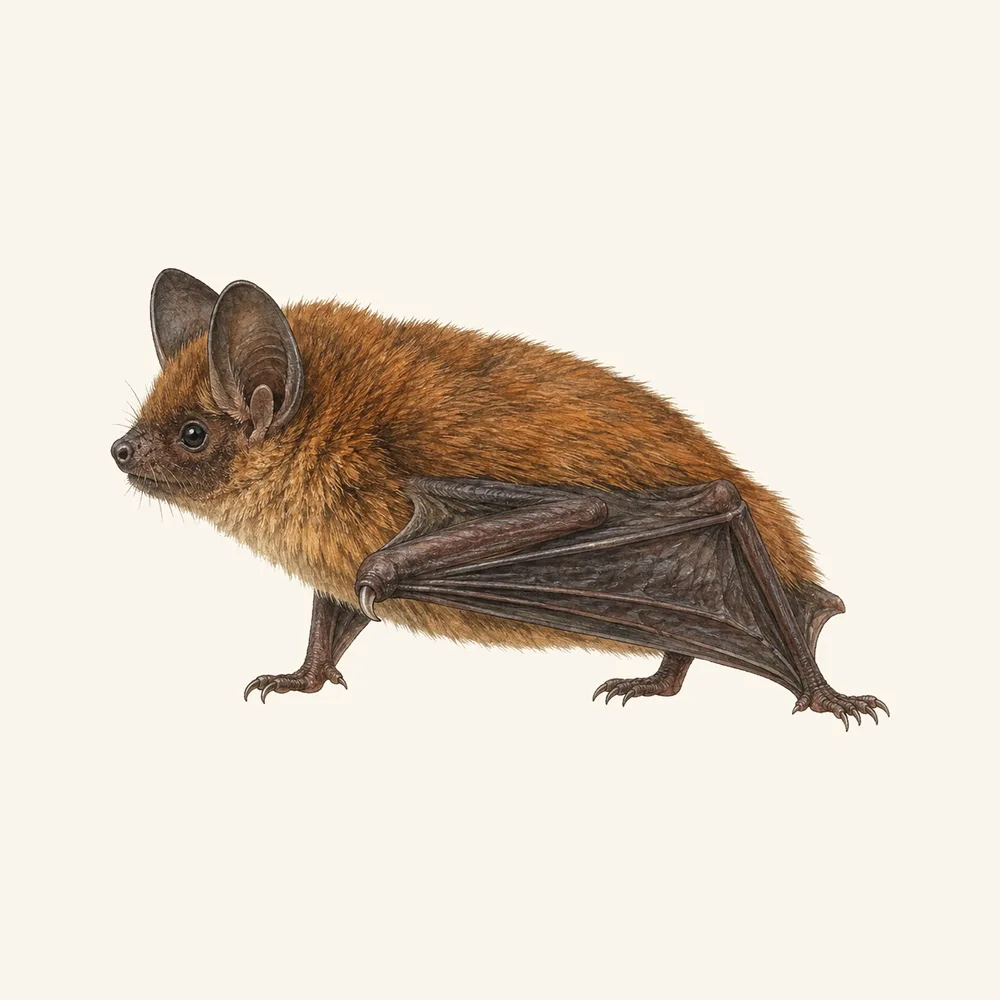
Common pipistrelle
Pipistrellus pipistrellus
The bat over your garden at dusk. Its roost is protected whether or not a bat is in it — check before any roof or loft work.
In many gardens
The commonest bat in Britain and the one most likely to be over a garden at dusk. Small enough, in the Wildlife Trusts' phrase, that it "can fit into a matchbox", and it roosts freely in the roof spaces of ordinary houses.
Not assessed
No conservation assessment exists for this species. That is not the same as being fine.
No assessment scheme records this species as “No Great Britain Red List assessment verified for this species. Its legal standing as a European Protected Species is a legal classification, not a Red List category, and the two should not be conflated.”. Source.
- Conservation of Habitats and Species Regulations 2017, regulation 43 — All UK bats are European Protected Species. It is an offence to "deliberately capture, injure or kill" a wild animal of a European protected species, to deliberately disturb one in a way that impairs its ability to survive, breed or rear young, and — separately and without any requirement of deliberateness — to damage or destroy "a breeding site or resting place of such an animal". Because the offence attaches to the place rather than to the animal, a bat roost is protected whether or not bats are present in it at the time. law
- Government guidance: Bats — protection, surveys and licences — "All bat species, their breeding sites and resting places are fully protected by law - they're European protected species." The guidance lists repairing or replacing a roof, insulating or converting a loft, and work involving timber among the activities that may affect bats, and states that where work could affect bats or their habitat "you'll need an expert to do a bat survey". Where a roost is present, the work needs a licence. law
At a glance
-
Size
Britain's smallest common bat and far smaller than a robin: 3.5-4.5cm long, 20-23cm wingspan, and just 3-8g.
-
Active when
From about 20 minutes after sunset, through the warmer half of the year. Hibernates roughly November to April, emerging on mild nights.
-
What it eats
Small flying insects — midges, mosquitoes, small moths and caddisflies — caught in flight. One bat can eat 3,000 insects a night.
-
Where it shelters
Tree holes, bat boxes and, very often, the roof space, soffits and cavity walls of ordinary houses.
-
Breeding season
Females gather in maternity colonies over the summer, each raising a single pup.
-
Status
No verified Great Britain Red List assessment. Legally a European Protected Species — a different thing from a Red List category.
Not to be confused with
- Soprano pipistrelle — Effectively inseparable in the field, and treated as one species until the 1990s. The difference is in the echolocation: the common pipistrelle's calls peak around 45kHz and the soprano's around 55kHz. The Wildlife Trusts put it plainly — they are "distinguished by the different frequency of their echolocation calls". Without a bat detector you cannot honestly claim either name, and "a pipistrelle" is the correct answer.
- Swift — Both are dark, fast and over the garden on a summer evening, and swifts are often called bats. A swift has stiff, scythe-shaped wings and holds a steady, sweeping glide between bursts; a pipistrelle's flight is fluttery and changes direction every second or two. Timing separates them cleanly: swifts stop at dusk, and bats start.
- Brown long-eared bat — Also a garden bat, but the ears are almost as long as its body — unmistakable at rest, and visible in a photograph. It also flies slowly and often hovers to pick insects off foliage, where a pipistrelle is fast and never still.
Through the year
Spring
Bats emerge from hibernation and maternity colonies start to form from around May. This is the point at which roof and loft work becomes most sensitive — get the survey done before you book the scaffolding, not after.
Summer
Maternity colonies are active and pups are being reared, typically June and July. Disturbance now is at its most damaging and most likely to be an offence. Watch them feed at dusk instead.
Autumn
Colonies break up, mating takes place and bats feed hard before winter. Bats may turn up in odd places as they move between roosts. Leave any bat you find alone and ring the National Bat Helpline.
Winter
Hibernation runs roughly November to April in cool, stable places, including cavity walls and outbuildings. Bats do rouse and fly on mild nights. Roosts remain legally protected throughout, whether occupied or not.
The law, before anything else
This is the part of the page that matters. All UK bats are European Protected Species under the Conservation of Habitats and Species Regulations 2017. Regulation 43 makes it an offence to deliberately capture, injure or kill one, or to deliberately disturb one in a way that impairs its ability to survive, breed or rear young. Crucially, it is a separate offence to damage or destroy "a breeding site or resting place". That offence is not qualified by deliberateness, and it attaches to the place rather than the animal, so a roost is protected whether or not bats are in it. In practice that means repairing or replacing a roof, insulating or converting a loft, replacing soffits and bargeboards, treating or replacing timber, or rendering a wall can all be offences if a roost is affected. Government guidance is explicit that where work could affect bats or their habitat, "you'll need an expert to do a bat survey", and where a roost is present the work requires a licence. Check first: pleading ignorance afterwards does not help.
If you find a bat
Never handle a bat, in any circumstance — not to move it, not to put it somewhere safer, not to look at it. The route is the National Bat Helpline, run by the Bat Conservation Trust, which government guidance names as the source of free advice on behalf of Natural England and which can arrange for a volunteer bat roost visitor to come and inspect a property. Ring them and follow what they tell you. That is the whole of the advice.
What it is doing over your garden
A common pipistrelle appears about twenty minutes after sunset and flies a circuit — along a hedge, around a tree canopy, over a pond, back again — because insects concentrate on those edges and it is hunting by echolocation, not sight. The flight looks chaotic and is not: every sharp turn is an interception. The numbers are worth knowing because they explain the pattern. A bat weighing as little as three grams can take three thousand small insects in a night, which is why it works the damp, sheltered, insect-rich lines of a garden rather than the open middle. The three things that make a garden good for pipistrelles are therefore insects, linear cover and darkness. A pond, an unclipped hedge, night-scented planting and a floodlight you turn off will do more than any product. Bats will not use a garden whose boundary is lit.
Bat boxes, honestly
Bat boxes work, but not the way nest boxes do, and it is worth setting expectations. Occupancy rates are low and slow: a box may stand empty for several years before it is found, and many never are. Bats are fussy about temperature and exposure in a way that birds are not, which is why boxes are usually put up in groups of three facing different directions so the colony can move between them as the weather changes. Height matters — well above head height, with a clear, unobstructed flight path in — and they are never cleaned out, because once a box is in use it is a roost and disturbing it needs a licence. None of which makes a box a bad idea. It just makes it a long-term, low-cost gesture rather than a guaranteed result, and it is honest to say so before someone spends a weekend on it and feels cheated in year two.
Guides
How we checked this
- The Wildlife Trusts: Common pipistrelle
- GOV.UK: Bats — protection, surveys and licences
- Conservation of Habitats and Species Regulations 2017, regulation 43
Checked against the sources above. Reviewed on 2026-09-20. Legal position checked 2026-09-20.