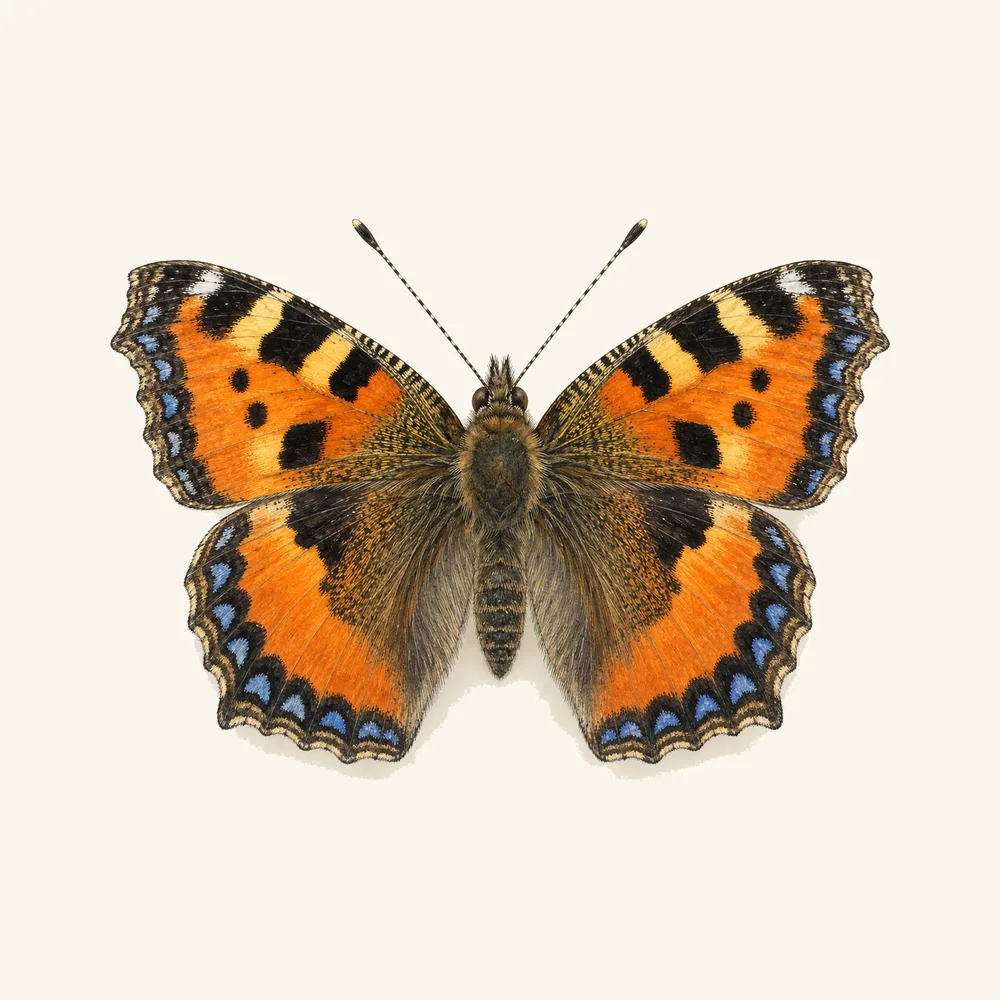
Small tortoiseshell
Aglais urticae
Orange and black with blue-spotted margins, often found hibernating in a shed. Still widespread, but down 79% in abundance since 1976.
In many gardens
Still one of the butterflies most likely to appear in a UK garden, and Butterfly Conservation notes it "often visits garden flowers in large numbers" in autumn. But common now is much thinner than common was: distribution has held while abundance has collapsed.
Least concern
Assessed as not currently at risk in Great Britain.
The IUCN Red List for Great Britain records this species as “"GB Red List (2022): Least Concern", with a Butterfly Conservation priority of "low (but concern over recent decades)".”, with a UK population trend of −79% (1976 to 2019). The two figures Butterfly Conservation gives pull in opposite directions and both are true: abundance has fallen 79% between 1976 and 2019, while distribution has barely moved at 0.2% over 1973 to 2019. The butterfly is still nearly everywhere it used to be; there are simply far fewer of them in each place, which is why a Least Concern listing sits alongside genuine concern. Source.
No specific legal protection found for this species as at 2026-09-20.
At a glance
-
Size
Wingspan 50–56mm (Butterfly Conservation) — medium to large, and noticeably smaller than a peacock or red admiral.
-
Flying season
One of the first butterflies of spring, on the wing again through summer and in numbers on garden flowers in autumn.
-
What it needs
Nectar for the adults, common or small nettle for the caterpillars, and a dry frost-free space to hibernate in.
-
Where it nests
No nest. Eggs are laid in batches on nettle, and the adults overwinter in sheds, garages and outbuildings.
-
Look-alikes
Painted lady and comma. The ring of blue crescents round the wing margin settles it.
-
Status
GB Red List (2022): Least Concern — but abundance is down 79% between 1976 and 2019.
Not to be confused with
- Painted lady — The blue margin. A small tortoiseshell has a border of small blue crescents running round the outer edge of both wings; a painted lady has none. The painted lady is also paler and pinker-orange rather than fiery, has a black forewing tip spotted with white, and is markedly bigger. If the butterfly is on a buddleia in August and you cannot decide, look at the wing edge, not the colour.
- Comma — The outline. A comma's wing edges are deeply and raggedly scalloped, as though torn, while a small tortoiseshell's are smoothly curved with only a shallow wave. The comma is also a plainer, more uniform russet-orange without the black-and-yellow blocks along the leading edge, and shows a small white comma mark on the dark underside.
- Large tortoiseshell — Size and the hindwing. The large tortoiseshell is considerably bigger, duller and browner-orange, and lacks the crisp white block near the forewing tip that a small tortoiseshell shows. It is also extremely rare in Britain, so in a garden the odds overwhelmingly favour small tortoiseshell — but the hindwing is the check: small tortoiseshell has a broad, solid black band across the base of the hindwing that the large tortoiseshell does not.
Through the year
Spring
Adults wake from hibernation on the first warm days and need early nectar immediately — leave dandelions and let early-flowering herbs bloom.
Summer
Caterpillars feed communally in silk webs on nettle; adults are on the wing. Do not strim nettles you can see webbing on.
Autumn
Adults feed heavily on late flowers before hibernating. Leave ivy, sedum and late perennials uncut, and leave windfalls on the ground.
Winter
Hibernating as adults in sheds, garages and porches. If you find one, leave it where it is and leave a route out for spring.
The honest answer about nettles
Common nettle and small nettle are the caterpillar foodplants, so the standard advice is to leave a nettle patch. We are not going to repeat that uncritically, because the RHS has tested it. Their summary of the evidence is blunt: "an experiment to explore different ways to increase biodiversity in gardens found that nettle patches made no significant difference." The RHS makes the further point that installing a pond delivers considerably more biodiversity benefit than a nettle patch does. That does not mean nettles are useless — they are genuinely the foodplant, and a large sunny nettle bed in an open situation can hold caterpillars. It means that a token clump of nettles in a shady corner is a gesture rather than a contribution, and that if you have limited space and effort, a pond and a long nectar season will do far more for this butterfly than the nettles will.
Common, and down 79%
Butterfly Conservation lists the small tortoiseshell as "GB Red List (2022): Least Concern", with a priority of "low (but concern over recent decades)". Read alongside the trend data, that is a more interesting statement than it looks. Abundance has fallen by 79% between 1976 and 2019. Distribution over almost the same period has changed by 0.2%. The butterfly has not retreated anywhere — it is still recorded across Britain and Ireland — but the number of individuals in each place has collapsed by roughly four-fifths in a working lifetime. That is why an older gardener's memory of tortoiseshells covering a buddleia is not nostalgia, and why the Red List category, which is driven largely by range, does not capture what has happened. It is also a useful caution about conservation labels generally: Least Concern is not the same as fine.
The one in your shed in January
Small tortoiseshells overwinter as adults, and sheds, garages, porches and unheated outbuildings are exactly the dry, dark, frost-free spaces they look for. Finding one clamped to a rafter in midwinter is normal, not a rescue situation. Leave it alone. Do not move it somewhere warmer — warmth wakes it, it burns reserves it cannot replace, and there is nothing in flower. Do not put it outside into frost either. The one useful thing you can do is make sure it has a way out in spring: leave a window on the latch or the door ajar on the first warm days of March, so a waking butterfly is not trapped behind glass. If one wakes indoors in a heated room in midwinter and is battering a window, the least-bad option is to move it gently to a cold shed or porch where it can settle again.
Nectar at both ends of the year
Because this butterfly hibernates as an adult, its needs are concentrated at the two points when most gardens have least to offer. In early spring it emerges hungry, before most borders have started. In September and October it feeds hard to build the reserves that carry it through to March. Mid-summer, when gardens are at their fullest, is the easy part. So plan for the shoulders: let dandelions flower in March rather than mowing them off, keep early herbs such as rosemary unclipped in spring, and leave late-flowering plants, ivy and sedum standing well into autumn instead of cutting everything down in September. Windfall apples left on the ground are taken readily in autumn. The tidy-in-October habit is probably the single most damaging routine gardening decision for this species.
Plant this for it
- lavenderDependable midsummer nectar in full sun, and small tortoiseshells bask on the warm gravel and paving that lavender is usually planted beside.
- mintIf you let mint flower rather than cutting it for the kitchen, it produces masses of small nectar-rich flowers in late summer, exactly when this butterfly is fuelling up for hibernation.
- appleWindfall apples left on the ground in autumn are fed on directly, and are one of the few genuinely useful things a gardener can leave out for butterflies.
Guides
How we checked this
- Butterfly Conservation: Small Tortoiseshell
- RHS Science: Five myths of wildlife gardening, pitted against science
- RHS: Butterflies in your garden
Checked against the sources above. Reviewed on 2026-09-20. Legal position checked 2026-09-20.