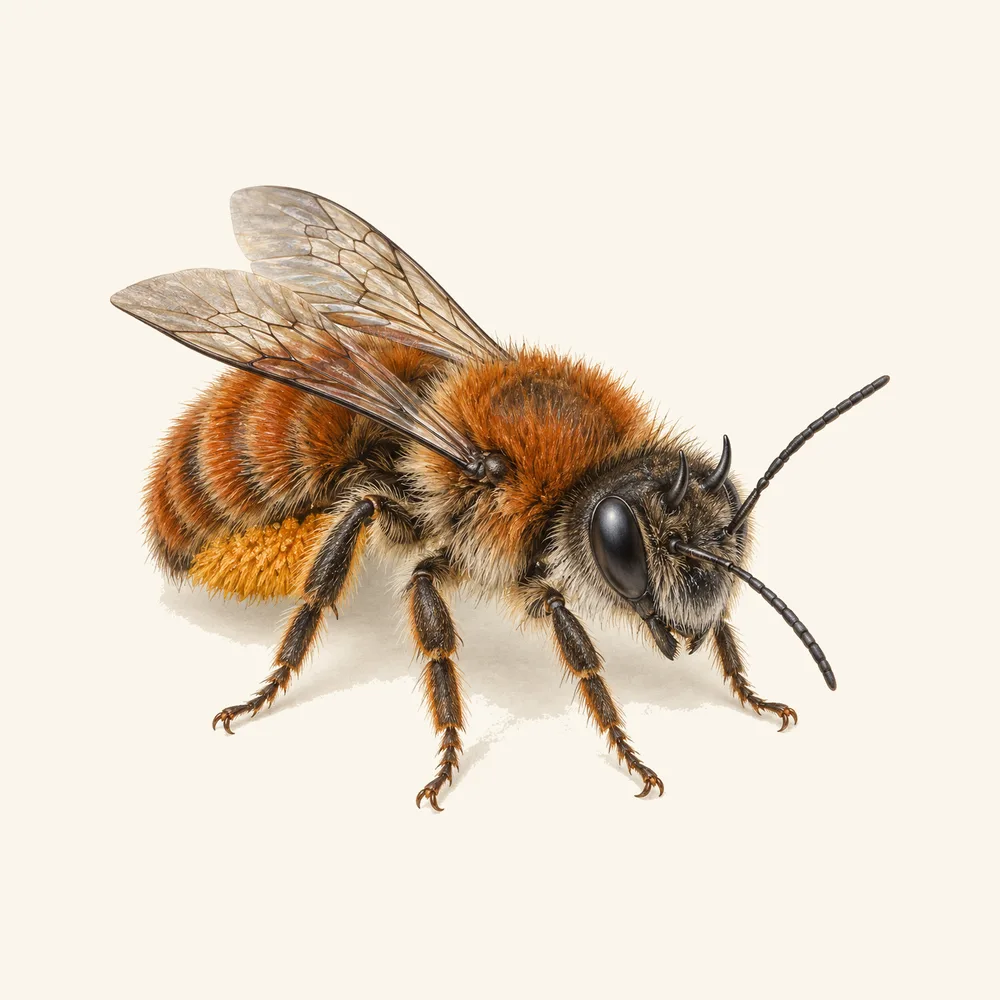
Red mason bee
Osmia bicornis
Gingery spring solitary bee that carries pollen under its abdomen, not on its legs. The one species that really does move into a bee hotel.
In many gardens
Widespread and one of the most likely solitary bees to appear in a garden, particularly where there are old walls, air bricks or hollow stems. Buglife notes it is "easily coaxed into made and bought 'bug hotels'", which is why it is the one most people meet.
Not assessed
No conservation assessment exists for this species. That is not the same as being fine.
No assessment scheme records this species as “No Great Britain Red List assessment verified for this species. Buglife records it as "Not Evaluated" globally and "IUCN Least Concern in Europe" — neither of which is a Great Britain assessment, so we record it as not assessed.”. Source.
No specific legal protection found for this species as at 2026-09-20.
At a glance
-
Size
6–11mm long (Buglife), with males smaller than females — roughly honeybee-sized but rounder and much gingerer.
-
Flying season
April to June, sometimes from late March. Males emerge first, females a little later.
-
What it needs
Spring blossom within a short flight of the nest, plus damp bare mud to seal the cells with.
-
Where it nests
Solitary, in pre-existing holes — hollow plant stems, bamboo, air bricks, old mortar. Never excavates its own tunnel.
-
Look-alikes
Tawny mining bee and honeybee. The pollen brush under the abdomen, rather than on the legs, is decisive.
-
Status
No Great Britain Red List assessment verified. No legal protection applies in a garden.
Not to be confused with
- Honeybee — Where the pollen is. A honeybee packs pollen into baskets on its hind legs, so a laden one has two obvious yellow lumps on its back legs. A female red mason bee carries pollen "in hairs on the undersides of their abdomen, in a structure known as a 'pollen brush'", so a laden one looks as though its belly has been dipped in custard, with clean legs. The red mason bee is also much gingerer and rounder, and flies alone rather than as part of a stream from a hive.
- Tawny mining bee — Both are foxy-ginger spring bees. The tawny mining bee is a ground nester and leaves a small volcano of excavated soil on a lawn or path, which a red mason bee never does; its coat is a brighter, flatter fox-red on the thorax with a black face and black underside. The red mason bee is gingery all over, nests in holes above ground, and plugs those holes with mud.
- Leafcutter bee — Both use tubes in a bee hotel, and both carry pollen under the abdomen. What they seal with settles it: a red mason bee carries pellets of wet mud and finishes the tube with a smooth mud plug, while a leafcutter flies in carrying a neat green disc of leaf and plugs the tube with layered leaf. Leafcutters are also later — high summer rather than spring.
Through the year
Spring
Males emerge first, then females, and nesting runs through April to June — leave tubes and old mortar alone and keep a patch of bare mud damp.
Summer
Adults have died by around July; the tubes are full of sealed cells with larvae inside. Do not open, move or clean an occupied bee hotel.
Autumn
Larvae have spun cocoons inside the tubes and are overwintering as adults. Leave the hotel outside, dry and rain-shielded — bringing it indoors into warmth is a common mistake.
Winter
Nothing to do. Next year's bees are in the tubes; late spring, after emergence, is the time to clean and replace them.
Save your money on the decorative bug hotel
The large ornamental "insect hotels" sold in garden centres, with their layers of pine cones, wood shavings and drilled slabs, are mostly decoration. Buglife's guidance on what actually works is specific and narrow: tubes of "varying diameters from 2-10 mm", because "tubes with a diameter greater than 10 mm are too large for many bees". Material matters too — Buglife warns that "plastic and cardboard tubes, increase the opportunity for condensation", which "contributes toward the spread of fungus, disease and parasites". And the tubes must be replaceable: "late spring is the time to clean your hotel and replace old tubes which have been used with new ones, as bees can't clean detritus." A hotel you cannot take apart cannot be maintained, and an unmaintained one accumulates parasites. A bundle of cut bamboo or drilled hardwood you can rebuild each year outperforms almost anything sold pre-assembled, at a fraction of the price.
Pollen under the belly
This is the field mark that makes solitary bees suddenly legible. Honeybees and bumblebees carry pollen in corbiculae — smooth baskets on the hind legs — so a loaded bee has two bright lumps on its back legs. Female mason bees have no such baskets. Buglife describes them carrying pollen "in hairs on the undersides of their abdomen, in a structure known as a 'pollen brush'", which is why a working red mason bee looks as though it has belly-flopped into a bowl of pollen. It also changes how she pollinates. She has to press her whole underside into the flower to load and unload, contacting anthers and stigma far more messily than a honeybee working a flower tidily with its legs. That scrambling, belly-first technique is why mason bees are so effective on apple and pear blossom.
Siting a tube nest that actually gets used
Buglife's advice is a sunny, south-facing spot, around a metre off the ground, in a rain-resistant frame. Three practical additions follow from that. Fix it rigidly — a hotel swinging on a string is unattractive to a bee trying to land and unusable in wind. Give it a roof or overhang so the tube ends stay dry, since damp tubes mould. And put it where you can see it, because the pleasure of this species is watching a female arrive with a pellet of mud in her jaws and reverse into a hole. Then leave it completely alone from April until the following spring. Once a tube is plugged with mud there is a developing bee inside it, and moving the hotel, bringing it into a shed, or tidying it away in autumn kills the occupants.
What to do in late spring, every year
A bee hotel is a piece of kit with a maintenance cycle, not an ornament. Buglife is explicit that bees cannot clean out detritus themselves, and that late spring — after this year's bees have chewed their way out, and before the new females start filling tubes — is the window to clean the hotel and replace used tubes with fresh ones. Pull out the tubes that were sealed last year and are now open at the end, discard them, and put clean ones in. If you cannot tell which have emerged, leave them one more season rather than binning occupied cells. This single annual habit is the difference between a bee hotel that supports a growing population and one that quietly becomes a reservoir of parasitic wasps and mould, which is the usual fate of the ones nobody touches.
Plant this for it
- appleApple blossom in April and May coincides exactly with the red mason bee's flight season, and its belly-first foraging makes it an unusually thorough pollinator of top fruit.
- rosemaryIn flower from early spring, so it covers the gap before fruit blossom opens, when newly emerged males and females most need nectar.
- strawberryOpen, shallow spring flowers that a small bee can work easily, and well-pollinated strawberry flowers are the ones that set even, unmisshapen fruit.
Guides
How we checked this
- Buglife: Red Mason Bee
- Buglife: How to be the best bee hotel manager
- Buglife: Building for Bees
- Buglife: Gardening for Solitary Bees
- Buglife: Solitary Bee Week — Learn
Checked against the sources above. Reviewed on 2026-09-20. Legal position checked 2026-09-20.