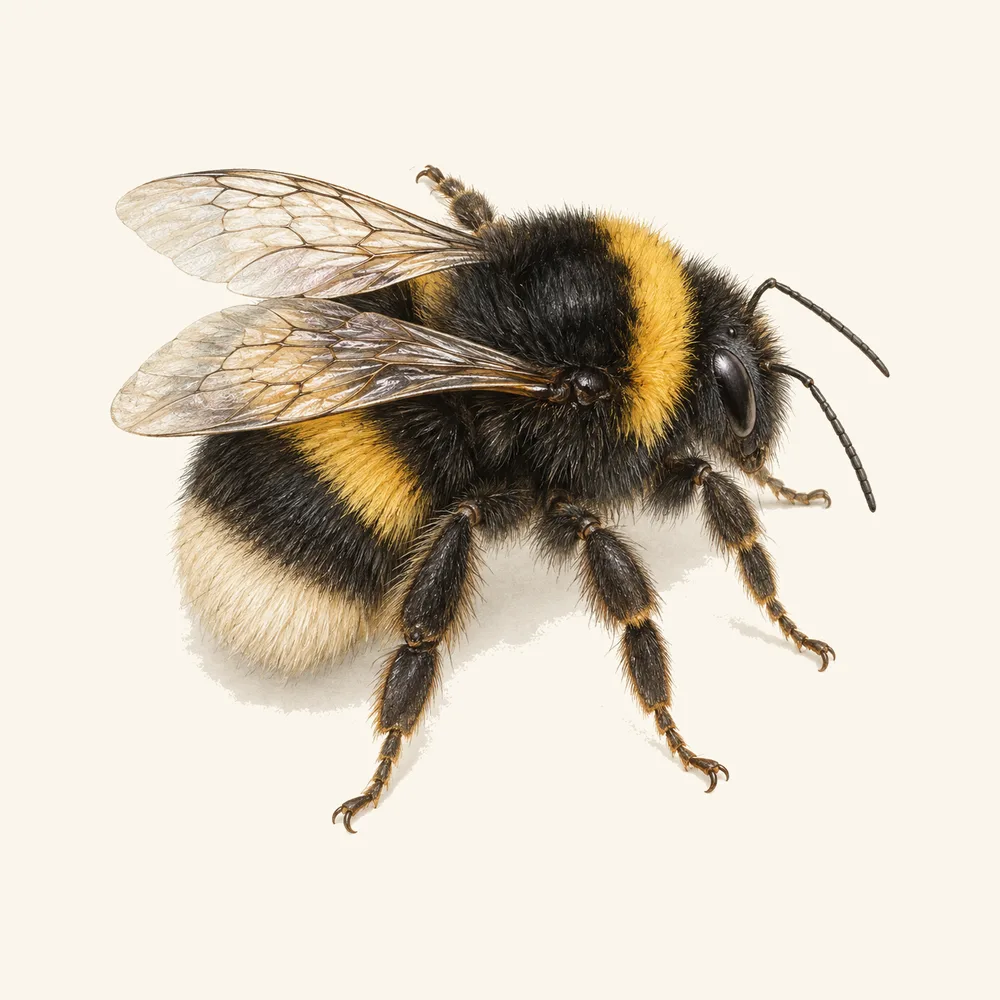
Buff-tailed bumblebee
Bombus terrestris
The UK's commonest big bumblebee. The queen has a buff tail; workers have white tails with a buff line. Nests underground, and now flies in winter.
In most gardens
One of the most widespread bumblebees in the UK and usually the first big bee of the year in a garden. Nests can hold around 350 workers, so a single colony behind a shed produces a lot of visible bees.
Not assessed
No conservation assessment exists for this species. That is not the same as being fine.
No assessment scheme records this species as “No Great Britain Red List assessment verified for this species. The Bumblebee Conservation Trust treats it as one of the UK's widespread and abundant bumblebees rather than a species of concern; we will not manufacture a Red List category from that.”. Source.
No specific legal protection found for this species as at 2026-09-20.
At a glance
-
Size
Large for a bumblebee — queens are among the biggest bees you will see in a UK garden; workers are noticeably smaller.
-
Flying season
Queens from February, workers about six weeks later, active to the end of September — and winter-active in the south and in cities.
-
What it needs
Nectar and pollen from February to October, plus winter forage where colonies stay active. Nothing you put in a feeder.
-
Where it nests
Underground, usually in old rodent holes. Nests can hold around 350 workers. It will not use a hanging bee hotel.
-
Look-alikes
White-tailed bumblebee — workers of the two genuinely cannot be told apart reliably. Queens can, by tail colour.
-
Status
No Great Britain Red List assessment verified. Widespread and abundant; no legal protection applies in a garden.
Not to be confused with
- White-tailed bumblebee — Queens are separable and workers largely are not — the Bumblebee Conservation Trust states that "the workers of these two species cannot be told apart". On a queen, the tail is the clincher: buff-tailed queens have a "yellow-brown buff-coloured tail", white-tailed queens a clean white one. On workers, buff-tailed have "white tails, sometimes with a narrow yellow-buff border", while white-tailed workers "never have any buff in the tail". If you are looking at a worker with a pure white tail and no buff line, honest identification stops at "a white-tailed bumblebee species".
- Honeybee — Shape and texture. A honeybee is slim, narrow-waisted and looks varnished amber-brown with dark bands; a buff-tailed bumblebee is round, broad and densely furry with two crisp yellow bands and a pale tail. Honeybees also arrive in numbers from a hive and work a plant methodically in a group; a buff-tailed queen in March is a single very large bee.
- Bee-mimicking hoverfly — Count the wings. Bumblebees have four wings — two pairs — while a hoverfly has only one pair, which is the defining feature of a true fly. A hoverfly also has short stubby antennae and huge eyes that meet or nearly meet over the front of the head, and it hangs motionless in mid-air in a way no bumblebee does.
Through the year
Spring
Queens emerge from February and fly low over the ground looking for nest holes — leave rough grass, bare banks and old mouse holes undisturbed.
Summer
Colonies are at full size, with up to around 350 workers. Keep nectar flowing through the July and August gap with lavender, thyme and sage.
Autumn
Most colonies wind down by the end of September, producing new queens and males. Leave late flowers standing rather than cutting everything back.
Winter
In southern England and in cities as far north as Edinburgh and Dundee, colonies now stay active through the winter, foraging on mahonia, winter honeysuckle and winter heathers.
Getting the tail right
The name is a trap. Buff-tailed bumblebee workers mostly do not have buff tails — they have white ones. The Bumblebee Conservation Trust puts it precisely: queens have a "yellow-brown buff-coloured tail", while workers and males have "white tails, sometimes with a narrow yellow-buff border". That narrow border, a thin buff line where the white tail meets the black abdomen, is the feature to look for on a worker, and it is often the only thing separating it from a white-tailed bumblebee, whose workers "never have any buff in the tail". The Trust is candid that in practice "the workers of these two species cannot be told apart". Both species show one golden yellow band at the front of the thorax and one across the middle of the abdomen. So: big bee in February with a dirty-buff tail, buff-tailed queen. Smaller bee in June with a clean white tail, you cannot be sure.
Why a bee hotel does almost nothing for bumblebees
The drilled block hanging on your fence is not for this bee, or for most bees. Buglife records that "90% of UK bee species are solitary bee — that's over 240 species", and that "roughly 70% of solitary bee species are mining bees and nest in burrows underground". Bumblebees are not solitary at all, and the buff-tailed bumblebee nests underground too, "usually in old rodent holes". Add those up and the great majority of the bees in a British garden nest in the ground, not in tubes. A bee hotel is a specialist provision for a minority of cavity-nesting solitary bees, and a worthwhile one, but it is not bee habitat in general. The equivalent provision for everything else is far less photogenic: a sunny bank of bare, undisturbed soil, rough grass left uncut, and old mouse and vole holes left where they are.
The bee that stopped hibernating
Textbooks say bumblebee queens hibernate and colonies die out in autumn. The buff-tailed bumblebee has increasingly stopped doing that. The Bumblebee Conservation Trust records winter-active colonies foraging "from October right through to March", with mating pairs seen in February, as far north as Edinburgh and Dundee, and with many sightings in towns and cities where it is warmer. So a large bumblebee on a mahonia in December is not a confused individual that needs rescuing; it is a worker from a functioning winter colony, doing exactly what it should. The practical consequence for a garden is a planting one. Winter forage is what those colonies depend on, and the Trust names mahonia, winter-flowering heather, winter honeysuckle and strawberry tree specifically. A garden that has nothing in flower between November and February is a dead zone for them.
Four wings, not two
If you are trying to decide whether something is a bee at all, count the wings. The RHS puts the rule cleanly: "the characteristic feature of true flies is that they have only two wings (one pair) compared to most other insects such as bees and wasps which have four wings (two pairs)". Bumblebees have four. The bee-mimicking hoverflies that fool people every summer have two. In practice you rarely count them, because the other cues arrive first — a hoverfly has enormous eyes covering most of its head, tiny stubby antennae, and the ability to hang stock-still in mid-air and then dart sideways. A bumblebee has small eyes at the sides of a furry face, obvious elbowed antennae, and blunders rather than hovers. Getting this right matters, because the mimics are harmless and so, very nearly, are the bees.
Plant this for it
- lavenderReliable high-summer nectar at exactly the point when spring blossom is over and many gardens go blank; buff-tailed workers work a lavender hedge in numbers.
- rosemaryOne of the few things flowering when buff-tailed queens emerge in February and March, and a genuine lifeline in a winter-active colony's forage gap.
- sageLong flowering season and open tubular flowers that large bumblebees can work easily, bridging the midsummer nectar gap between blossom and late perennials.
- thymeLow, sun-warmed and covered in tiny nectar-rich flowers in June and July; also thrives in the dry, sunny, bare-ish ground that ground-nesting bees look for.
Guides
How we checked this
- Bumblebee Conservation Trust: Buff-tailed bumblebee
- Bumblebee Conservation Trust: Winter-active bumblebees
- Buglife: Solitary Bee Week — Learn
- RHS: Hoverflies
Checked against the sources above. Reviewed on 2026-09-20. Legal position checked 2026-09-20.