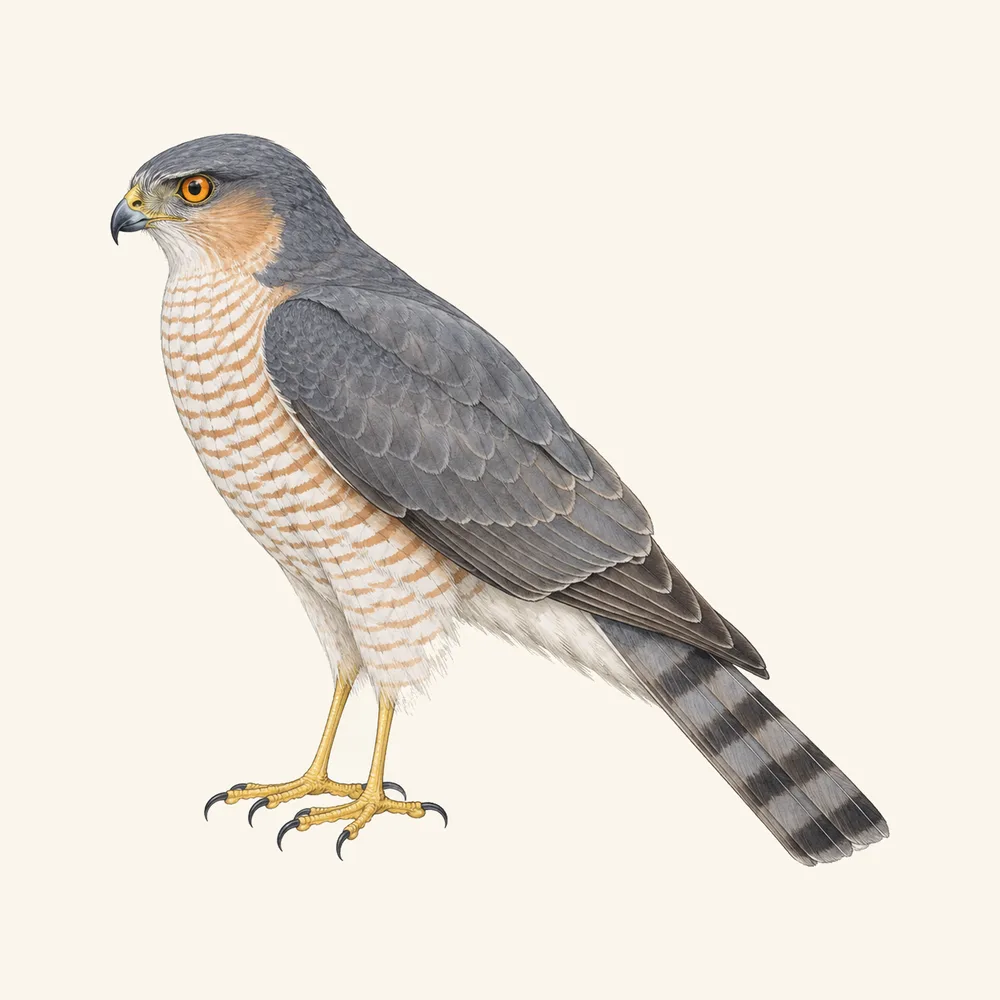
Sparrowhawk
Accipiter nisus
A fast, low-flying hawk that hunts small birds. Its arrival at a feeder is alarming, but it is a sign of a food chain that works.
Occasional visitor
Widespread across the UK and present in far more gardens than are aware of it, because visits last seconds. BTO notes that sparrowhawks come into close contact with people when visiting garden bird feeders for an easy meal. Most gardens with feeders will be hunted over at some point in a year.
Amber list
Of medium conservation concern in the UK.
Birds of Conservation Concern 5 records this species as “Amber listed”, with a UK population trend of +35% (1975 to 2024). BTO describes a dramatic recovery after the organochlorine pesticide crash of the 1950s and 1960s, steep growth from the 1970s to the mid-1990s and stability thereafter, with a moderate decline in England over the past decade and falling breeding success in that later period. Source.
- Wildlife and Countryside Act 1981, section 1 — It is an offence to intentionally kill, injure or take any wild bird, or to take, damage or destroy the nest of any wild bird while that nest is in use or being built, or to take or destroy its eggs. This applies to the sparrowhawk in full, including where it is hunting at a garden feeder. law
At a glance
-
Size
Female around woodpigeon-sized; the male is far smaller, closer to a collared dove. Females are larger, as in all birds of prey.
-
Where you'll see it
Streaking low along a hedge or fence, briefly on a lawn over prey, or circling high on a still day.
-
What it eats
Small and medium birds, caught in flight or from cover. Males take tits and finches; females take thrushes and pigeons.
-
When
Resident all year. Most often noticed in winter, when garden birds are concentrated at feeders.
-
Nests
A flat stick platform high in a tree, usually in a conifer or dense woodland. Does not use a nestbox.
-
Song
Usually silent. Near the nest, a rapid repeated 'kew-kew-kew'; otherwise you hear the alarm of other birds instead.
Not to be confused with
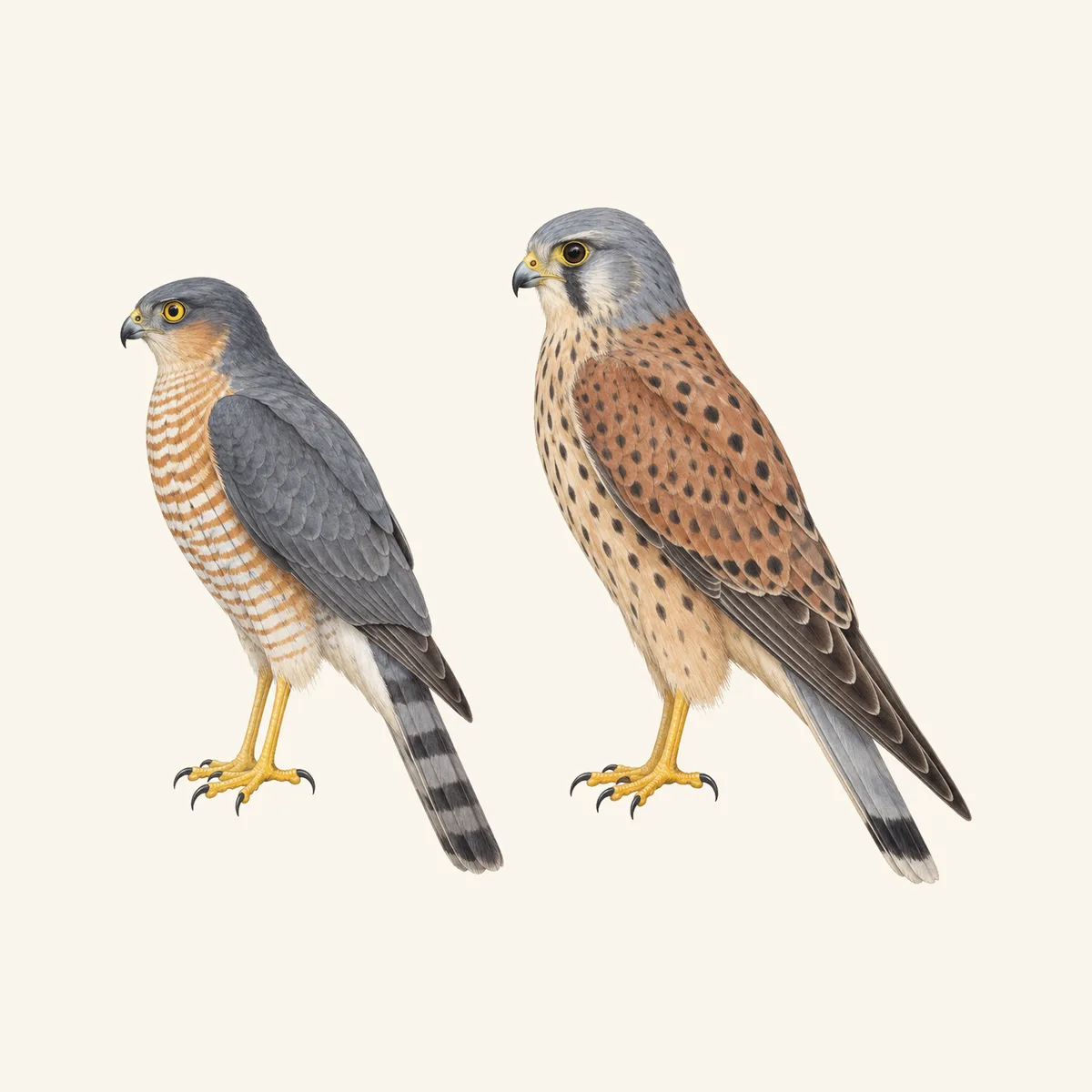
- Kestrel — Behaviour separates them before plumage does. A kestrel hovers on open ground hunting voles; a sparrowhawk never hovers and hunts birds from cover. A kestrel also has long pointed wings and a plain rufous back, against the sparrowhawk's short broad rounded wings and barred underparts.
- Goshawk — Very scarce and a bird of large forests, but it is what a big female sparrowhawk gets reported as. A goshawk is buzzard-sized and deep-chested with a bulging rear body, a strikingly broad white undertail and a heavy white eyebrow. A female sparrowhawk is far slighter, with a pinched waist and a proportionally longer, thinner tail.
- Male and female Sparrowhawk — Routinely logged as two species in the same garden, because the size difference is extreme. The male is not much bigger than a blackbird, blue-grey above with orange barring below; the female can be almost twice his weight, brown above with brown barring and a pale eyebrow. Same bird, same garden, very different look.
Through the year
Spring
Nesting high in trees, often conifers, and hunting hard to feed young. Sparrowhawk nests are protected like any other — check tall trees before work.
Summer
Provisioning chicks, and fledgling garden birds make easy targets. Dense shrub cover close to feeding areas does more for songbirds now than anything else.
Autumn
Young sparrowhawks disperse and inexperienced birds turn up in unlikely places, including small urban gardens.
Winter
The season gardeners notice them, because prey is concentrated at feeders. Review feeder placement rather than feeding less.
Feeding
Takes: small and medium garden birds, caught in flight or from cover.
A sparrowhawk takes live birds and nothing else, so there is no food to put out and nothing to buy. The practical question is feeder placement. RSPB advice is to site feeders "a couple of metres away from thick cover like bushes, so that small birds can beat a hasty retreat from aerial predators such as Sparrowhawks", and high enough to be out of reach of ground predators such as cats. That distance is the working answer: close enough that a chaffinch can reach cover in one dash, far enough that a hawk cannot use the bush itself as a hide. Rotating feeder positions weekly, which RSPB also recommends on hygiene grounds, makes the ambush harder to set up.
What the evidence actually says about songbirds
A sparrowhawk killing a blue tit at a feeder is distressing, and the internet is full of confident claims that hawks are behind Britain's songbird declines. The research does not support it. BTO's Garden BirdWatch work on sparrowhawk predation concludes that "the reduction in the rate of change in numbers visiting gardens accredited to Sparrowhawks is relatively small, and so unlikely to be the main driver of observed population declines", and adds that the associations found may not even be predation as such, but "a behavioural response of the prey species to avoid feeding stations frequented by Sparrowhawks". Britain's songbird losses are driven by habitat and food supply — the causes that also drove bullfinch down 55% and put fieldfare on the red list. A native predator taking native prey is not the same kind of problem, and treating it as one misdirects effort that could go somewhere useful.
Why a sparrowhawk in your garden is good news
Sparrowhawks are at the top of a garden food chain, and top predators only persist where everything beneath them does. A hunting sparrowhawk means your area supports enough small birds, which means enough insects and seeds, which means enough plants and undisturbed ground. Their own history makes the point: BTO records a dramatic recovery after organochlorine pesticides crashed the population in the 1950s and 1960s, followed by steep growth from the 1970s to the mid-1990s — and notes a moderate decline in England over the last decade, with breeding success falling. The species is Amber listed. It is not a surplus predator that needs managing; it is a bird that was nearly lost once and is under pressure again. Its presence is a reading on the health of the system, and the reading is a good one.
Feeder placement: the useful answer
There is a genuinely practical thing to do, and it is about geometry rather than the hawk. RSPB advises placing feeders a couple of metres away from thick cover such as bushes, so that small birds can beat a hasty retreat from aerial predators like sparrowhawks, and high enough to be out of reach of ground predators like cats. Roughly two metres is the balance point: any closer and the bush becomes the hawk's hide, so the ambush starts from inside cover; much further and a chaffinch caught in the open has nowhere to go. Thorny cover — hawthorn, holly, a thick mixed hedge — works better than open shrubs, because a hawk cannot follow into it. Moving the feeder to a different spot each week, which RSPB recommends anyway for hygiene, stops a hawk learning a fixed flight line.
What not to do, and what it looks like afterwards
Sparrowhawks are wild birds fully protected under section 1 of the Wildlife and Countryside Act 1981: it is an offence to intentionally kill, injure or take one, or to damage or destroy an active nest. That protection applies while it is hunting at your feeder. Taking feeders down for a few days is sometimes suggested, and mostly just moves the hunting elsewhere while leaving small birds short of food in the weather when they need it most; better placement is the more effective response. Afterwards, expect the garden to go silent and empty for ten or twenty minutes — that is normal, and the birds return. A neat ring of plucked feathers on a lawn with no body is a sparrowhawk kill site, not evidence of a cat, and it is worth recognising if only so you know what you are looking at.
Plant this for it
- clematis Dense clematis on a fence gives small birds thick tangled cover to dive into within a short dash of a feeder — the escape route that makes the recommended couple of metres of separation work.
- apple A mature apple tree gives sparrowhawks a plucking perch and small birds a layered canopy to scatter into, and its windfalls and insects support the prey base the hawk depends on.
Guides
How we checked this
- BTO BirdFacts: Sparrowhawk
- BTO Garden BirdWatch: Sparrowhawk Predation Work
- RSPB: Open a bird cafe — feeder placement
- RSPB: Sparrowhawk
- Wildlife and Countryside Act 1981, section 1
Checked against the sources above. Reviewed on 2026-09-20. Legal position checked 2026-09-20.