Most plants that hurt people do it when eaten. A smaller group does it through the skin, and summer is their season: bare arms, strong sun and a lot of cutting back. One of them, giant hogweed, deserves real respect. The rest call for gloves and a bit of thought.
None of this needs panic. It needs you to know which plant you are looking at before you grab it.
In pictures
-
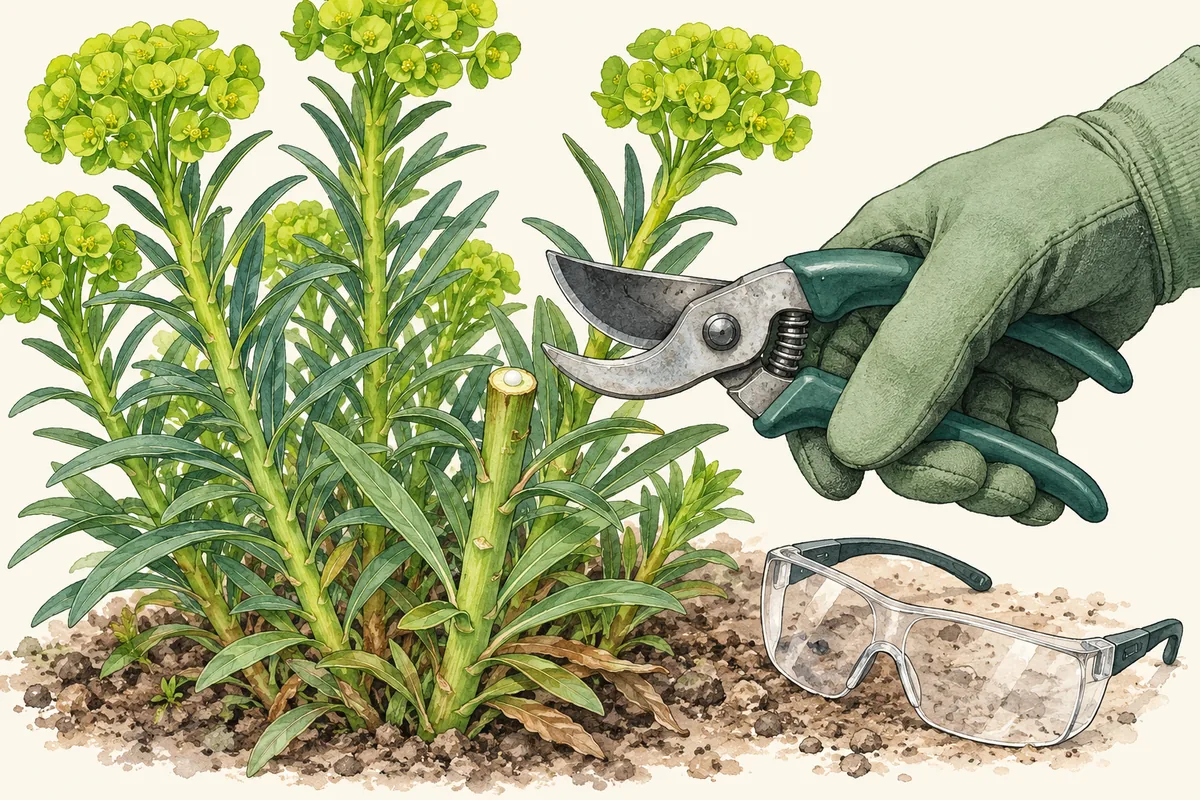
2Euphorbia sap irritates skin and eyes: gloves, long sleeves and eye protection.
01At a glance
- The serious one: giant hogweed. Sap on skin, followed by sunlight, can cause burning and blistering.
- The one for your eyes: euphorbia (spurge). The milky sap irritates skin and can injure eyes.
- The other sun-reactive saps: rue, parsnip and fig. Usually less severe than giant hogweed, but rue and parsnip can still blister skin in sunshine.
- Kit: gloves, long sleeves, eye protection for euphorbias. Keep cut stems away from your face.
02Why sunlight matters
Giant hogweed sap contains furanocoumarins, which the RHS describes as chemicals that make skin very sensitive to sunlight. The reaction is called phytophotodermatitis. Dermatologists class it as a direct toxic reaction triggered by ultraviolet light, which means it is not an allergy and anyone can get it.
The catch is the delay. Contact itself may not hurt. DermNet puts redness and blistering at roughly 24 to 48 hours after sun exposure, and the darkened skin left behind can last for years. The RHS lists burning, blistering, pigmentation and long-lasting scarring.
03Giant hogweed: how to recognise it
Giant hogweed (Heracleum mantegazzianum) is a garden escape from the Caucasus, now most abundant along lowland rivers and streams and on waste ground. It flowers in June and July.
- Height: up to 5m in flower, though 2–3m is typical.
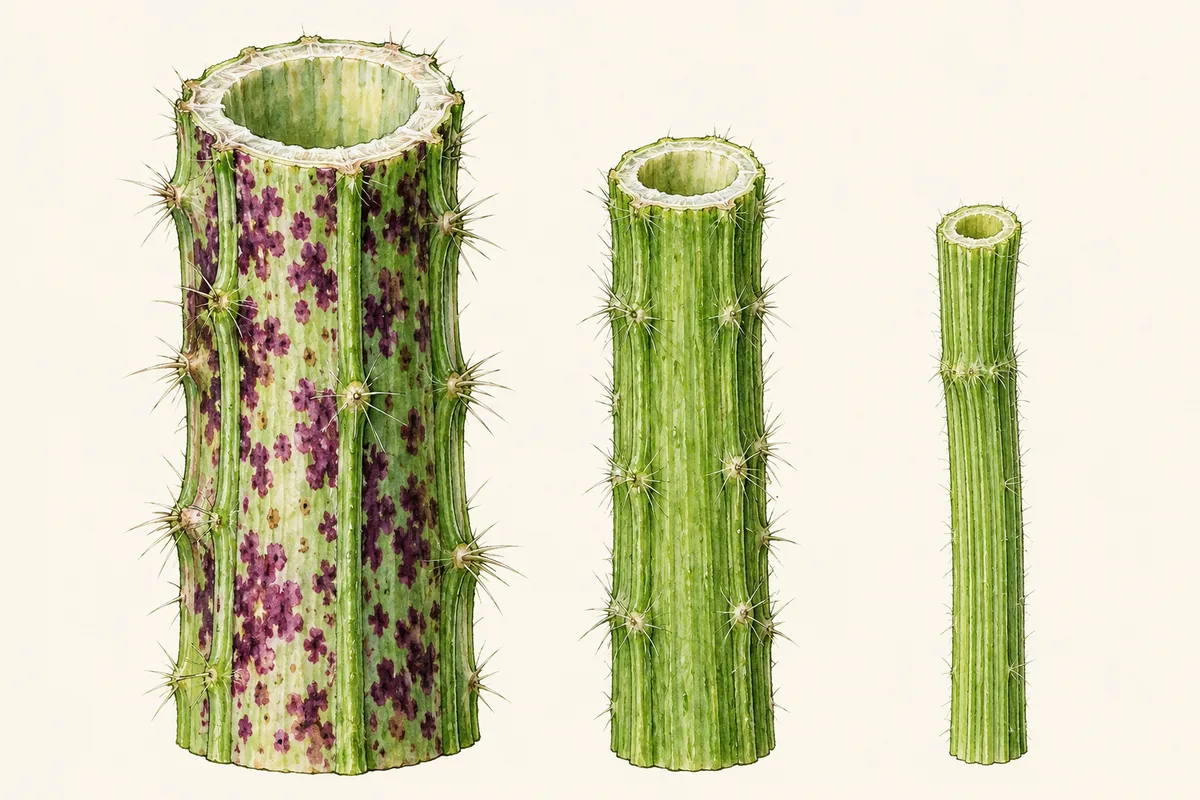
- Stem: thick, hollow and bristly, green with purple blotches.
- Leaves: deeply divided with jagged, serrated edges, up to 1.5m wide and 3m long.
- Flower heads: white umbrellas up to 60cm across.
Two native plants get mistaken for it:
- Common hogweed grows to about 2m, has no purple blotching on the stem, more rounded leaves, and flower heads only about 20cm across.
- Cow parsley is smaller again, at 60–170cm, with soft, fern-like foliage, and it flowers earlier. Its own lookalike problem is hemlock, which our profile covers.
Common hogweed is not a free pass. Its sap also contains furanocoumarins, and dermatologists see "strimmer's dermatitis" in people who have sprayed themselves with it while cutting verges. Cover up before strimming any of this family.
04If you touch giant hogweed
We are gardeners, so here is the official wording rather than ours.
- RHS: "Wash any skin that touches the plant immediately, keep it out of sunlight and seek medical advice."
- Woodland Trust: wash the area thoroughly and immediately, seek medical advice, and do not expose the area to sunlight for a few days.
- nidirect (Northern Ireland government): cover the affected skin immediately to avoid exposure to the sun and wash the skin with cold water. If there is blistering, or the contact was with the eyes, seek medical advice.
For medical advice, ring NHS 111. Call 999 for anything that looks like an emergency.
05Dogs and giant hogweed
Dogs are affected too. The PDSA says the toxins in the stems and leaves can cause skin burns and blisters, mainly on hairless or thin-furred areas such as the ears, mouth and belly, and that sap licked off the coat or getting into the eyes does more damage still. The Woodland Trust says the same of dogs and cats, and warns that sap in the eyes can cause blindness. Blue Cross includes giant hogweed on its list of plants poisonous to dogs.
Keep dogs out of riverbank stands in summer. If yours has pushed through one, ring your vet or the Animal PoisonLine on 01202 509000.
06The law, briefly
- Having it is not an offence. The RHS and the Woodland Trust both say so, provided you stop it spreading.
- Spreading it is. Across the UK it is an offence to plant giant hogweed in the wild or cause it to grow there. In England and Wales it is a listed "species of special concern" under the Invasive Alien Species Order 2019, which also means you must not grow, sell or intentionally allow it to spread. Scotland and Northern Ireland have their own equivalent laws.
- You can be made to deal with it. The RHS notes that environmental authorities can issue a species control agreement or order requiring removal.
- The waste is controlled waste. It cannot go on the compost heap. It has to go to a licensed site with a registered waste carrier.
Report plants on council land to the council and plants on private land to the landowner. For your own garden, the RHS says the easiest and safest route is a specialist contractor, and warns that cut material can still damage skin several hours later.
07Euphorbias: gloves, and mind your eyes
Every spurge bleeds milky white latex when cut. The RHS rates the whole genus "irritant to skin/eye; harmful if eaten" and advises gloves and other protective equipment when handling, especially when pruning.
The eye is the part to take seriously. Ophthalmology case reports describe inflammation inside the eye and sharply reduced vision after euphorbia sap got in, which in the reported case cleared with prompt treatment. Don't wait to see if it settles. So wear glasses or goggles when cutting back, and don't wipe your face with a sappy glove. If sap gets in an eye, get medical advice straight away: NHS 111, or 999 in an emergency.
The houseplant cousins behave the same way. Poinsettia sap is a mild irritant to cats, dogs and people, and its fearsome reputation is overstated, as we set out in the poinsettia myth. The pencil cactus is at the other end: a strong irritant, with documented eye injuries.
08The other sun-reactive saps
- Fig. The RHS lists it as harmful to skin with sunlight. The compounds responsible are mostly in the leaves and unripe fruit, so wear gloves and sleeves for summer pruning. It is also toxic to cats and dogs if chewed.
- Rue. Listed by the RHS as toxic to skin with sunlight. Handle it with gloves on bright days.
- Parsnip. A skin irritant on the RHS list. DermNet says the juice of the foliage, wild parsnip in particular, can cause a blistering rash in sunlight and discolouration lasting months. Thin and weed the row with gloves on.
How we checked this
Every care and safety claim on this page is verified against horticultural and veterinary sources.
Sources: RHS — Giant hogweed · RHS — Potentially harmful garden plants · RHS — How to grow garden euphorbias · Woodland Trust — Giant hogweed in the UK · GB Non-native Species Secretariat — Giant hogweed · GOV.UK — How to stop invasive non-native plants from spreading · GOV.UK — Invasive non-native plant species: rules in England and Wales · nidirect — Be aware of giant hogweed and avoid contact · DermNet — Phytophotodermatitis · DermNet — Cow parsnip or hogweed · DermNet — Fig · DermNet — Parsnip · PDSA — Which plants are poisonous to pets? · Blue Cross — Poisonous plants for dogs · Revista Brasileira de Oftalmologia — Keratouveitis caused by Euphorbia milii sap · GB Non-native Species Secretariat — Legislation, England and Wales
Checked 3 October 2026. If our advice ever conflicts with the RHS, believe them and tell us.