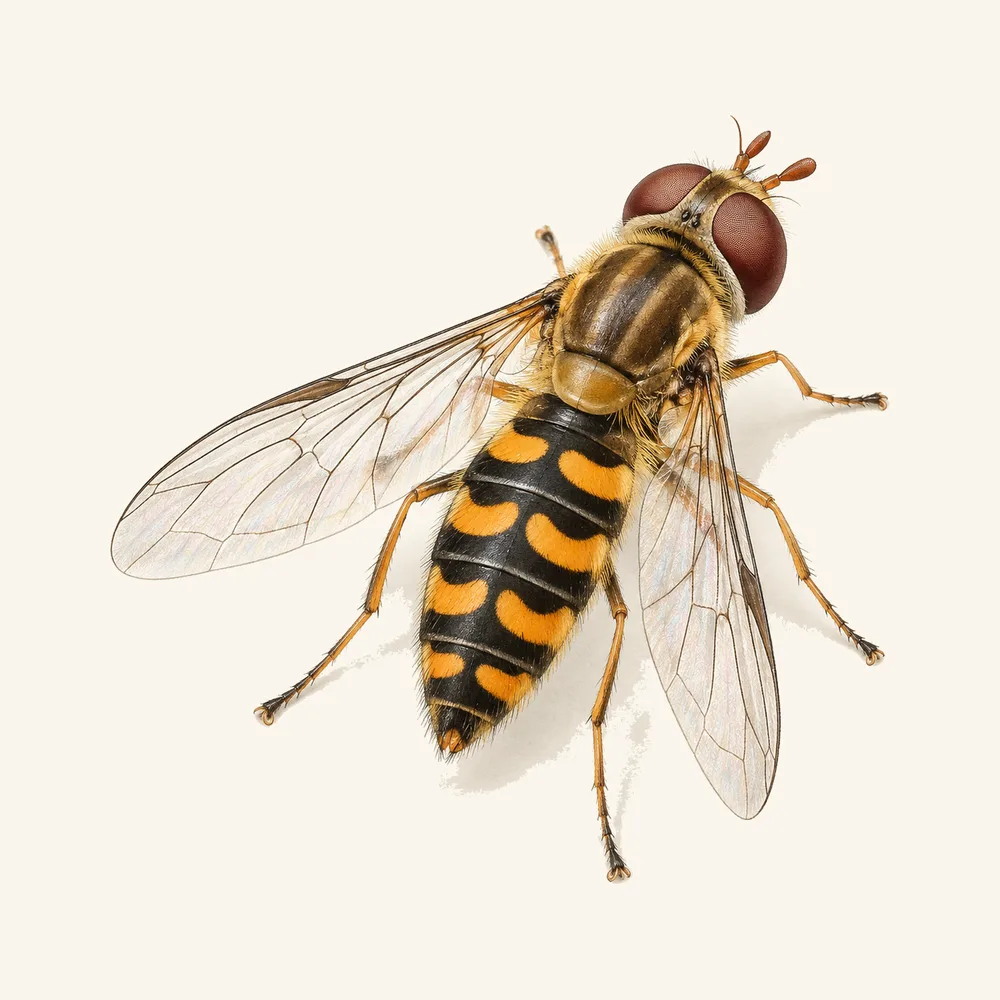
Marmalade hoverfly
Episyrphus balteatus
A fly, not a bee — one pair of wings, and double orange bands on each segment. Its larvae are among the garden's best aphid predators.
In most gardens
Probably the most frequently seen hoverfly in Britain, and present in gardens in every month of the year. The Wildlife Trusts give its season as January to December, with numbers peaking in summer and boosted by mass immigration from the continent in some years.
Not assessed
No conservation assessment exists for this species. That is not the same as being fine.
No assessment scheme records this species as “No Great Britain Red List assessment verified for this species. It is one of Britain's most abundant and widespread hoverflies, but abundance is not a status and we will not record one we have not seen assessed.”. Source.
No specific legal protection found for this species as at 2026-09-20.
At a glance
-
Size
Length 0.9–1.2cm (The Wildlife Trusts) — slim and narrow, noticeably smaller and flatter-bodied than a honeybee.
-
Flying season
Recorded January to December, peaking in summer. The RHS gives the main hoverfly season as May to September.
-
What it needs
Open, shallow flowers for the adults, and aphids for the larvae. Both, in the same garden, at the same time.
-
Where it nests
No nest. Eggs are laid singly among aphid colonies, and the legless larvae feed where they hatch.
-
Look-alikes
Wasps and small bees. Count the wings — one pair means a fly, and it cannot sting.
-
Status
No Great Britain Red List assessment verified. No legal protection; abundant and widespread.
Not to be confused with
- Common wasp — Wings and waist. The RHS puts the rule plainly: "the characteristic feature of true flies is that they have only two wings (one pair) compared to most other insects such as bees and wasps which have four wings (two pairs)". A marmalade hoverfly has one pair. It also has no narrow wasp waist, huge eyes filling most of its head, and stubby antennae instead of a wasp's long jointed ones. And it hovers — genuinely stationary in mid-air — which a wasp does not. It has no sting at all.
- Other banded hoverflies — The band pattern is the species-level clincher. The marmalade hoverfly carries two black bands on each abdominal segment — one thick and one thin, described by The Wildlife Trusts as "'thin cut', 'thick cut'" like the marmalade it is named for. Most other orange-and-black hoverflies of this size show one band per segment. If you can get a photograph of the abdomen, the doubled bands settle it.
- Honeybee — A honeybee is furry, thick-bodied and amber-brown with four wings and elbowed antennae, and works flowers steadily one after another. A marmalade hoverfly is smooth, slim, bright orange-and-black, has one pair of wings, and hangs in the air between visits. A honeybee also never stops dead in mid-flight the way a hoverfly does.
Through the year
Spring
Adults appear early, often on the first warm days, and lay into the first aphid colonies — resist spraying the first greenfly you see on a rose.
Summer
Peak numbers, sometimes swollen by huge arrivals from the continent. Let herbs such as mint and thyme flower rather than clipping them.
Autumn
Still on the wing into late autumn. Leave late-flowering open-faced plants standing and do not cut everything back in September.
Winter
Some adults are recorded in every month, and they shelter in leaf litter, ivy and evergreen cover in cold weather. Leave a corner uncleared.
It is a fly, and it cannot sting you
The marmalade hoverfly is a wasp mimic doing an extremely good job on a very cheap budget, and it works because people identify insects by colour. The tell is the wings. The RHS states the rule: "the characteristic feature of true flies is that they have only two wings (one pair) compared to most other insects such as bees and wasps which have four wings (two pairs)." Beyond that, the head gives it away instantly once you know — enormous eyes taking up most of it, and tiny stubby antennae rather than a wasp's long jointed ones. So does the flight: it hangs stock-still in mid-air, then flicks sideways and stops again, which nothing with a sting does. It has no sting and no bite. Swatting one is a small loss, since it is one of the more useful insects in the garden.
The best reason on this site to leave aphids alone
Hoverfly larvae are aphid predators, and the numbers matter. The RHS puts them alongside the insect everyone already trusts: "approaching half of British hoverflies are aphid predators as larvae and are as important as ladybirds in reducing populations of aphids." The larvae are legless, blind, translucent little slugs that most gardeners have seen on an infested shoot without recognising, and they work their way through the colony they hatched in. That gives a concrete instruction. When greenfly appear on the roses in May, the useful move is usually to do nothing for a fortnight. Spraying — even with something advertised as organic — removes the aphids, and with them the food that would have produced the next generation of predators. The RHS advice is the same: "tolerating the presence of aphids and other prey on some plants will provide a food source for hoverflies and can help promote a natural balance in the garden."
Flowers a short tongue can reach
Hoverflies are frequently left out of pollinator planting, and the plants chosen for bumblebees often do not suit them. A marmalade hoverfly has short mouthparts and cannot reach nectar down a long floral tube, so a border built around foxgloves, penstemons and honeysuckle offers it very little. What it wants is open and shallow: flat daisy faces, umbels, and the small massed flowers of herbs left to bloom. Letting mint, thyme, marjoram and fennel flower rather than clipping them for the kitchen turns them into hoverfly plants overnight. So does leaving a patch of hogweed or cow parsley at the edge of a garden. This is also why a hoverfly-friendly garden looks slightly less manicured than a bee-friendly one: the plants that suit it are the ones most gardeners deadhead.
The year-round hoverfly
Most garden insects have a season. This one, more or less, does not. The Wildlife Trusts give its flight period as January to December, with numbers peaking in summer, and note that "in some years, huge numbers migrate here from the continent when they can be seen busily feeding on flowers near the coast". Those arrivals can be spectacular, and they are the reason a garden can go from a handful of hoverflies to hundreds within days in high summer. Practically, the year-round presence means that winter and early-spring flowers matter to this species in a way they do not to most insects a gardener plants for. Anything open-faced and in flower between November and March — winter heathers, early hellebores, the first dandelions — will be used, and the earliest adults are the ones that seed the first aphid-eating generation of the year.
Plant this for it
- roseRoses reliably carry the early aphid colonies that adult hoverflies lay their eggs into, so an unsprayed rose is a hoverfly nursery rather than a problem.
- mintLeft to flower instead of clipped, mint produces exactly the small, open, shallow flowers a short-tongued hoverfly can actually feed from.
- thymeMasses of tiny open flowers in full sun, at a height hoverflies work readily — and thyme thrives in the dry sunny spots where they bask.
How we checked this
Checked against the sources above. Reviewed on 2026-09-20. Legal position checked 2026-09-20.