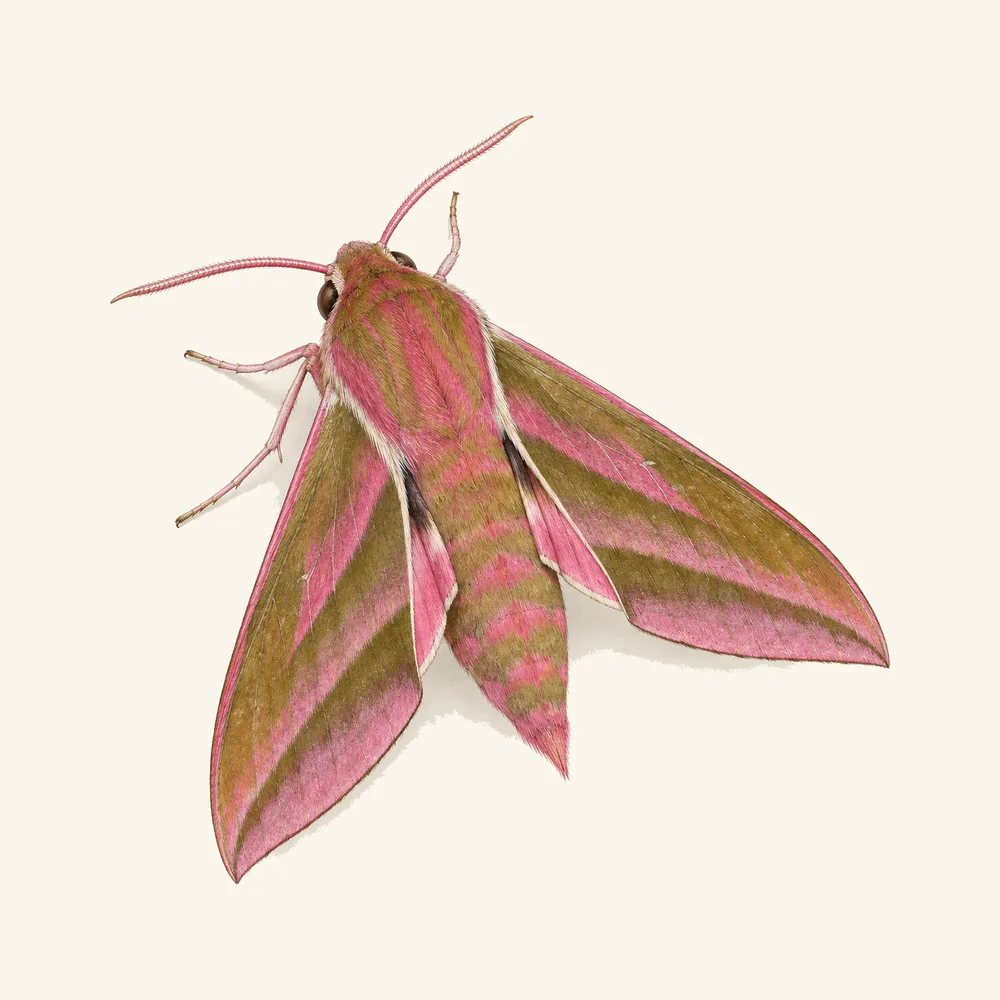
Elephant hawk-moth
Deilephila elpenor
Pink and olive moth flying May to July. The caterpillar is what people find: 8cm, grey-brown, eyespots — alarming, and completely harmless.
In many gardens
Butterfly Conservation describes it as "very widely and well distributed throughout England and Wales, expanding its range north", thinly distributed in Scotland. In gardens it is usually met as a caterpillar on a fuchsia rather than as an adult moth.
Not assessed
No conservation assessment exists for this species. That is not the same as being fine.
No assessment scheme records this species as “No Great Britain Red List category verified for this species. Butterfly Conservation gives its UK status as "Common" and its UK BAP listing as "Not listed"; neither is a Red List assessment, so we record it as not assessed.”. Source.
No specific legal protection found for this species as at 2026-09-20.
At a glance
-
Size
Wingspan 45–60mm — a substantial, fast, heavy-bodied moth. The caterpillar is bigger still, at 80–85mm.
-
Flying season
May to July in one generation (Butterfly Conservation), flying at dusk. Caterpillars are found late summer to early autumn.
-
What it needs
Willowherbs, bedstraws, enchanter's nightshade, fuchsia or Himalayan balsam for the caterpillars; night-scented nectar for the adults.
-
Where it nests
No nest. It pupates in a flimsy cocoon in leaf litter or just under the soil surface, where autumn tidying destroys it.
-
Look-alikes
Small elephant hawk-moth. Size is the clincher — and the caterpillar's eyespots are unlike anything else in a garden.
-
Status
No Great Britain Red List category verified. Butterfly Conservation gives its UK status as "Common".
Not to be confused with
- Small elephant hawk-moth — Size, and the absence of olive. The small elephant hawk-moth is markedly smaller, with a wingspan around 4cm against 45–60mm, and is pink and yellow-buff rather than pink and golden-olive — it lacks the olive-green wash that makes the elephant hawk-moth look almost metallic. Its caterpillar is smaller and lacks the elephant hawk-moth's dramatic paired eyespots.
- Hummingbird hawk-moth — Time of day and colour. The hummingbird hawk-moth flies in bright sunshine, hovering at flowers with an audible hum and a fanned tail; the elephant hawk-moth flies at dusk. The hummingbird hawk-moth is grey-brown with orange hindwings and no pink whatever.
- A snake, or something dangerous — The commonest reaction to the caterpillar, and worth stating plainly: it is harmless. It does not sting, bite or irritate skin, and the eyespots are a bluff. The RHS describes them as "large (80-85 mm long) brown or green caterpillars with black and pink eye spots and a small black horn on the rear end". The horn is soft and harmless too — it is a hawk-moth family feature, not a weapon.
Through the year
Spring
Pupae are in the leaf litter and topsoil, and the first adults emerge from May — rake and clear borders lightly rather than scraping them bare.
Summer
Adults fly at dusk from May to July. Keep outside lights off on warm still nights, and let night-scented flowers stay open.
Autumn
Full-grown caterpillars leave the foodplant and wander, often across paths and lawns, looking for somewhere to pupate. Leave them to it.
Winter
The moth is underground or in leaf litter as a pupa. Leaving leaf litter and an uncultivated strip under the fuchsia is the whole of the winter job.
The caterpillar people actually find
Almost nobody meets this species as a moth. They meet it in late August on a fuchsia, as an enormous grey-brown grub with what look like four eyes, and they either panic or assume it must be something exotic and harmful. It is neither. The RHS describes it as a "large (80-85 mm long) brown or green caterpillar with black and pink eye spots and a small black horn on the rear end", usually found "in late summer to early autumn". The eyespots are defensive theatre: threatened, the caterpillar pulls its head in and swells the front segments so the spots bulge, producing a passable snake. The name comes from the same trick — retracted, the front end looks like a small trunk. It cannot sting, bite or irritate skin, and the horn is soft. The correct response is to look at it and leave it alone.
It is eating your fuchsia and that is fine
Fuchsia is the plant this caterpillar is most often found on in gardens, alongside willowherbs, bedstraws, enchanter's nightshade and Himalayan balsam. Defoliation can look alarming on a container fuchsia, because a caterpillar that size gets through a lot of leaf. The RHS is nonetheless clear: "plant damage is rarely severe or widespread", and "there is no need to take control measures against this insect." A fuchsia stripped in September has already done its season and will come back. If the plant is small and you are unwilling to lose it, the RHS suggests moving the caterpillars onto a wild foodplant such as rosebay willowherb rather than killing them. Do it gently, with the leaf rather than the animal, and put them somewhere with plenty of growth left on it.
Lighting, honestly
Outside lighting is the part of this that gardeners actually control, and the advice is more specific than "turn the lights off". The RHS notes that nocturnal moths "navigate in part by natural light sources, such as the moon, and can become disorientated by artificial light", and that "LEDs with cool white light (blue end of the spectrum) attract more insects than warm white ones". Their recommendation is to "choose low-intensity lighting and warmer hues (warm white, yellow or amber)", to "position lights as low as possible and aim them downwards or to where they're needed", and to use "PIR motion sensors or timers for essential or security lighting so they only come on when absolutely necessary". That is a realistic package: you do not have to garden in the dark. Warm or amber, aimed down, low, and on a timer does most of the work.
Where it spends the winter, and how people destroy it
The life cycle has a weak point that garden routine walks straight into. Butterfly Conservation records one generation a year, flying May to July. Caterpillars feed through late summer, then leave the foodplant and wander — which is why you find them crossing paths and lawns in September — looking for somewhere to pupate. They pupate in a flimsy cocoon among leaf litter or in the top few centimetres of soil, and they stay there all winter. So the moth you would like to see at dusk next June is currently under the ground beneath the fuchsia, or in the leaves you are about to bag up. Leave an uncultivated, unmulched strip of soil under the plants they feed on, and leave leaf litter in borders over winter rather than clearing it to bare earth.
How we checked this
- Butterfly Conservation: Elephant Hawk-moth
- RHS: Elephant hawk moth
- RHS: Garden lighting — effects on wildlife
- The Wildlife Trusts: Elephant hawk-moth
Checked against the sources above. Reviewed on 2026-09-20. Legal position checked 2026-09-20.