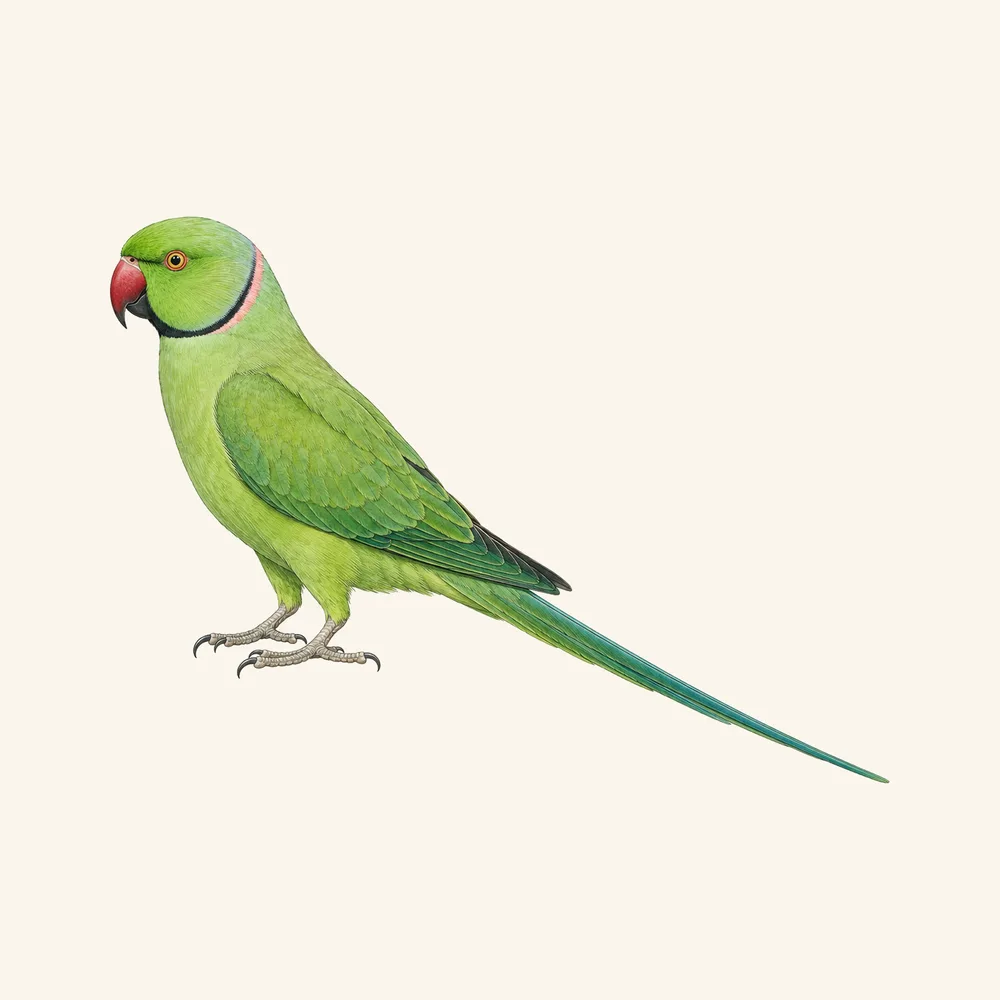
Ring-necked Parakeet
Psittacula krameri
A bright green, long-tailed parrot with a red bill. Genuinely common only in London and the south-east, and heard long before it is seen.
Occasional visitor
Honestly: not a national garden bird. BTO centres the population on Greater London and the Isle of Thanet in east Kent, with colonies in some other large conurbations including Liverpool, Manchester, Sheffield and Birmingham. Across most of the UK a parakeet in the garden would be a genuine rarity.
Not assessed
No conservation assessment exists for this species. That is not the same as being fine.
No assessment scheme records this species as “No UK Birds of Conservation Concern listing as an introduced species; BTO gives "Least Concern" (IUCN Red List).”, with a UK population trend of +2696% (1995 to 2024). BTO states that national BBS data indicate more than a tenfold increase since 1995, with more substantial range expansion, particularly in Greater London, and describes the UK population as the result of birds escaping from captivity over a long period, with around 12,000 breeding pairs estimated in 2016. Source.
- Wildlife and Countryside Act 1981, section 1 — It is an offence to intentionally kill, injure or take any wild bird, or to take, damage or destroy the nest of any wild bird while that nest is in use or being built, or to take or destroy its eggs. As a naturalised species living wild in Great Britain, the ring-necked parakeet falls within this protection. law
- Wildlife and Countryside Act 1981, Schedule 9, Part I — "Parakeet, Ring-necked" (Psittacula krameri) is listed by name in Part I of Schedule 9. law
- Wildlife and Countryside Act 1981, section 14(1) — "if any person releases or allows to escape into the wild any animal which … is included in Part I, IA or IB of Schedule 9, he shall be guilty of an offence." Because the ring-necked parakeet is listed in Part I, releasing one or allowing one to escape is an offence. law
At a glance
-
Size
Around 40cm including the tail, so longer than a woodpigeon but much slimmer and lighter-bodied.
-
Where you'll see it
Mature trees in parks and large gardens, on peanut and sunflower feeders, and streaking overhead between roosts.
-
What it eats
Buds, blossom, fruit, berries, nuts and seeds; readily takes peanuts, sunflower hearts and fat from feeders.
-
When
Resident all year where it occurs, and most obvious at dawn and dusk when flocks commute to roost.
-
Nests
In a natural tree hole or old woodpecker hole, usually high in a mature tree. Does not use a standard garden nestbox.
-
Song
No song — a piercing, repeated 'kee-ak' screech, carrying a long way and unmistakably parrot-like.
Not to be confused with
- Green Woodpecker — The only realistic green confusion in a UK garden. A green woodpecker is dull green above with a bright yellow rump and a red crown, has a short stiff tail, a straight chisel bill, and spends much of its time on the ground eating ants. A parakeet is uniform bright green, has an extremely long pointed tail and a hooked red bill, and never feeds on a lawn.
- Monk Parakeet — The other parakeet on Schedule 9, and very much rarer in Britain. A monk parakeet has a grey face, throat and breast against a green back, and builds a huge communal stick nest rather than using a tree hole. A ring-necked parakeet's face and breast are green, and its nest is a hole.
- Escaped cage birds — Budgerigars, cockatiels and lovebirds do escape and turn up in gardens. All are far smaller than a ring-necked parakeet — budgerigar length is roughly half — and none has the parakeet's combination of full green body, red bill and tail longer than the wing. An isolated green bird well outside London and the south-east is more likely to be an escape than a wild parakeet.
Through the year
Spring
One of the earliest UK birds to nest, taking tree holes from late winter. Do not cut or fell hole-bearing limbs now — any nest in use is protected whatever the species.
Summer
Feeding young on fruit, buds and seeds. Soft fruit in gardens within the range may be taken; netting fitted well clear of the crop is the practical answer.
Autumn
Feeding heavily on fruit, berries and nuts, and forming larger flocks. Roost flights at dusk become very obvious in south-east London and north-west Kent.
Winter
Communal roosts at their biggest, sometimes hundreds of birds. Parakeets use feeders hard in cold weather; metal feeders and weekly cleaning both matter.
Feeding
Takes: peanuts in a mesh feeder, sunflower hearts, fat blocks and suet, fruit and berries, tree buds and blossom.
Parakeets are powerful, dexterous feeders that will strip a feeder quickly and displace tits and finches while they do it, and they can gnaw through plastic ports. Where they are established, metal feeders last and plastic ones do not. Follow current RSPB guidance in any case: pause seeds and peanuts from 1 May to 31 October, keep suet and mealworms to small amounts in summer, clean feeders at least weekly and move them to a different spot each week. There is no need to feed parakeets deliberately, and nothing here should be read as encouragement to spread them.
A London bird, not a British one
It is worth saying flatly, because a lot of writing on parakeets implies otherwise: for most of the UK this is not a garden bird. BTO puts the main populations in Greater London and the Isle of Thanet in east Kent, with colonies established in several other large conurbations including Liverpool, Manchester, Sheffield and Birmingham, and estimated around 12,000 breeding pairs in 2016. If you garden in south-west London you may see fifty in a morning. If you garden in Cumbria, Devon or most of Wales, you almost certainly will not see one at all, and a green parrot in your apple tree is more likely to be an escaped pet. The population is expanding, so this may change, but the honest position today is regional abundance, not national spread.
How it got here, and what the law says
BTO describes the UK population as the result of birds escaping from captivity over a long period of time. The persistent stories about a single film set or a rock star's aviary are folklore; repeated escapes over decades is the documented explanation. Two legal points follow, and both are verifiable. First, the ring-necked parakeet is listed by name in Part I of Schedule 9 of the Wildlife and Countryside Act 1981, and section 14(1) makes it an offence to release into the wild, or allow to escape, any animal included in that Part. Anyone keeping one in captivity needs to understand that. Second, as a bird living wild in Great Britain it is nonetheless covered by section 1 of the same Act, so killing, injuring or taking one, or destroying an active nest, is an offence.
What they do to a garden
Parakeets are large, loud and assertive, and in the parts of London where they are dense they change the feel of a garden considerably. They dominate feeders, emptying a peanut cage in a morning and displacing smaller birds while they do it, and they gnaw plastic feeder ports to pieces. They feed on buds, blossom and fruit, so soft fruit and early tree blossom within their range can take a hit. They also compete for nest holes, which is the ecological question that has had most attention and which remains genuinely unsettled — the evidence that they are displacing native hole-nesters such as starlings and nuthatches at a population level is not conclusive. Where they are, metal feeders, fruit netting fitted well clear of the crop, and weekly feeder cleaning are the practical responses.
Identifying one without seeing it
You will hear a parakeet before you see it, every time. The call is a piercing, repeated screech thrown out in flight, quite unlike anything native, and a flock passing over is unmistakable even from indoors. The flight silhouette is the next clue: fast, straight and direct on stiff, shallow, rapidly beaten wings, with a tail so long and narrow the bird looks like a dart. Perched, the field marks are simple — uniform bright grass-green, a heavy hooked red bill, and on adult males only a thin black and rose-pink ring around the throat and neck. Females and young birds lack the ring entirely, which trips people up: a green parrot with no ring is still a ring-necked parakeet.
Plant this for it
How we checked this
- BTO BirdFacts: Ring-necked Parakeet
- RSPB: Ring-necked Parakeet
- Wildlife and Countryside Act 1981, Schedule 9
- Wildlife and Countryside Act 1981, section 14
- Wildlife and Countryside Act 1981, section 1
Checked against the sources above. Reviewed on 2026-09-20. Legal position checked 2026-09-20.